

3.4 Problems
39
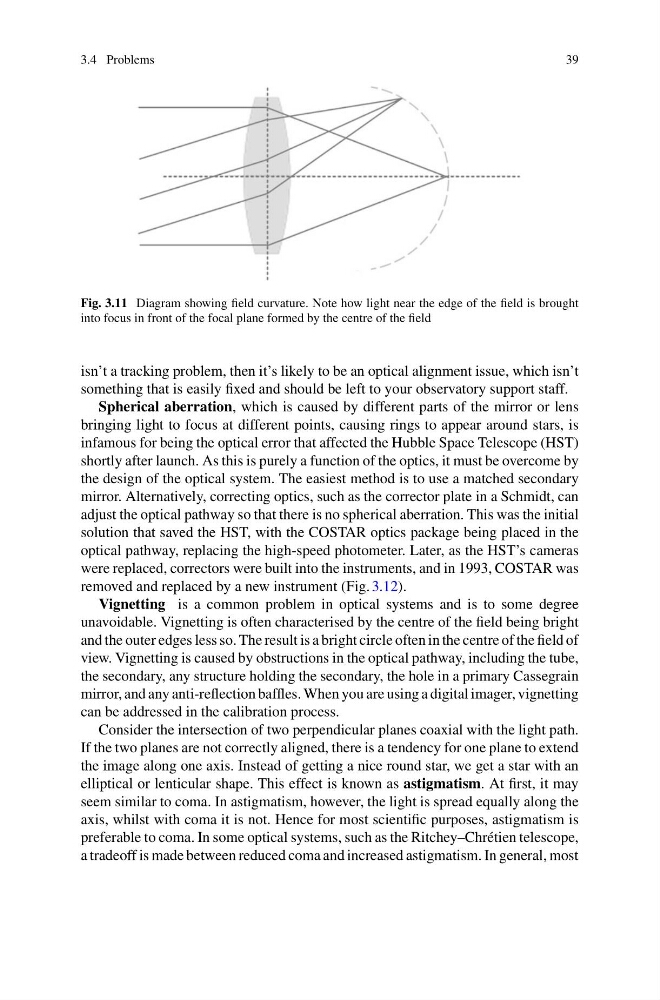
Fig. 3.11 Diagram showing field curvature. Note how light near the edge of the field is brought
into focus in front of the focal plane formed by the centre of the field
isn’t a tracking problem, then it’s likely to be an optical alignment issue, which isn’t
something that is easily fixed and should be left to your observatory support staff.
Spherical aberration, which is caused by different parts of the mirror or lens
bringing light to focus at different points, causing rings to appear around stars, is
infamous for being the optical error that affected the Hubble Space Telescope (HST)
shortly after launch. As this is purely a function of the optics, it must be overcome by
the design of the optical system. The easiest method is to use a matched secondary
mirror. Alternatively, correcting optics, such as the corrector plate in a Schmidt, can
adjust the optical pathway so that there is no spherical aberration. This was the initial
solution that saved the HST, with the COSTAR optics package being placed in the
optical pathway, replacing the high-speed photometer. Later, as the HST’s cameras
were replaced, correctors were built into the instruments, and in 1993, COSTAR was
removed and replaced by a new instrument (Fig. 3.12).
Vignetting is a common problem in optical systems and is to some degree
unavoidable. Vignetting is often characterised by the centre of the field being bright
and the outer edges less so. The result is a bright circle often in the centre of the field of
view. Vignetting is caused by obstructions in the optical pathway, including the tube,
the secondary, any structure holding the secondary, the hole in a primary Cassegrain
mirror, and any anti-reflection baffles. When you are using a digital imager, vignetting
can be addressed in the calibration process.
Consider the intersection of two perpendicular planes coaxial with the light path.
If the two planes are not correctly aligned, there is a tendency for one plane to extend
the image along one axis. Instead of getting a nice round star, we get a star with an
elliptical or lenticular shape. This effect is known as astigmatism. At first, it may
seem similar to coma. In astigmatism, however, the light is spread equally along the
axis, whilst with coma it is not. Hence for most scientific purposes, astigmatism is
preferable to coma. In some optical systems, such as the Ritchey–Chrétien telescope,
a tradeoff is made between reduced coma and increased astigmatism. In general, most
39
Fig. 3.11 Diagram showing field curvature. Note how light near the edge of the field is brought
into focus in front of the focal plane formed by the centre of the field
isn’t a tracking problem, then it’s likely to be an optical alignment issue, which isn’t
something that is easily fixed and should be left to your observatory support staff.
Spherical aberration, which is caused by different parts of the mirror or lens
bringing light to focus at different points, causing rings to appear around stars, is
infamous for being the optical error that affected the Hubble Space Telescope (HST)
shortly after launch. As this is purely a function of the optics, it must be overcome by
the design of the optical system. The easiest method is to use a matched secondary
mirror. Alternatively, correcting optics, such as the corrector plate in a Schmidt, can
adjust the optical pathway so that there is no spherical aberration. This was the initial
solution that saved the HST, with the COSTAR optics package being placed in the
optical pathway, replacing the high-speed photometer. Later, as the HST’s cameras
were replaced, correctors were built into the instruments, and in 1993, COSTAR was
removed and replaced by a new instrument (Fig. 3.12).
Vignetting is a common problem in optical systems and is to some degree
unavoidable. Vignetting is often characterised by the centre of the field being bright
and the outer edges less so. The result is a bright circle often in the centre of the field of
view. Vignetting is caused by obstructions in the optical pathway, including the tube,
the secondary, any structure holding the secondary, the hole in a primary Cassegrain
mirror, and any anti-reflection baffles. When you are using a digital imager, vignetting
can be addressed in the calibration process.
Consider the intersection of two perpendicular planes coaxial with the light path.
If the two planes are not correctly aligned, there is a tendency for one plane to extend
the image along one axis. Instead of getting a nice round star, we get a star with an
elliptical or lenticular shape. This effect is known as astigmatism. At first, it may
seem similar to coma. In astigmatism, however, the light is spread equally along the
axis, whilst with coma it is not. Hence for most scientific purposes, astigmatism is
preferable to coma. In some optical systems, such as the Ritchey–Chrétien telescope,
a tradeoff is made between reduced coma and increased astigmatism. In general, most