

28
3 The Telescope
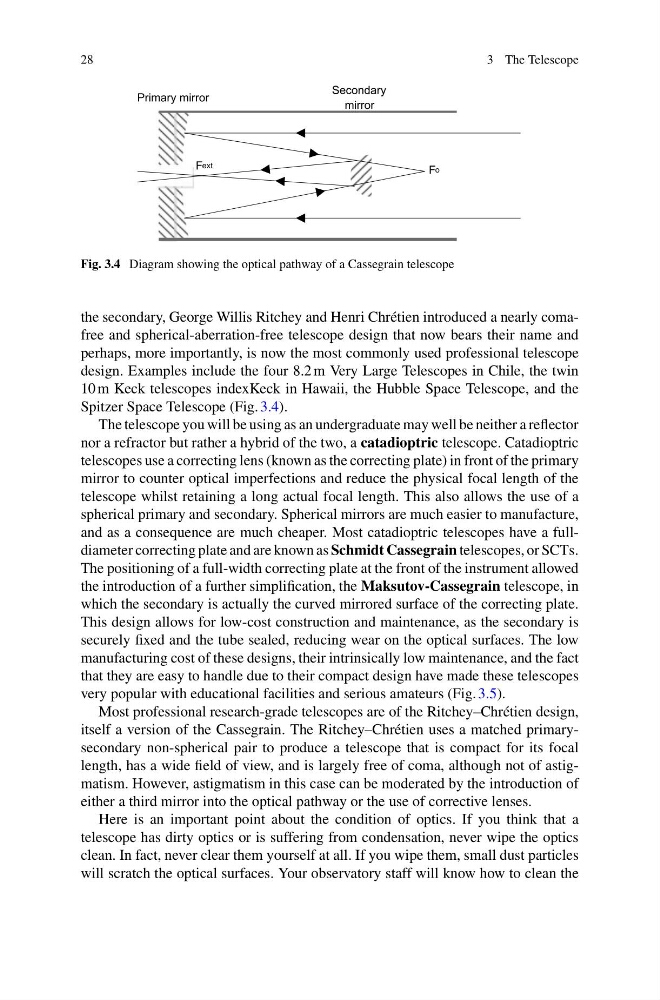
Fig. 3.4 Diagram showing the optical pathway of a Cassegrain telescope
the secondary, George Willis Ritchey and Henri Chrétien introduced a nearly comafree and spherical-aberration-free telescope design that now bears their name and
perhaps, more importantly, is now the most commonly used professional telescope
design. Examples include the four 8.2 m Very Large Telescopes in Chile, the twin
10 m Keck telescopes indexKeck in Hawaii, the Hubble Space Telescope, and the
Spitzer Space Telescope (Fig. 3.4).
The telescope you will be using as an undergraduate may well be neither a reflector
nor a refractor but rather a hybrid of the two, a catadioptric telescope. Catadioptric
telescopes use a correcting lens (known as the correcting plate) in front of the primary
mirror to counter optical imperfections and reduce the physical focal length of the
telescope whilst retaining a long actual focal length. This also allows the use of a
spherical primary and secondary. Spherical mirrors are much easier to manufacture,
and as a consequence are much cheaper. Most catadioptric telescopes have a fulldiameter correcting plate and are known as Schmidt Cassegrain telescopes, or SCTs.
The positioning of a full-width correcting plate at the front of the instrument allowed
the introduction of a further simplification, the Maksutov-Cassegrain telescope, in
which the secondary is actually the curved mirrored surface of the correcting plate.
This design allows for low-cost construction and maintenance, as the secondary is
securely fixed and the tube sealed, reducing wear on the optical surfaces. The low
manufacturing cost of these designs, their intrinsically low maintenance, and the fact
that they are easy to handle due to their compact design have made these telescopes
very popular with educational facilities and serious amateurs (Fig. 3.5).
Most professional research-grade telescopes are of the Ritchey–Chrétien design,
itself a version of the Cassegrain. The Ritchey–Chrétien uses a matched primarysecondary non-spherical pair to produce a telescope that is compact for its focal
length, has a wide field of view, and is largely free of coma, although not of astigmatism. However, astigmatism in this case can be moderated by the introduction of
either a third mirror into the optical pathway or the use of corrective lenses.
Here is an important point about the condition of optics. If you think that a
telescope has dirty optics or is suffering from condensation, never wipe the optics
clean. In fact, never clear them yourself at all. If you wipe them, small dust particles
will scratch the optical surfaces. Your observatory staff will know how to clean the
3 The Telescope
Fig. 3.4 Diagram showing the optical pathway of a Cassegrain telescope
the secondary, George Willis Ritchey and Henri Chrétien introduced a nearly comafree and spherical-aberration-free telescope design that now bears their name and
perhaps, more importantly, is now the most commonly used professional telescope
design. Examples include the four 8.2 m Very Large Telescopes in Chile, the twin
10 m Keck telescopes indexKeck in Hawaii, the Hubble Space Telescope, and the
Spitzer Space Telescope (Fig. 3.4).
The telescope you will be using as an undergraduate may well be neither a reflector
nor a refractor but rather a hybrid of the two, a catadioptric telescope. Catadioptric
telescopes use a correcting lens (known as the correcting plate) in front of the primary
mirror to counter optical imperfections and reduce the physical focal length of the
telescope whilst retaining a long actual focal length. This also allows the use of a
spherical primary and secondary. Spherical mirrors are much easier to manufacture,
and as a consequence are much cheaper. Most catadioptric telescopes have a fulldiameter correcting plate and are known as Schmidt Cassegrain telescopes, or SCTs.
The positioning of a full-width correcting plate at the front of the instrument allowed
the introduction of a further simplification, the Maksutov-Cassegrain telescope, in
which the secondary is actually the curved mirrored surface of the correcting plate.
This design allows for low-cost construction and maintenance, as the secondary is
securely fixed and the tube sealed, reducing wear on the optical surfaces. The low
manufacturing cost of these designs, their intrinsically low maintenance, and the fact
that they are easy to handle due to their compact design have made these telescopes
very popular with educational facilities and serious amateurs (Fig. 3.5).
Most professional research-grade telescopes are of the Ritchey–Chrétien design,
itself a version of the Cassegrain. The Ritchey–Chrétien uses a matched primarysecondary non-spherical pair to produce a telescope that is compact for its focal
length, has a wide field of view, and is largely free of coma, although not of astigmatism. However, astigmatism in this case can be moderated by the introduction of
either a third mirror into the optical pathway or the use of corrective lenses.
Here is an important point about the condition of optics. If you think that a
telescope has dirty optics or is suffering from condensation, never wipe the optics
clean. In fact, never clear them yourself at all. If you wipe them, small dust particles
will scratch the optical surfaces. Your observatory staff will know how to clean the