

3.1 Telescopes
27
grade mirrors has been reached at around 8 m. A number of 10 m class telescopes
exist beyond this limit, but those have segmented mirrors, which are manufactured as
individual components and then combined using a technique that is not itself without
problems. The planned 30 m+ class telescopes currently under construction, including the appropriately named 39 m European Extremely Large Telescope (E-ELT), all
have segmented mirrors.
A wide range of designs for reflecting telescopes exist, most of which differ only
in the path the light travels. The simplest and perhaps the least useful is the prime
focus telescope. This has no secondary mirror. Rather, the detector is placed at the
prime focus. Although of little use for observing with the eye, the introduction of
the camera to astronomy, and in particular the digital camera, has made this design
more practicable. In fact, many parabolic dish radio telescopes are of this design.
Newton’s original design is still in wide use around the world, particularly with
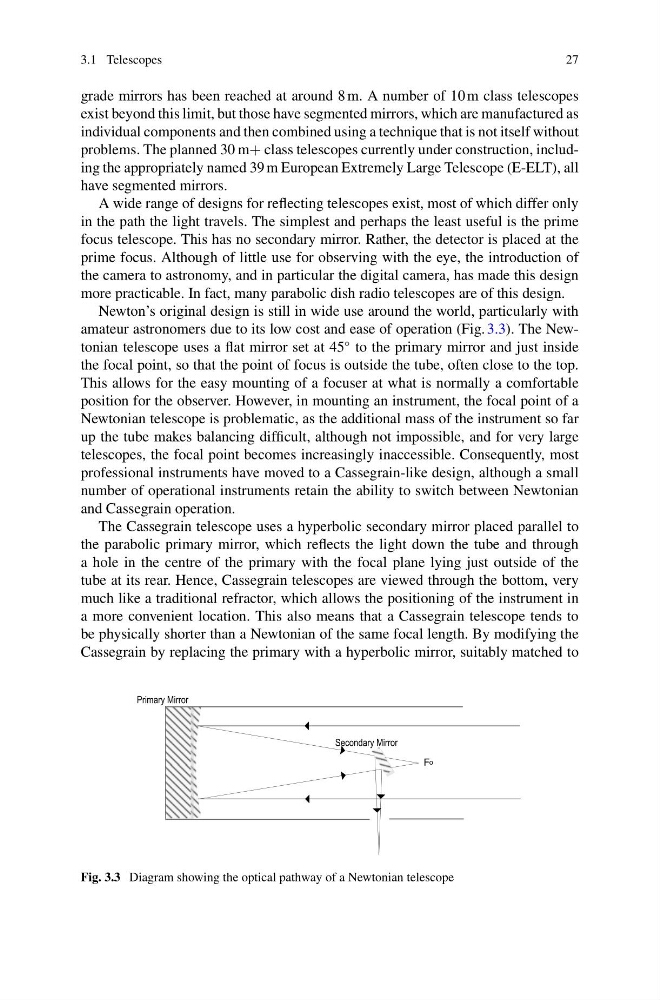
amateur astronomers due to its low cost and ease of operation (Fig. 3.3). The Newtonian telescope uses a flat mirror set at 45
◦ to the primary mirror and just inside
the focal point, so that the point of focus is outside the tube, often close to the top.
This allows for the easy mounting of a focuser at what is normally a comfortable
position for the observer. However, in mounting an instrument, the focal point of a
Newtonian telescope is problematic, as the additional mass of the instrument so far
up the tube makes balancing difficult, although not impossible, and for very large
telescopes, the focal point becomes increasingly inaccessible. Consequently, most
professional instruments have moved to a Cassegrain-like design, although a small
number of operational instruments retain the ability to switch between Newtonian
and Cassegrain operation.
The Cassegrain telescope uses a hyperbolic secondary mirror placed parallel to
the parabolic primary mirror, which reflects the light down the tube and through
a hole in the centre of the primary with the focal plane lying just outside of the
tube at its rear. Hence, Cassegrain telescopes are viewed through the bottom, very
much like a traditional refractor, which allows the positioning of the instrument in
a more convenient location. This also means that a Cassegrain telescope tends to
be physically shorter than a Newtonian of the same focal length. By modifying the
Cassegrain by replacing the primary with a hyperbolic mirror, suitably matched to
Fig. 3.3 Diagram showing the optical pathway of a Newtonian telescope
27
grade mirrors has been reached at around 8 m. A number of 10 m class telescopes
exist beyond this limit, but those have segmented mirrors, which are manufactured as
individual components and then combined using a technique that is not itself without
problems. The planned 30 m+ class telescopes currently under construction, including the appropriately named 39 m European Extremely Large Telescope (E-ELT), all
have segmented mirrors.
A wide range of designs for reflecting telescopes exist, most of which differ only
in the path the light travels. The simplest and perhaps the least useful is the prime
focus telescope. This has no secondary mirror. Rather, the detector is placed at the
prime focus. Although of little use for observing with the eye, the introduction of
the camera to astronomy, and in particular the digital camera, has made this design
more practicable. In fact, many parabolic dish radio telescopes are of this design.
Newton’s original design is still in wide use around the world, particularly with
amateur astronomers due to its low cost and ease of operation (Fig. 3.3). The Newtonian telescope uses a flat mirror set at 45
◦ to the primary mirror and just inside
the focal point, so that the point of focus is outside the tube, often close to the top.
This allows for the easy mounting of a focuser at what is normally a comfortable
position for the observer. However, in mounting an instrument, the focal point of a
Newtonian telescope is problematic, as the additional mass of the instrument so far
up the tube makes balancing difficult, although not impossible, and for very large
telescopes, the focal point becomes increasingly inaccessible. Consequently, most
professional instruments have moved to a Cassegrain-like design, although a small
number of operational instruments retain the ability to switch between Newtonian
and Cassegrain operation.
The Cassegrain telescope uses a hyperbolic secondary mirror placed parallel to
the parabolic primary mirror, which reflects the light down the tube and through
a hole in the centre of the primary with the focal plane lying just outside of the
tube at its rear. Hence, Cassegrain telescopes are viewed through the bottom, very
much like a traditional refractor, which allows the positioning of the instrument in
a more convenient location. This also means that a Cassegrain telescope tends to
be physically shorter than a Newtonian of the same focal length. By modifying the
Cassegrain by replacing the primary with a hyperbolic mirror, suitably matched to
Fig. 3.3 Diagram showing the optical pathway of a Newtonian telescope