

22
2 The Nature of Light
2.7 Polarisation
As stated previously, light is an electromagnetic wave consisting of an electric field
perpendicular to a magnetic field, both of which are perpendicular to the direction
of travel. In general, the orientation of the electric field is random. However, certain
physical processes can cause the electric field to be inclined at a preferential angle to
the direction of movement. If this is the case, the light is said to be linearly polarised.
Additionally, the electric and magnetic fields may rotate, with their axis of rotation
the direction of travel. Hence in this case, the light appears to draw out a helix. We
can characterise a wave as being either left-handed or right-handed, depending on
the direction of rotation seen from the position of the observer. Again, in general, the
distribution of the fields’ handedness is random, but physical processes can cause
light to exhibit a preferential left- or right-hand rotation. In this case, it is said to be
circularly polarised.
Polarisation plays an important part in astronomy, with linear polarisation being
significant in the study of interstellar dust and planetary atmospheres, whilst circular
polarisation is a key investigative tool in understanding the nature of very large scale
magnetic fields, especially in radio astronomy. In general, besides observations of
the Sun, work with polarisation is beyond the capability of small telescopes, since
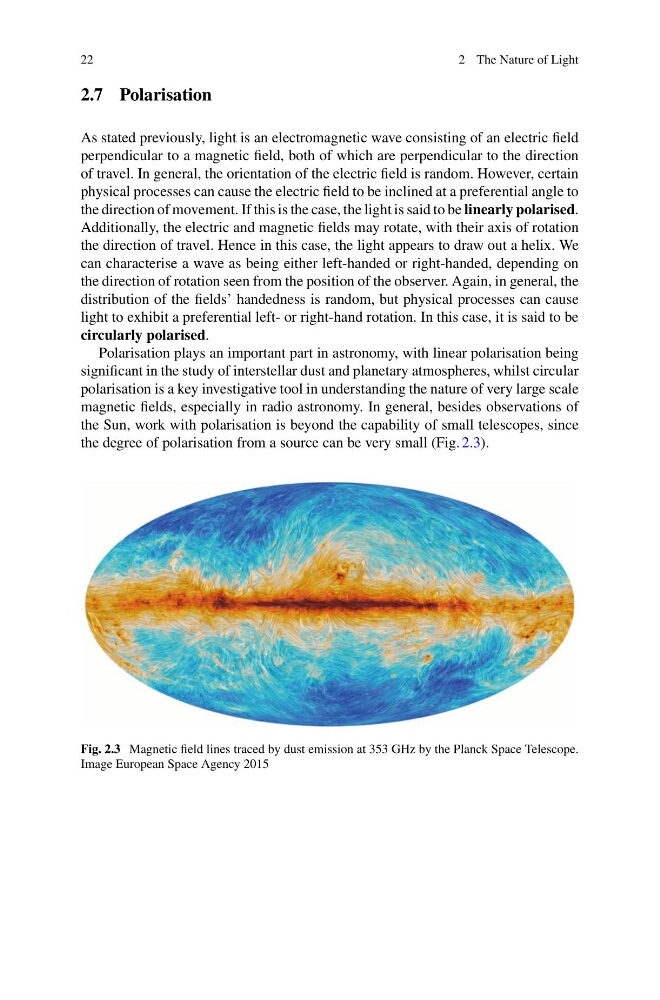
the degree of polarisation from a source can be very small (Fig. 2.3).
Fig. 2.3 Magnetic field lines traced by dust emission at 353 GHz by the Planck Space Telescope.
Image European Space Agency 2015
2 The Nature of Light
2.7 Polarisation
As stated previously, light is an electromagnetic wave consisting of an electric field
perpendicular to a magnetic field, both of which are perpendicular to the direction
of travel. In general, the orientation of the electric field is random. However, certain
physical processes can cause the electric field to be inclined at a preferential angle to
the direction of movement. If this is the case, the light is said to be linearly polarised.
Additionally, the electric and magnetic fields may rotate, with their axis of rotation
the direction of travel. Hence in this case, the light appears to draw out a helix. We
can characterise a wave as being either left-handed or right-handed, depending on
the direction of rotation seen from the position of the observer. Again, in general, the
distribution of the fields’ handedness is random, but physical processes can cause
light to exhibit a preferential left- or right-hand rotation. In this case, it is said to be
circularly polarised.
Polarisation plays an important part in astronomy, with linear polarisation being
significant in the study of interstellar dust and planetary atmospheres, whilst circular
polarisation is a key investigative tool in understanding the nature of very large scale
magnetic fields, especially in radio astronomy. In general, besides observations of
the Sun, work with polarisation is beyond the capability of small telescopes, since
the degree of polarisation from a source can be very small (Fig. 2.3).
Fig. 2.3 Magnetic field lines traced by dust emission at 353 GHz by the Planck Space Telescope.
Image European Space Agency 2015