

16.2 The Proper Motion of Asteroids
221
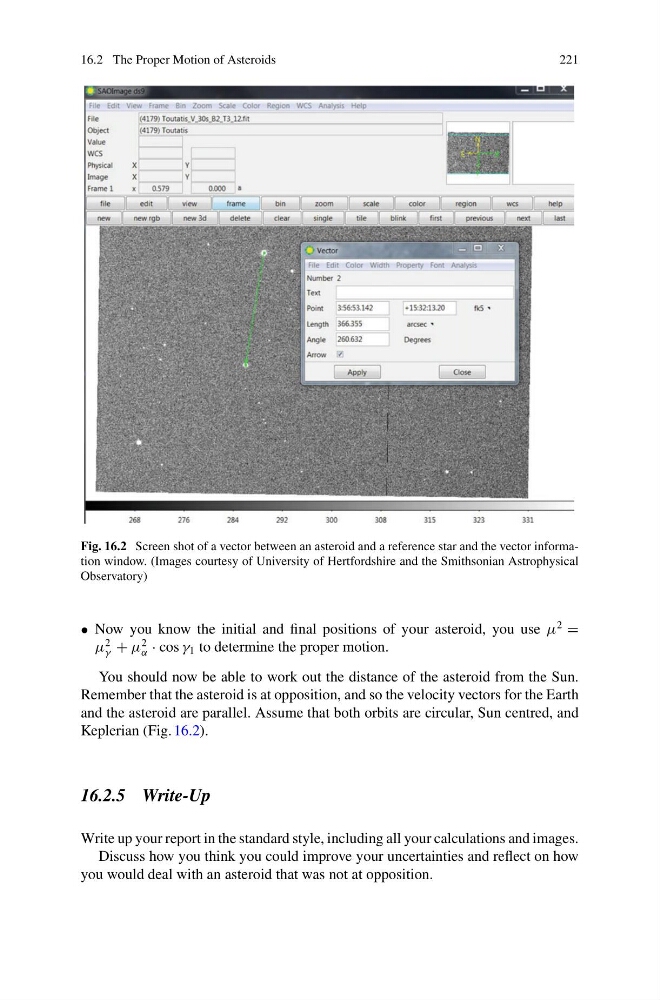
Fig. 16.2 Screen shot of a vector between an asteroid and a reference star and the vector information window. (Images courtesy of University of Hertfordshire and the Smithsonian Astrophysical
Observatory)
• Now you know the initial and final positions of your asteroid, you use μ
2
=
μ
2
γ + μ
2
α · cos γ 1 to determine the proper motion.
You should now be able to work out the distance of the asteroid from the Sun.
Remember that the asteroid is at opposition, and so the velocity vectors for the Earth
and the asteroid are parallel. Assume that both orbits are circular, Sun centred, and
Keplerian (Fig. 16.2).
16.2.5 Write-Up
Write up your report in the standard style, including all your calculations and images.
Discuss how you think you could improve your uncertainties and reflect on how
you would deal with an asteroid that was not at opposition.
221
Fig. 16.2 Screen shot of a vector between an asteroid and a reference star and the vector information window. (Images courtesy of University of Hertfordshire and the Smithsonian Astrophysical
Observatory)
• Now you know the initial and final positions of your asteroid, you use μ
2
=
μ
2
γ + μ
2
α · cos γ 1 to determine the proper motion.
You should now be able to work out the distance of the asteroid from the Sun.
Remember that the asteroid is at opposition, and so the velocity vectors for the Earth
and the asteroid are parallel. Assume that both orbits are circular, Sun centred, and
Keplerian (Fig. 16.2).
16.2.5 Write-Up
Write up your report in the standard style, including all your calculations and images.
Discuss how you think you could improve your uncertainties and reflect on how
you would deal with an asteroid that was not at opposition.