

15.2 Instrument Background
209
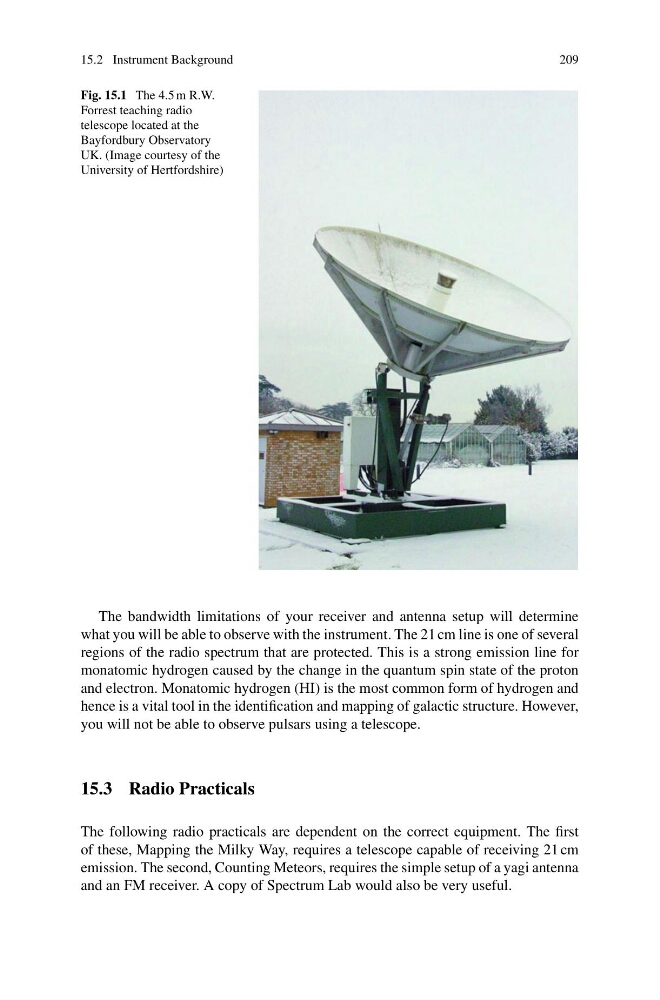
Fig. 15.1 The 4.5 m R.W.
Forrest teaching radio
telescope located at the
Bayfordbury Observatory
UK. (Image courtesy of the
University of Hertfordshire)
The bandwidth limitations of your receiver and antenna setup will determine
what you will be able to observe with the instrument. The 21 cm line is one of several
regions of the radio spectrum that are protected. This is a strong emission line for
monatomic hydrogen caused by the change in the quantum spin state of the proton
and electron. Monatomic hydrogen (HI) is the most common form of hydrogen and
hence is a vital tool in the identification and mapping of galactic structure. However,
you will not be able to observe pulsars using a telescope.
15.3 Radio Practicals
The following radio practicals are dependent on the correct equipment. The first
of these, Mapping the Milky Way, requires a telescope capable of receiving 21 cm
emission. The second, Counting Meteors, requires the simple setup of a yagi antenna
and an FM receiver. A copy of Spectrum Lab would also be very useful.
209
Fig. 15.1 The 4.5 m R.W.
Forrest teaching radio
telescope located at the
Bayfordbury Observatory
UK. (Image courtesy of the
University of Hertfordshire)
The bandwidth limitations of your receiver and antenna setup will determine
what you will be able to observe with the instrument. The 21 cm line is one of several
regions of the radio spectrum that are protected. This is a strong emission line for
monatomic hydrogen caused by the change in the quantum spin state of the proton
and electron. Monatomic hydrogen (HI) is the most common form of hydrogen and
hence is a vital tool in the identification and mapping of galactic structure. However,
you will not be able to observe pulsars using a telescope.
15.3 Radio Practicals
The following radio practicals are dependent on the correct equipment. The first
of these, Mapping the Milky Way, requires a telescope capable of receiving 21 cm
emission. The second, Counting Meteors, requires the simple setup of a yagi antenna
and an FM receiver. A copy of Spectrum Lab would also be very useful.