

190
13 Solar Astronomy
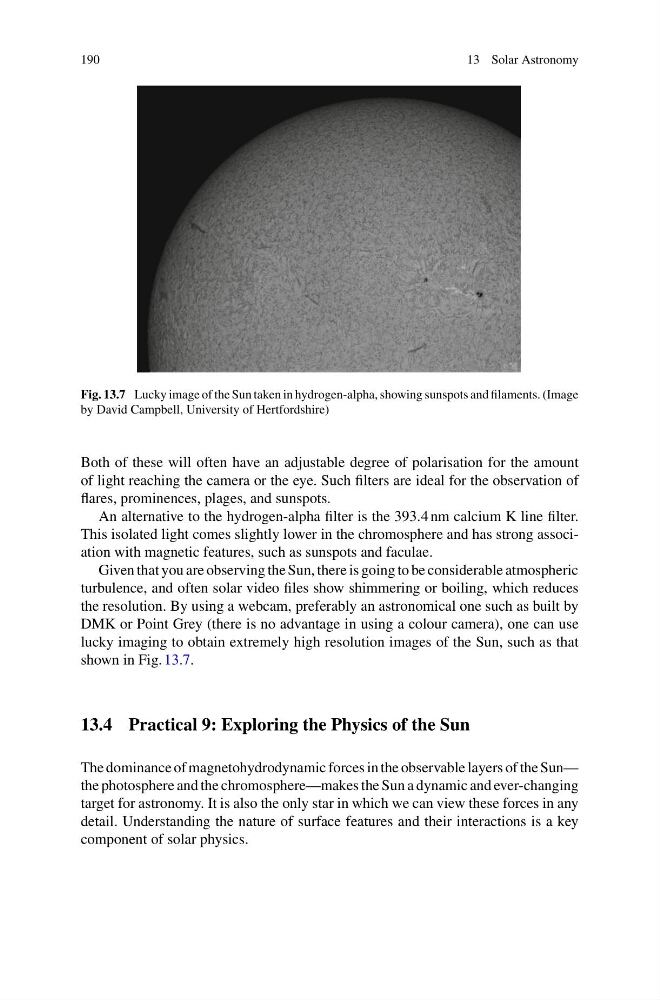
Fig. 13.7 Lucky image of the Sun taken in hydrogen-alpha, showing sunspots and filaments. (Image
by David Campbell, University of Hertfordshire)
Both of these will often have an adjustable degree of polarisation for the amount
of light reaching the camera or the eye. Such filters are ideal for the observation of
flares, prominences, plages, and sunspots.
An alternative to the hydrogen-alpha filter is the 393.4 nm calcium K line filter.
This isolated light comes slightly lower in the chromosphere and has strong association with magnetic features, such as sunspots and faculae.
Given that you are observing the Sun, there is going to be considerable atmospheric
turbulence, and often solar video files show shimmering or boiling, which reduces
the resolution. By using a webcam, preferably an astronomical one such as built by
DMK or Point Grey (there is no advantage in using a colour camera), one can use
lucky imaging to obtain extremely high resolution images of the Sun, such as that
shown in Fig. 13.7.
13.4 Practical 9: Exploring the Physics of the Sun
The dominance of magnetohydrodynamic forces in the observable layers of the Sun—
the photosphere and the chromosphere—makes the Sun a dynamic and ever-changing
target for astronomy. It is also the only star in which we can view these forces in any
detail. Understanding the nature of surface features and their interactions is a key
component of solar physics.
13 Solar Astronomy
Fig. 13.7 Lucky image of the Sun taken in hydrogen-alpha, showing sunspots and filaments. (Image
by David Campbell, University of Hertfordshire)
Both of these will often have an adjustable degree of polarisation for the amount
of light reaching the camera or the eye. Such filters are ideal for the observation of
flares, prominences, plages, and sunspots.
An alternative to the hydrogen-alpha filter is the 393.4 nm calcium K line filter.
This isolated light comes slightly lower in the chromosphere and has strong association with magnetic features, such as sunspots and faculae.
Given that you are observing the Sun, there is going to be considerable atmospheric
turbulence, and often solar video files show shimmering or boiling, which reduces
the resolution. By using a webcam, preferably an astronomical one such as built by
DMK or Point Grey (there is no advantage in using a colour camera), one can use
lucky imaging to obtain extremely high resolution images of the Sun, such as that
shown in Fig. 13.7.
13.4 Practical 9: Exploring the Physics of the Sun
The dominance of magnetohydrodynamic forces in the observable layers of the Sun—
the photosphere and the chromosphere—makes the Sun a dynamic and ever-changing
target for astronomy. It is also the only star in which we can view these forces in any
detail. Understanding the nature of surface features and their interactions is a key
component of solar physics.