

188
13 Solar Astronomy
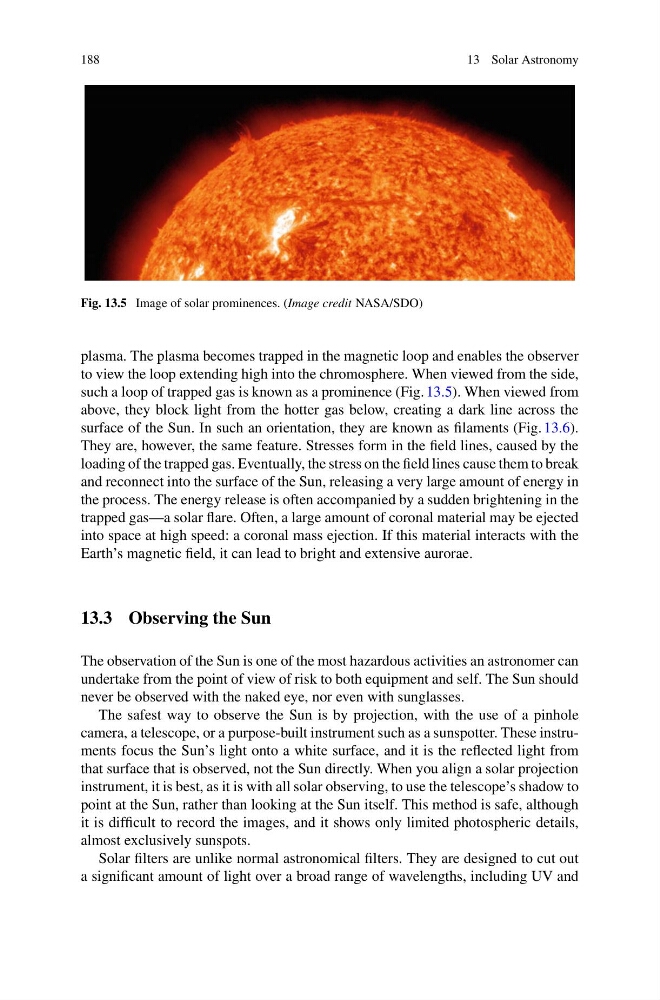
Fig. 13.5 Image of solar prominences. (Image credit NASA/SDO)
plasma. The plasma becomes trapped in the magnetic loop and enables the observer
to view the loop extending high into the chromosphere. When viewed from the side,
such a loop of trapped gas is known as a prominence (Fig. 13.5). When viewed from
above, they block light from the hotter gas below, creating a dark line across the
surface of the Sun. In such an orientation, they are known as filaments (Fig. 13.6).
They are, however, the same feature. Stresses form in the field lines, caused by the
loading of the trapped gas. Eventually, the stress on the field lines cause them to break
and reconnect into the surface of the Sun, releasing a very large amount of energy in
the process. The energy release is often accompanied by a sudden brightening in the
trapped gas—a solar flare. Often, a large amount of coronal material may be ejected
into space at high speed: a coronal mass ejection. If this material interacts with the
Earth’s magnetic field, it can lead to bright and extensive aurorae.
13.3 Observing the Sun
The observation of the Sun is one of the most hazardous activities an astronomer can
undertake from the point of view of risk to both equipment and self. The Sun should
never be observed with the naked eye, nor even with sunglasses.
The safest way to observe the Sun is by projection, with the use of a pinhole
camera, a telescope, or a purpose-built instrument such as a sunspotter. These instruments focus the Sun’s light onto a white surface, and it is the reflected light from
that surface that is observed, not the Sun directly. When you align a solar projection
instrument, it is best, as it is with all solar observing, to use the telescope’s shadow to
point at the Sun, rather than looking at the Sun itself. This method is safe, although
it is difficult to record the images, and it shows only limited photospheric details,
almost exclusively sunspots.
Solar filters are unlike normal astronomical filters. They are designed to cut out
a significant amount of light over a broad range of wavelengths, including UV and
13 Solar Astronomy
Fig. 13.5 Image of solar prominences. (Image credit NASA/SDO)
plasma. The plasma becomes trapped in the magnetic loop and enables the observer
to view the loop extending high into the chromosphere. When viewed from the side,
such a loop of trapped gas is known as a prominence (Fig. 13.5). When viewed from
above, they block light from the hotter gas below, creating a dark line across the
surface of the Sun. In such an orientation, they are known as filaments (Fig. 13.6).
They are, however, the same feature. Stresses form in the field lines, caused by the
loading of the trapped gas. Eventually, the stress on the field lines cause them to break
and reconnect into the surface of the Sun, releasing a very large amount of energy in
the process. The energy release is often accompanied by a sudden brightening in the
trapped gas—a solar flare. Often, a large amount of coronal material may be ejected
into space at high speed: a coronal mass ejection. If this material interacts with the
Earth’s magnetic field, it can lead to bright and extensive aurorae.
13.3 Observing the Sun
The observation of the Sun is one of the most hazardous activities an astronomer can
undertake from the point of view of risk to both equipment and self. The Sun should
never be observed with the naked eye, nor even with sunglasses.
The safest way to observe the Sun is by projection, with the use of a pinhole
camera, a telescope, or a purpose-built instrument such as a sunspotter. These instruments focus the Sun’s light onto a white surface, and it is the reflected light from
that surface that is observed, not the Sun directly. When you align a solar projection
instrument, it is best, as it is with all solar observing, to use the telescope’s shadow to
point at the Sun, rather than looking at the Sun itself. This method is safe, although
it is difficult to record the images, and it shows only limited photospheric details,
almost exclusively sunspots.
Solar filters are unlike normal astronomical filters. They are designed to cut out
a significant amount of light over a broad range of wavelengths, including UV and