

112
8 Imaging
When you start up, you will need to perform a focus. This is done by pointing
the telescope at a bright star and taking an image (look through the telescope if you
are using just an eyepiece). Then move the focuser in one direction, either out or in,
and take a second image. If the image of the star is getting smaller, you are moving
the focuser in the right direction. If it is not getting smaller, move the focuser in the
opposite direction. Repeat this cycle until the star is as small as you can get it.
There is a tendency for bright stars to fill in when focusing, so when you have
finished focusing on the bright star, move on to a fainter star and repeat the cycle until
all the stars in the field are focused. Note that you will need to refocus throughout the
night, as the altitude of the target, the air temperature, and possibly the filters used,
can all change the focal point.
Your camera control may have some focusing tools that can help your initial focus.
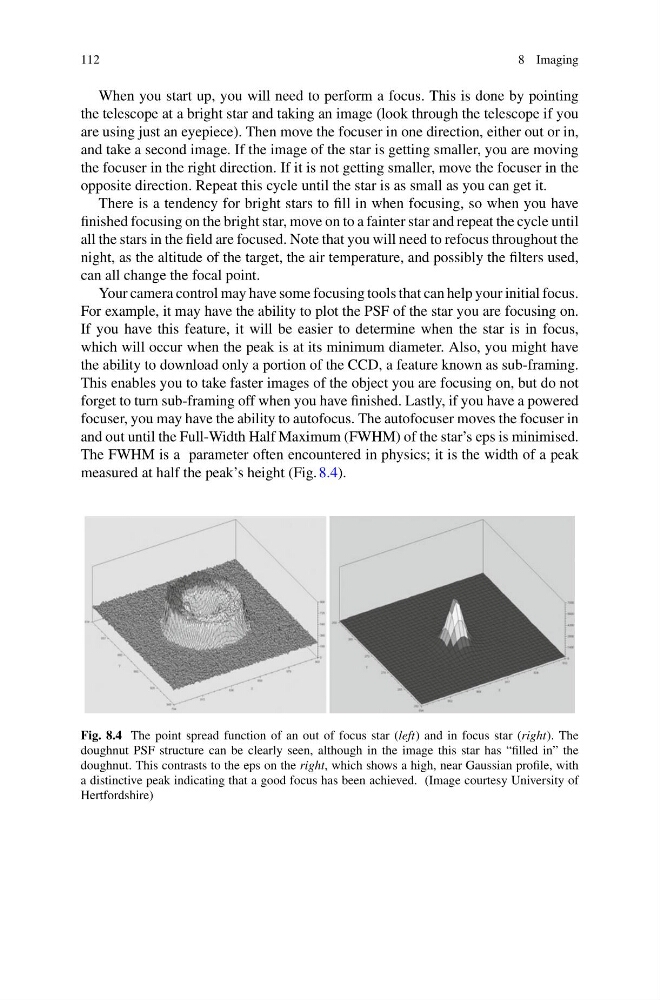
For example, it may have the ability to plot the PSF of the star you are focusing on.
If you have this feature, it will be easier to determine when the star is in focus,
which will occur when the peak is at its minimum diameter. Also, you might have
the ability to download only a portion of the CCD, a feature known as sub-framing.
This enables you to take faster images of the object you are focusing on, but do not
forget to turn sub-framing off when you have finished. Lastly, if you have a powered
focuser, you may have the ability to autofocus. The autofocuser moves the focuser in
and out until the Full-Width Half Maximum (FWHM) of the star’s eps is minimised.
The FWHM is a parameter often encountered in physics; it is the width of a peak
measured at half the peak’s height (Fig. 8.4).
Fig. 8.4 The point spread function of an out of focus star (left) and in focus star (right). The
doughnut PSF structure can be clearly seen, although in the image this star has “filled in” the
doughnut. This contrasts to the eps on the right, which shows a high, near Gaussian profile, with
a distinctive peak indicating that a good focus has been achieved. (Image courtesy University of
Hertfordshire)
8 Imaging
When you start up, you will need to perform a focus. This is done by pointing
the telescope at a bright star and taking an image (look through the telescope if you
are using just an eyepiece). Then move the focuser in one direction, either out or in,
and take a second image. If the image of the star is getting smaller, you are moving
the focuser in the right direction. If it is not getting smaller, move the focuser in the
opposite direction. Repeat this cycle until the star is as small as you can get it.
There is a tendency for bright stars to fill in when focusing, so when you have
finished focusing on the bright star, move on to a fainter star and repeat the cycle until
all the stars in the field are focused. Note that you will need to refocus throughout the
night, as the altitude of the target, the air temperature, and possibly the filters used,
can all change the focal point.
Your camera control may have some focusing tools that can help your initial focus.
For example, it may have the ability to plot the PSF of the star you are focusing on.
If you have this feature, it will be easier to determine when the star is in focus,
which will occur when the peak is at its minimum diameter. Also, you might have
the ability to download only a portion of the CCD, a feature known as sub-framing.
This enables you to take faster images of the object you are focusing on, but do not
forget to turn sub-framing off when you have finished. Lastly, if you have a powered
focuser, you may have the ability to autofocus. The autofocuser moves the focuser in
and out until the Full-Width Half Maximum (FWHM) of the star’s eps is minimised.
The FWHM is a parameter often encountered in physics; it is the width of a peak
measured at half the peak’s height (Fig. 8.4).
Fig. 8.4 The point spread function of an out of focus star (left) and in focus star (right). The
doughnut PSF structure can be clearly seen, although in the image this star has “filled in” the
doughnut. This contrasts to the eps on the right, which shows a high, near Gaussian profile, with
a distinctive peak indicating that a good focus has been achieved. (Image courtesy University of
Hertfordshire)