

8.3 In-Dome Pre-observation Preparation
111
image if I have the time, just long enough to check that the field is in focus and the
telescope is pointing at the correct location. Most of the time, no refocus is needed,
but it is better to waste a few 10 s exposures than several 300 s ones.
Independent of the focuser design, the procedure for focusing is the same. Initially,
it would seem that a star, being a point source at infinity, should occupy only one pixel,
which is not the case. The light is spread out over several pixels by a combination of
diffraction within the optics and atmospheric turbulence. The amount by which the
light is spread is known as the seeing; if you plot pixel position against count, you
will find that plot, for a focused star, appears Gaussian. This plot is the point spread
function PSF of the star. A star in focus appears as a round, solid, and small object
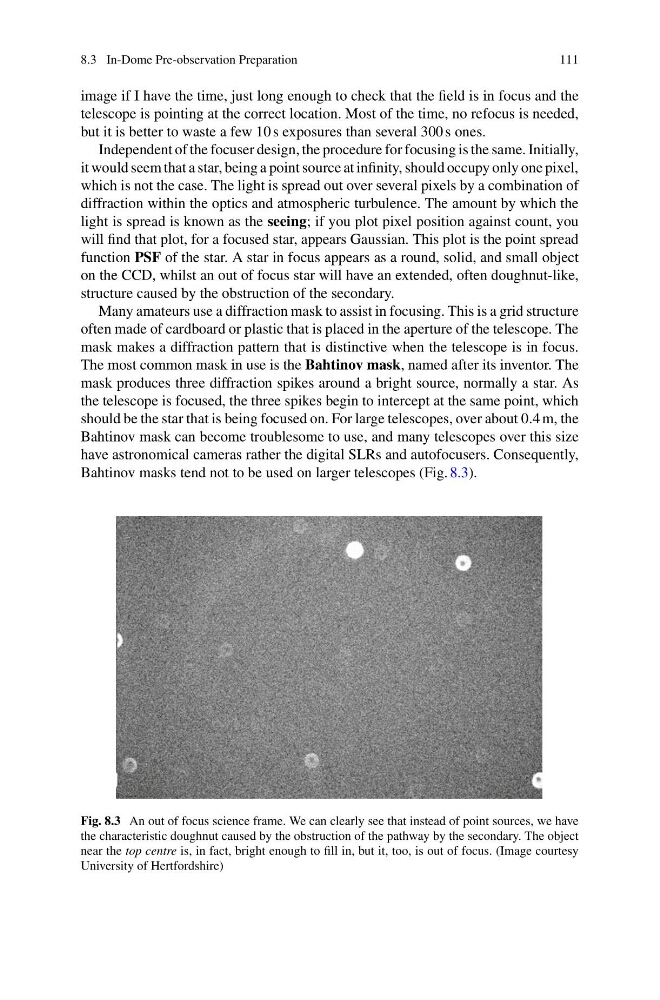
on the CCD, whilst an out of focus star will have an extended, often doughnut-like,
structure caused by the obstruction of the secondary.
Many amateurs use a diffraction mask to assist in focusing. This is a grid structure
often made of cardboard or plastic that is placed in the aperture of the telescope. The
mask makes a diffraction pattern that is distinctive when the telescope is in focus.
The most common mask in use is the Bahtinov mask, named after its inventor. The
mask produces three diffraction spikes around a bright source, normally a star. As
the telescope is focused, the three spikes begin to intercept at the same point, which
should be the star that is being focused on. For large telescopes, over about 0.4 m, the
Bahtinov mask can become troublesome to use, and many telescopes over this size
have astronomical cameras rather the digital SLRs and autofocusers. Consequently,
Bahtinov masks tend not to be used on larger telescopes (Fig. 8.3).
Fig. 8.3 An out of focus science frame. We can clearly see that instead of point sources, we have
the characteristic doughnut caused by the obstruction of the pathway by the secondary. The object
near the top centre is, in fact, bright enough to fill in, but it, too, is out of focus. (Image courtesy
University of Hertfordshire)
111
image if I have the time, just long enough to check that the field is in focus and the
telescope is pointing at the correct location. Most of the time, no refocus is needed,
but it is better to waste a few 10 s exposures than several 300 s ones.
Independent of the focuser design, the procedure for focusing is the same. Initially,
it would seem that a star, being a point source at infinity, should occupy only one pixel,
which is not the case. The light is spread out over several pixels by a combination of
diffraction within the optics and atmospheric turbulence. The amount by which the
light is spread is known as the seeing; if you plot pixel position against count, you
will find that plot, for a focused star, appears Gaussian. This plot is the point spread
function PSF of the star. A star in focus appears as a round, solid, and small object
on the CCD, whilst an out of focus star will have an extended, often doughnut-like,
structure caused by the obstruction of the secondary.
Many amateurs use a diffraction mask to assist in focusing. This is a grid structure
often made of cardboard or plastic that is placed in the aperture of the telescope. The
mask makes a diffraction pattern that is distinctive when the telescope is in focus.
The most common mask in use is the Bahtinov mask, named after its inventor. The
mask produces three diffraction spikes around a bright source, normally a star. As
the telescope is focused, the three spikes begin to intercept at the same point, which
should be the star that is being focused on. For large telescopes, over about 0.4 m, the
Bahtinov mask can become troublesome to use, and many telescopes over this size
have astronomical cameras rather the digital SLRs and autofocusers. Consequently,
Bahtinov masks tend not to be used on larger telescopes (Fig. 8.3).
Fig. 8.3 An out of focus science frame. We can clearly see that instead of point sources, we have
the characteristic doughnut caused by the obstruction of the pathway by the secondary. The object
near the top centre is, in fact, bright enough to fill in, but it, too, is out of focus. (Image courtesy
University of Hertfordshire)