

3.15 Equations of Compatibility for Strains
71
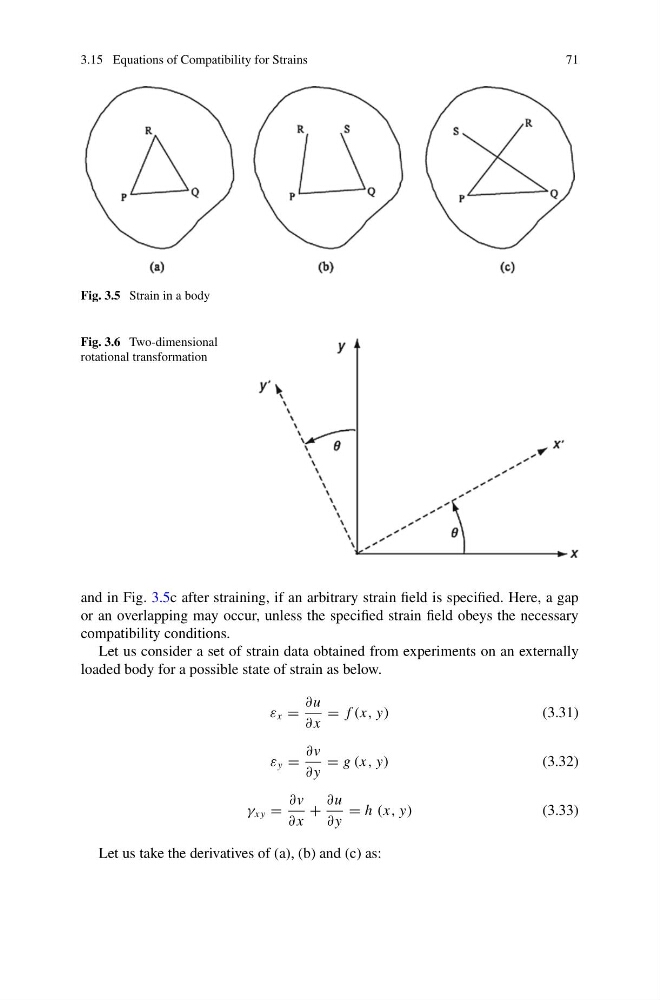
Fig. 3.5 Strain in a body
Fig. 3.6 Two-dimensional
rotational transformation
and in Fig. 3.5c after straining, if an arbitrary strain field is specified. Here, a gap
or an overlapping may occur, unless the specified strain field obeys the necessary
compatibility conditions.
Let us consider a set of strain data obtained from experiments on an externally
loaded body for a possible state of strain as below.
ε x =
∂u
∂ x
= f (x, y)
(3.31)
ε y =
∂v
∂ y
= g (x, y)
(3.32)
γ xy =
∂v
∂ x
+
∂u
∂ y
= h (x, y)
(3.33)
Let us take the derivatives of (a), (b) and (c) as:
71
Fig. 3.5 Strain in a body
Fig. 3.6 Two-dimensional
rotational transformation
and in Fig. 3.5c after straining, if an arbitrary strain field is specified. Here, a gap
or an overlapping may occur, unless the specified strain field obeys the necessary
compatibility conditions.
Let us consider a set of strain data obtained from experiments on an externally
loaded body for a possible state of strain as below.
ε x =
∂u
∂ x
= f (x, y)
(3.31)
ε y =
∂v
∂ y
= g (x, y)
(3.32)
γ xy =
∂v
∂ x
+
∂u
∂ y
= h (x, y)
(3.33)
Let us take the derivatives of (a), (b) and (c) as: