

16
2 Analysis of Stress
which is equivalent to the balance of moment of momentum with respect to an
arbitrary point. In deriving (2.19), it is implied that there are no body couples. If
body couples and/or couple stresses are present, Eq. (2.20) is modified, but Eq. (2.19)
remains unchanged.
Cauchy stress principle has four essential ingradients
1. The physical dimensions of stress are (force)/(area).
2. Stress is defined on an imaginary surface that separates the region under
consideration into two parts.
3. Stress is a vector or vector field equipollent to the action of one part of the material
on the other.
4. The direction of the stress vector is not restricted.
2.11 Direction Cosines
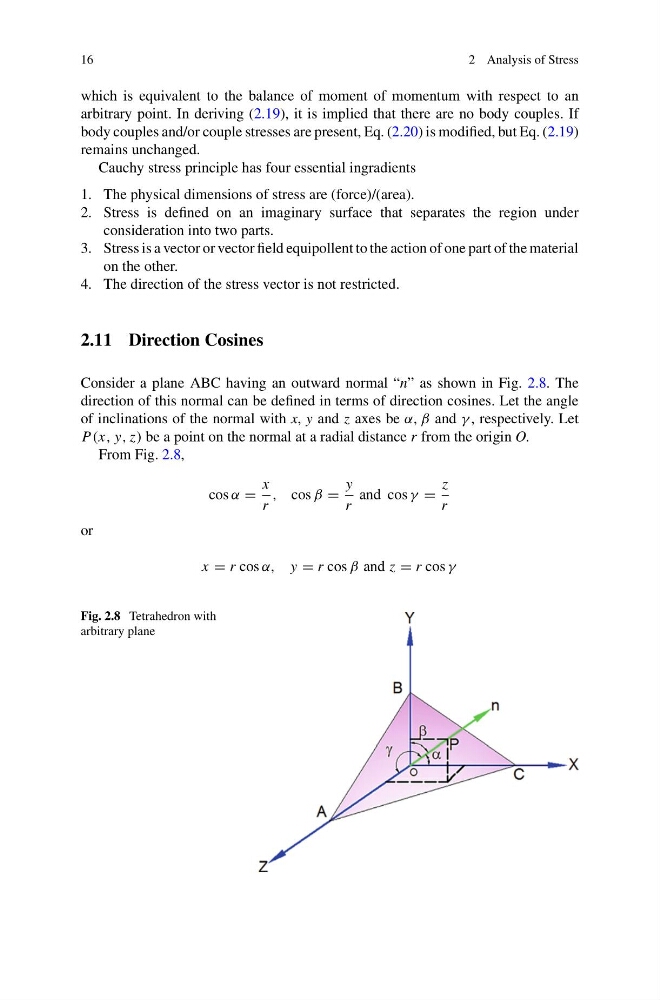
Consider a plane ABC having an outward normal “n” as shown in Fig. 2.8. The
direction of this normal can be defined in terms of direction cosines. Let the angle
of inclinations of the normal with x, y and z axes be α, β and γ , respectively. Let
P(x, y, z) be a point on the normal at a radial distance r from the origin O.
From Fig. 2.8,
cos α =
x
r
, cos β =
y
r
and cos γ =
z
r
or
x = r cos α, y = r cos β and z = r cos γ
Fig. 2.8 Tetrahedron with
arbitrary plane
2 Analysis of Stress
which is equivalent to the balance of moment of momentum with respect to an
arbitrary point. In deriving (2.19), it is implied that there are no body couples. If
body couples and/or couple stresses are present, Eq. (2.20) is modified, but Eq. (2.19)
remains unchanged.
Cauchy stress principle has four essential ingradients
1. The physical dimensions of stress are (force)/(area).
2. Stress is defined on an imaginary surface that separates the region under
consideration into two parts.
3. Stress is a vector or vector field equipollent to the action of one part of the material
on the other.
4. The direction of the stress vector is not restricted.
2.11 Direction Cosines
Consider a plane ABC having an outward normal “n” as shown in Fig. 2.8. The
direction of this normal can be defined in terms of direction cosines. Let the angle
of inclinations of the normal with x, y and z axes be α, β and γ , respectively. Let
P(x, y, z) be a point on the normal at a radial distance r from the origin O.
From Fig. 2.8,
cos α =
x
r
, cos β =
y
r
and cos γ =
z
r
or
x = r cos α, y = r cos β and z = r cos γ
Fig. 2.8 Tetrahedron with
arbitrary plane