

2.9 Principal Stresses in Two Dimensions
15
σ 1,2 =
σ x + σ y
2
±
σ x − σ y
2
2
+ τ 2
xy
(2.16)
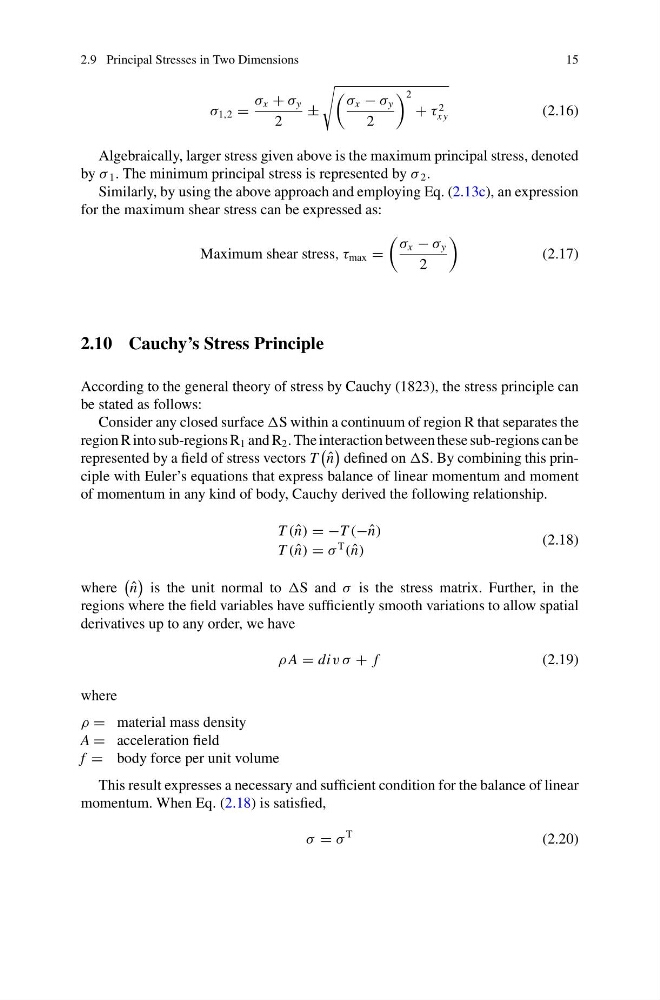
Algebraically, larger stress given above is the maximum principal stress, denoted
by σ 1 . The minimum principal stress is represented by σ 2 .
Similarly, by using the above approach and employing Eq. (2.13c), an expression
for the maximum shear stress can be expressed as:
Maximum shear stress, τ max =
σ x − σ y
2
(2.17)
2.10 Cauchy’s Stress Principle
According to the general theory of stress by Cauchy (1823), the stress principle can
be stated as follows:
Consider any closed surface S within a continuum of region R that separates the
region R into sub-regions R 1 and R 2 . The interaction between these sub-regions can be
represented by a field of stress vectors T
ˆ
n
defined on S. By combining this principle with Euler’s equations that express balance of linear momentum and moment
of momentum in any kind of body, Cauchy derived the following relationship.
T ( ˆ
n) = −T (− ˆ
n)
T ( ˆ
n) = σ
T
( ˆ
n)
(2.18)
where
ˆ
n
is the unit normal to S and σ is the stress matrix. Further, in the
regions where the field variables have sufficiently smooth variations to allow spatial
derivatives up to any order, we have
ρ A = div σ + f
(2.19)
where
ρ = material mass density
A = acceleration field
f = body force per unit volume
This result expresses a necessary and sufficient condition for the balance of linear
momentum. When Eq. (2.18) is satisfied,
σ = σ
T
(2.20)
15
σ 1,2 =
σ x + σ y
2
±
σ x − σ y
2
2
+ τ 2
xy
(2.16)
Algebraically, larger stress given above is the maximum principal stress, denoted
by σ 1 . The minimum principal stress is represented by σ 2 .
Similarly, by using the above approach and employing Eq. (2.13c), an expression
for the maximum shear stress can be expressed as:
Maximum shear stress, τ max =
σ x − σ y
2
(2.17)
2.10 Cauchy’s Stress Principle
According to the general theory of stress by Cauchy (1823), the stress principle can
be stated as follows:
Consider any closed surface S within a continuum of region R that separates the
region R into sub-regions R 1 and R 2 . The interaction between these sub-regions can be
represented by a field of stress vectors T
ˆ
n
defined on S. By combining this principle with Euler’s equations that express balance of linear momentum and moment
of momentum in any kind of body, Cauchy derived the following relationship.
T ( ˆ
n) = −T (− ˆ
n)
T ( ˆ
n) = σ
T
( ˆ
n)
(2.18)
where
ˆ
n
is the unit normal to S and σ is the stress matrix. Further, in the
regions where the field variables have sufficiently smooth variations to allow spatial
derivatives up to any order, we have
ρ A = div σ + f
(2.19)
where
ρ = material mass density
A = acceleration field
f = body force per unit volume
This result expresses a necessary and sufficient condition for the balance of linear
momentum. When Eq. (2.18) is satisfied,
σ = σ
T
(2.20)