

8.6 Mindlin’s Problem
281
τ zx =
P
8π(1 − v)
3x
2 z 1
R
5
1
+
(1 − 2v)z 1
R
3
1
−
(1 − 2v)(z − 2h)
R 3
−
3x
2 z + 6(1 − 2v)hx
2
− 6hz(z − h)
R 5
−
30hx
2 z(z − h)
R 7
(8.22h)
8.7 Applications
The mechanical response of soils and rocks are influenced by a variety of factors
such as shape, size and mechanical properties of the individual soil particles, soil
structure, the intergranular stresses and stress history, and soil moisture, the degree of
saturation and the soil permeability. These factors generally contribute to nonlinear
stress–strain phenomena, which is generally irreversible and time dependent. These
materials also exhibit anisotropic and non-homogeneous material properties. Thus,
any attempt to solve a soil–foundation interaction problem, taking into account all
such material properties, is very difficult. In order to obtain meaningful results for
practical problems of soil–foundation interaction, it becomes necessary to idealize
the behaviour of soil and rocks. The simplest type of idealized soil response assumes
linear elastic behaviour.
Two classes of foundation problems can be considered, and they are (1) interactive
problems and (2) non-interactive problems. For interactive problems, the elasticity
of the foundation plays an important role. For example, a flexible raft foundation
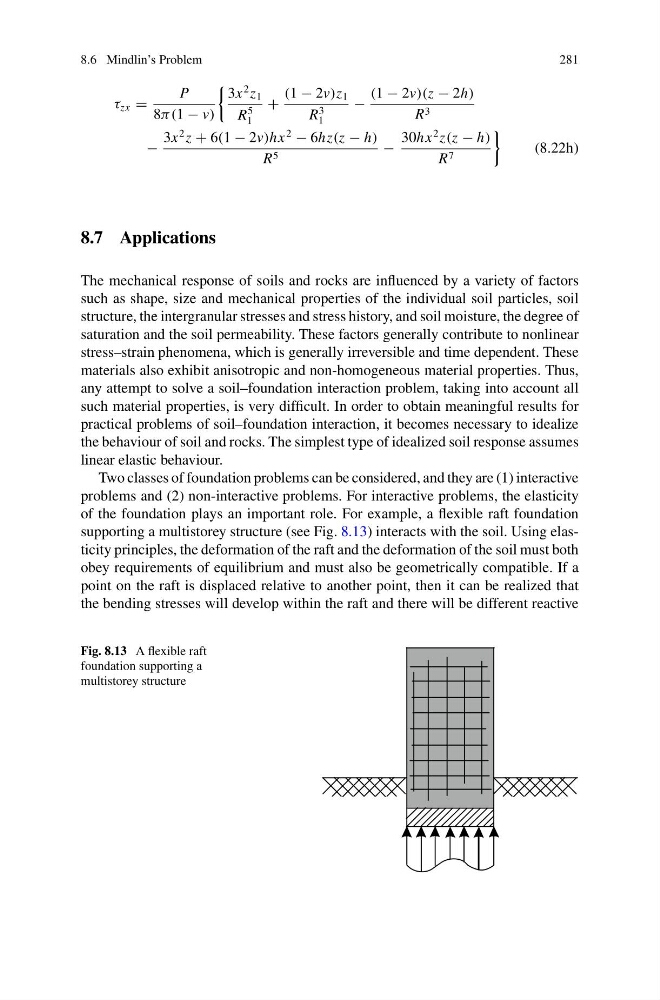
supporting a multistorey structure (see Fig. 8.13) interacts with the soil. Using elasticity principles, the deformation of the raft and the deformation of the soil must both
obey requirements of equilibrium and must also be geometrically compatible. If a
point on the raft is displaced relative to another point, then it can be realized that
the bending stresses will develop within the raft and there will be different reactive
Fig. 8.13 A flexible raft
foundation supporting a
multistorey structure
281
τ zx =
P
8π(1 − v)
3x
2 z 1
R
5
1
+
(1 − 2v)z 1
R
3
1
−
(1 − 2v)(z − 2h)
R 3
−
3x
2 z + 6(1 − 2v)hx
2
− 6hz(z − h)
R 5
−
30hx
2 z(z − h)
R 7
(8.22h)
8.7 Applications
The mechanical response of soils and rocks are influenced by a variety of factors
such as shape, size and mechanical properties of the individual soil particles, soil
structure, the intergranular stresses and stress history, and soil moisture, the degree of
saturation and the soil permeability. These factors generally contribute to nonlinear
stress–strain phenomena, which is generally irreversible and time dependent. These
materials also exhibit anisotropic and non-homogeneous material properties. Thus,
any attempt to solve a soil–foundation interaction problem, taking into account all
such material properties, is very difficult. In order to obtain meaningful results for
practical problems of soil–foundation interaction, it becomes necessary to idealize
the behaviour of soil and rocks. The simplest type of idealized soil response assumes
linear elastic behaviour.
Two classes of foundation problems can be considered, and they are (1) interactive
problems and (2) non-interactive problems. For interactive problems, the elasticity
of the foundation plays an important role. For example, a flexible raft foundation
supporting a multistorey structure (see Fig. 8.13) interacts with the soil. Using elasticity principles, the deformation of the raft and the deformation of the soil must both
obey requirements of equilibrium and must also be geometrically compatible. If a
point on the raft is displaced relative to another point, then it can be realized that
the bending stresses will develop within the raft and there will be different reactive
Fig. 8.13 A flexible raft
foundation supporting a
multistorey structure