

8.6 Mindlin’s Problem
279
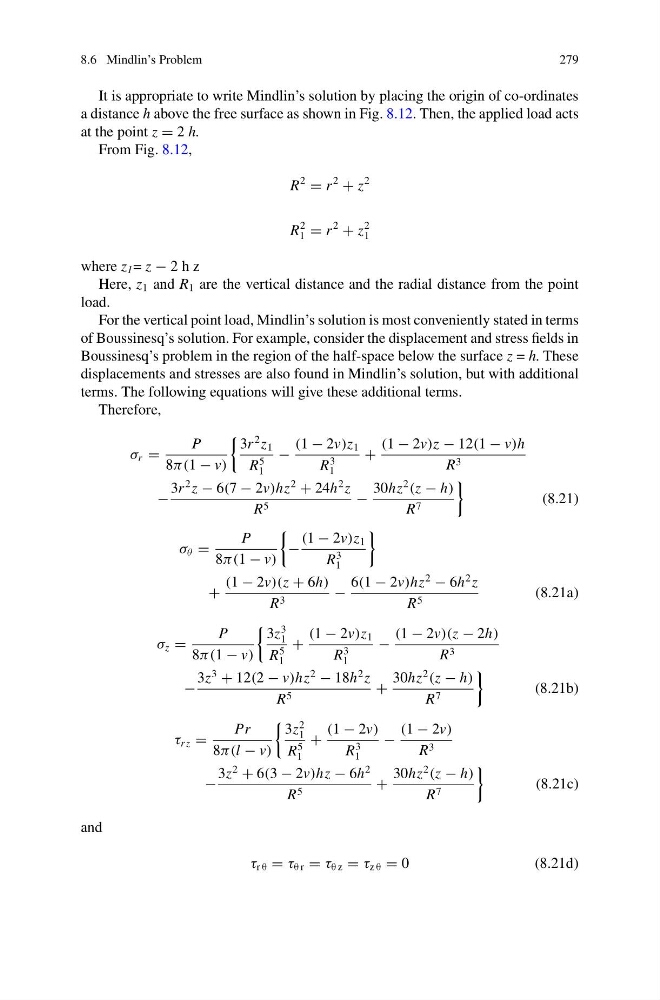
It is appropriate to write Mindlin’s solution by placing the origin of co-ordinates
a distance h above the free surface as shown in Fig. 8.12. Then, the applied load acts
at the point z = 2 h.
From Fig. 8.12,
R
2
= r
2
+ z
2
R
2
1 = r
2
+ z
2
1
where z 1 = z − 2 h z
Here, z 1 and R 1 are the vertical distance and the radial distance from the point
load.
For the vertical point load, Mindlin’s solution is most conveniently stated in terms
of Boussinesq’s solution. For example, consider the displacement and stress fields in
Boussinesq’s problem in the region of the half-space below the surface z = h. These
displacements and stresses are also found in Mindlin’s solution, but with additional
terms. The following equations will give these additional terms.
Therefore,
σ r =
P
8π(1 − v)
3r
2 z 1
R
5
1
−
(1 − 2v)z 1
R
3
1
+
(1 − 2v)z − 12(1 − v)h
R 3
−
3r
2 z − 6(7 − 2v)hz
2
+ 24h
2 z
R 5
−
30hz
2
(z − h)
R 7
(8.21)
σ θ =
P
8π(1 − v)
−
(1 − 2v)z 1
R
3
1
+
(1 − 2v)(z + 6h)
R 3
−
6(1 − 2v)hz
2
− 6h
2 z
R 5
(8.21a)
σ z =
P
8π(1 − v)
3z
3
1
R
5
1
+
(1 − 2v)z 1
R
3
1
−
(1 − 2v)(z − 2h)
R 3
−
3z
3
+ 12(2 − v)hz
2
− 18h
2 z
R 5
+
30hz
2
(z − h)
R 7
(8.21b)
τ r z =
Pr
8π(l − v)
3z
2
1
R
5
1
+
(1 − 2v)
R
3
1
−
(1 − 2v)
R 3
−
3z
2
+ 6(3 − 2v)hz − 6h
2
R 5
+
30hz
2
(z − h)
R 7
(8.21c)
and
τ r θ = τ θ r = τ θ z = τ z θ = 0
(8.21d)
279
It is appropriate to write Mindlin’s solution by placing the origin of co-ordinates
a distance h above the free surface as shown in Fig. 8.12. Then, the applied load acts
at the point z = 2 h.
From Fig. 8.12,
R
2
= r
2
+ z
2
R
2
1 = r
2
+ z
2
1
where z 1 = z − 2 h z
Here, z 1 and R 1 are the vertical distance and the radial distance from the point
load.
For the vertical point load, Mindlin’s solution is most conveniently stated in terms
of Boussinesq’s solution. For example, consider the displacement and stress fields in
Boussinesq’s problem in the region of the half-space below the surface z = h. These
displacements and stresses are also found in Mindlin’s solution, but with additional
terms. The following equations will give these additional terms.
Therefore,
σ r =
P
8π(1 − v)
3r
2 z 1
R
5
1
−
(1 − 2v)z 1
R
3
1
+
(1 − 2v)z − 12(1 − v)h
R 3
−
3r
2 z − 6(7 − 2v)hz
2
+ 24h
2 z
R 5
−
30hz
2
(z − h)
R 7
(8.21)
σ θ =
P
8π(1 − v)
−
(1 − 2v)z 1
R
3
1
+
(1 − 2v)(z + 6h)
R 3
−
6(1 − 2v)hz
2
− 6h
2 z
R 5
(8.21a)
σ z =
P
8π(1 − v)
3z
3
1
R
5
1
+
(1 − 2v)z 1
R
3
1
−
(1 − 2v)(z − 2h)
R 3
−
3z
3
+ 12(2 − v)hz
2
− 18h
2 z
R 5
+
30hz
2
(z − h)
R 7
(8.21b)
τ r z =
Pr
8π(l − v)
3z
2
1
R
5
1
+
(1 − 2v)
R
3
1
−
(1 − 2v)
R 3
−
3z
2
+ 6(3 − 2v)hz − 6h
2
R 5
+
30hz
2
(z − h)
R 7
(8.21c)
and
τ r θ = τ θ r = τ θ z = τ z θ = 0
(8.21d)