

7.8 Torsion of Thin-Walled Sections
241
7.8 Torsion of Thin-Walled Sections
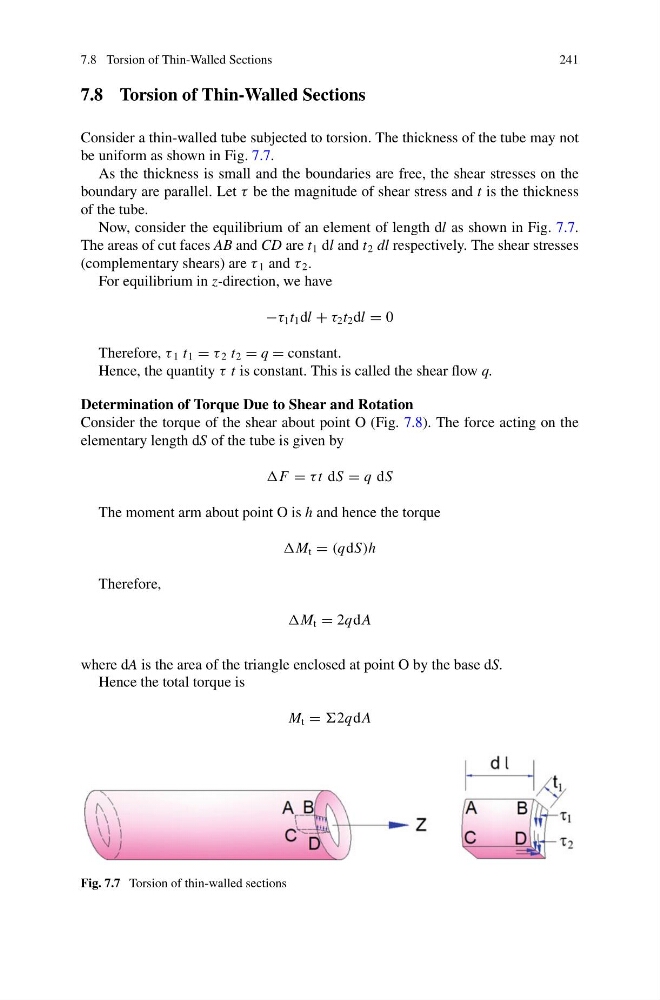
Consider a thin-walled tube subjected to torsion. The thickness of the tube may not
be uniform as shown in Fig. 7.7.
As the thickness is small and the boundaries are free, the shear stresses on the
boundary are parallel. Let τ be the magnitude of shear stress and t is the thickness
of the tube.
Now, consider the equilibrium of an element of length dl as shown in Fig. 7.7.
The areas of cut faces AB and CD are t 1 dl and t 2 dl respectively. The shear stresses
(complementary shears) are τ 1 and τ 2 .
For equilibrium in z-direction, we have
−τ 1 t 1 dl + τ 2 t 2 dl = 0
Therefore, τ 1 t 1 = τ 2 t 2 = q = constant.
Hence, the quantity τ t is constant. This is called the shear flow q.
Determination of Torque Due to Shear and Rotation
Consider the torque of the shear about point O (Fig. 7.8). The force acting on the
elementary length dS of the tube is given by
F = τ t dS = q dS
The moment arm about point O is h and hence the torque
M t = (qdS)h
Therefore,
M t = 2qdA
where dA is the area of the triangle enclosed at point O by the base dS.
Hence the total torque is
M t = 2qd A
Fig. 7.7 Torsion of thin-walled sections
241
7.8 Torsion of Thin-Walled Sections
Consider a thin-walled tube subjected to torsion. The thickness of the tube may not
be uniform as shown in Fig. 7.7.
As the thickness is small and the boundaries are free, the shear stresses on the
boundary are parallel. Let τ be the magnitude of shear stress and t is the thickness
of the tube.
Now, consider the equilibrium of an element of length dl as shown in Fig. 7.7.
The areas of cut faces AB and CD are t 1 dl and t 2 dl respectively. The shear stresses
(complementary shears) are τ 1 and τ 2 .
For equilibrium in z-direction, we have
−τ 1 t 1 dl + τ 2 t 2 dl = 0
Therefore, τ 1 t 1 = τ 2 t 2 = q = constant.
Hence, the quantity τ t is constant. This is called the shear flow q.
Determination of Torque Due to Shear and Rotation
Consider the torque of the shear about point O (Fig. 7.8). The force acting on the
elementary length dS of the tube is given by
F = τ t dS = q dS
The moment arm about point O is h and hence the torque
M t = (qdS)h
Therefore,
M t = 2qdA
where dA is the area of the triangle enclosed at point O by the base dS.
Hence the total torque is
M t = 2qd A
Fig. 7.7 Torsion of thin-walled sections