

240
7 Torsion of Prismatic Bars
= −T dy
∂z
∂ x
+ T dy
∂z
∂ x
+
∂
2 z
∂ x 2 dx
− T dx
∂z
∂ y
+ T dx
∂z
∂ y
+
∂
2 z
∂ y 2 dy
= T
∂
2 z
∂ x 2 +
∂
2 z
∂ y 2
dx dy
But the force p acting upwards on the membrane element ABCD is p dxdy,
assuming that the membrane deflection is small.
Hence, for equilibrium,
T
∂
2 z
∂ x 2 +
∂
2 z
∂ y 2
= −p
or
∂
2 z
∂ x 2 +
∂
2 z
∂ y 2
= −p/T
(7.22)
Now, if the membrane tension T or the air pressure p is adjusted in such a way that
p/T becomes numerically equal to 2Gθ, then Eq. (7.22) of the membrane becomes
identical to Eq. (7.8) of the torsion stress function φ. Also, if the membrane height
z remains zero at the boundary contour of the section, then the height z of the
membrane becomes numerically equal to the torsion stress function φ = 0. The
slopes of the membrane are then equal to the shear stresses and these are in a direction
perpendicular to that of the slope.
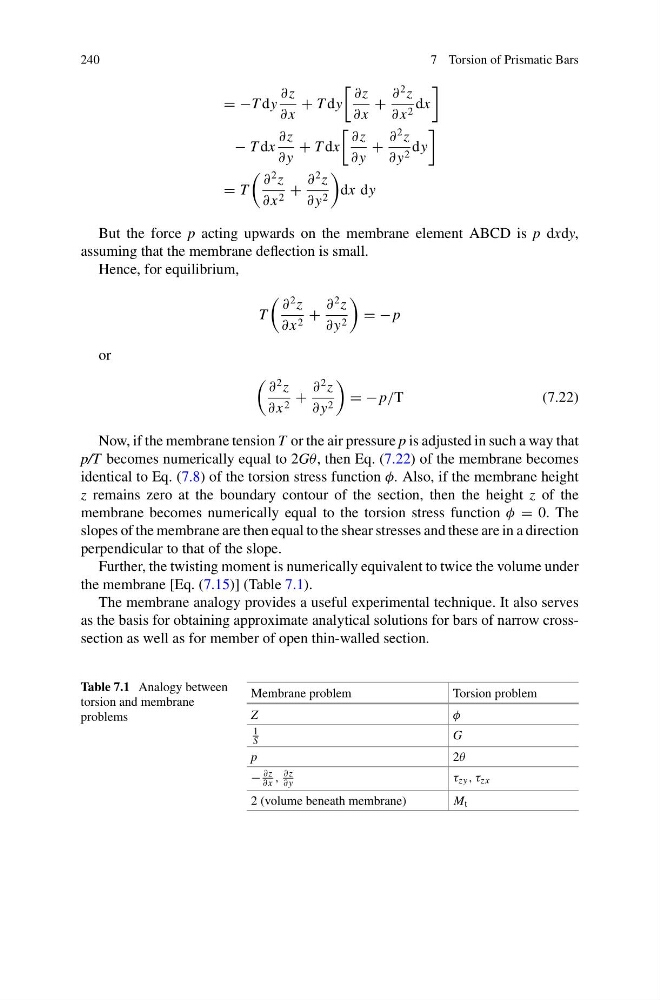
Further, the twisting moment is numerically equivalent to twice the volume under
the membrane [Eq. (7.15)] (Table 7.1).
The membrane analogy provides a useful experimental technique. It also serves
as the basis for obtaining approximate analytical solutions for bars of narrow crosssection as well as for member of open thin-walled section.
Table 7.1 Analogy between
torsion and membrane
problems
Membrane problem
Torsion problem
Z
φ
1
S
G
p
2θ
−
∂z
∂ x ,
∂z
∂ y
τ zy , τ zx
2 (volume beneath membrane)
M t
7 Torsion of Prismatic Bars
= −T dy
∂z
∂ x
+ T dy
∂z
∂ x
+
∂
2 z
∂ x 2 dx
− T dx
∂z
∂ y
+ T dx
∂z
∂ y
+
∂
2 z
∂ y 2 dy
= T
∂
2 z
∂ x 2 +
∂
2 z
∂ y 2
dx dy
But the force p acting upwards on the membrane element ABCD is p dxdy,
assuming that the membrane deflection is small.
Hence, for equilibrium,
T
∂
2 z
∂ x 2 +
∂
2 z
∂ y 2
= −p
or
∂
2 z
∂ x 2 +
∂
2 z
∂ y 2
= −p/T
(7.22)
Now, if the membrane tension T or the air pressure p is adjusted in such a way that
p/T becomes numerically equal to 2Gθ, then Eq. (7.22) of the membrane becomes
identical to Eq. (7.8) of the torsion stress function φ. Also, if the membrane height
z remains zero at the boundary contour of the section, then the height z of the
membrane becomes numerically equal to the torsion stress function φ = 0. The
slopes of the membrane are then equal to the shear stresses and these are in a direction
perpendicular to that of the slope.
Further, the twisting moment is numerically equivalent to twice the volume under
the membrane [Eq. (7.15)] (Table 7.1).
The membrane analogy provides a useful experimental technique. It also serves
as the basis for obtaining approximate analytical solutions for bars of narrow crosssection as well as for member of open thin-walled section.
Table 7.1 Analogy between
torsion and membrane
problems
Membrane problem
Torsion problem
Z
φ
1
S
G
p
2θ
−
∂z
∂ x ,
∂z
∂ y
τ zy , τ zx
2 (volume beneath membrane)
M t