

226
7 Torsion of Prismatic Bars
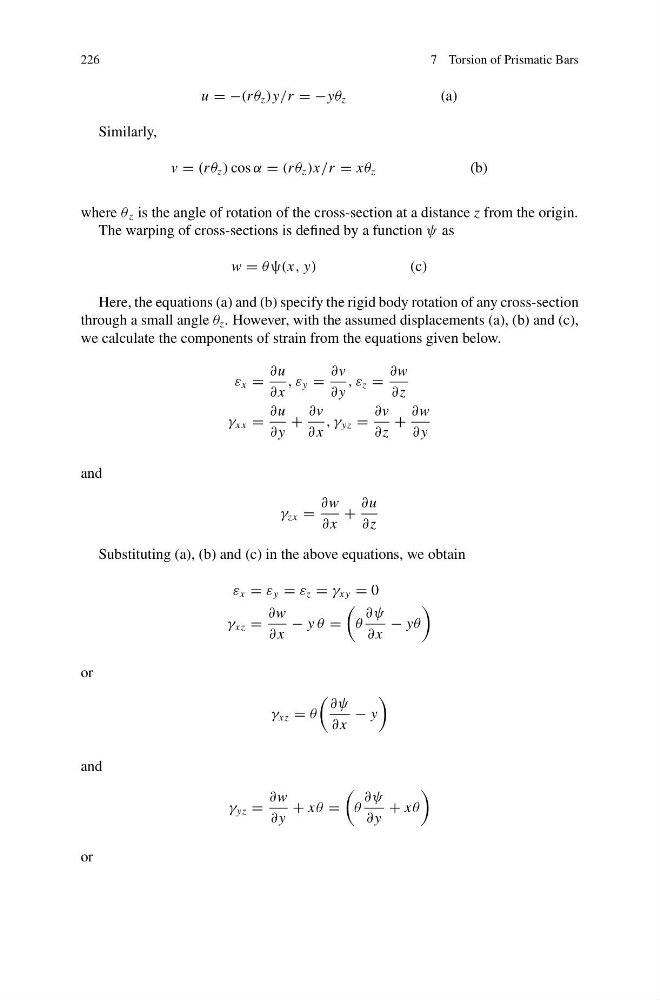
u = −(r θ z )y/r = −yθ z
(a)
Similarly,
v = (r θ z ) cos α = (r θ z )x/r = xθ z
(b)
where θ z is the angle of rotation of the cross-section at a distance z from the origin.
The warping of cross-sections is defined by a function ψ as
w = θ ψ(x, y)
( c)
Here, the equations (a) and (b) specify the rigid body rotation of any cross-section
through a small angle θ z . However, with the assumed displacements (a), (b) and (c),
we calculate the components of strain from the equations given below.
ε x =
∂u
∂ x
, ε y =
∂v
∂ y
, ε z =
∂w
∂z
γ xx =
∂u
∂ y
+
∂v
∂ x
, γ yz =
∂v
∂z
+
∂w
∂ y
and
γ zx =
∂w
∂ x
+
∂u
∂z
Substituting (a), (b) and (c) in the above equations, we obtain
ε x = ε y = ε z = γ xy = 0
γ xz =
∂w
∂ x
− y θ =
θ
∂ψ
∂ x
− yθ
or
γ xz = θ
∂ψ
∂ x
− y
and
γ yz =
∂w
∂ y
+ xθ =
θ
∂ψ
∂ y
+ xθ
or
7 Torsion of Prismatic Bars
u = −(r θ z )y/r = −yθ z
(a)
Similarly,
v = (r θ z ) cos α = (r θ z )x/r = xθ z
(b)
where θ z is the angle of rotation of the cross-section at a distance z from the origin.
The warping of cross-sections is defined by a function ψ as
w = θ ψ(x, y)
( c)
Here, the equations (a) and (b) specify the rigid body rotation of any cross-section
through a small angle θ z . However, with the assumed displacements (a), (b) and (c),
we calculate the components of strain from the equations given below.
ε x =
∂u
∂ x
, ε y =
∂v
∂ y
, ε z =
∂w
∂z
γ xx =
∂u
∂ y
+
∂v
∂ x
, γ yz =
∂v
∂z
+
∂w
∂ y
and
γ zx =
∂w
∂ x
+
∂u
∂z
Substituting (a), (b) and (c) in the above equations, we obtain
ε x = ε y = ε z = γ xy = 0
γ xz =
∂w
∂ x
− y θ =
θ
∂ψ
∂ x
− yθ
or
γ xz = θ
∂ψ
∂ x
− y
and
γ yz =
∂w
∂ y
+ xθ =
θ
∂ψ
∂ y
+ xθ
or