

224
7 Torsion of Prismatic Bars
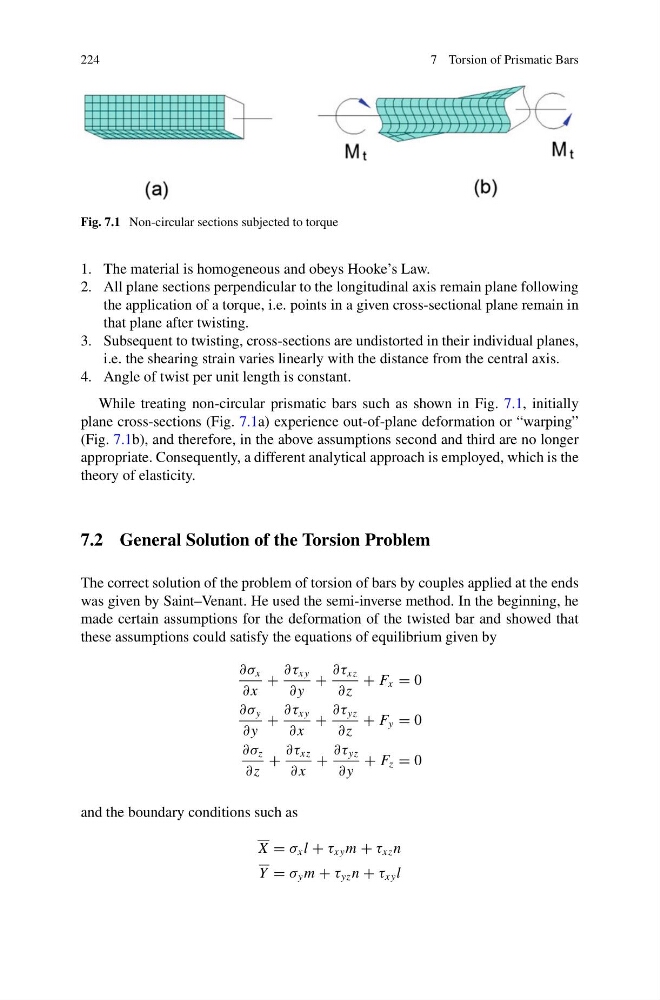
Fig. 7.1 Non-circular sections subjected to torque
1. The material is homogeneous and obeys Hooke’s Law.
2. All plane sections perpendicular to the longitudinal axis remain plane following
the application of a torque, i.e. points in a given cross-sectional plane remain in
that plane after twisting.
3. Subsequent to twisting, cross-sections are undistorted in their individual planes,
i.e. the shearing strain varies linearly with the distance from the central axis.
4. Angle of twist per unit length is constant.
While treating non-circular prismatic bars such as shown in Fig. 7.1, initially
plane cross-sections (Fig. 7.1a) experience out-of-plane deformation or “warping”
(Fig. 7.1b), and therefore, in the above assumptions second and third are no longer
appropriate. Consequently, a different analytical approach is employed, which is the
theory of elasticity.
7.2 General Solution of the Torsion Problem
The correct solution of the problem of torsion of bars by couples applied at the ends
was given by Saint–Venant. He used the semi-inverse method. In the beginning, he
made certain assumptions for the deformation of the twisted bar and showed that
these assumptions could satisfy the equations of equilibrium given by
∂σ x
∂ x
+
∂τ xy
∂ y
+
∂τ xz
∂z
+ F x = 0
∂σ y
∂ y
+
∂τ xy
∂ x
+
∂τ yz
∂z
+ F y = 0
∂σ z
∂z
+
∂τ xz
∂ x
+
∂τ yz
∂ y
+ F z = 0
and the boundary conditions such as
X = σ x l + τ xy m + τ xz n
Y = σ y m + τ yz n + τ xy l
7 Torsion of Prismatic Bars
Fig. 7.1 Non-circular sections subjected to torque
1. The material is homogeneous and obeys Hooke’s Law.
2. All plane sections perpendicular to the longitudinal axis remain plane following
the application of a torque, i.e. points in a given cross-sectional plane remain in
that plane after twisting.
3. Subsequent to twisting, cross-sections are undistorted in their individual planes,
i.e. the shearing strain varies linearly with the distance from the central axis.
4. Angle of twist per unit length is constant.
While treating non-circular prismatic bars such as shown in Fig. 7.1, initially
plane cross-sections (Fig. 7.1a) experience out-of-plane deformation or “warping”
(Fig. 7.1b), and therefore, in the above assumptions second and third are no longer
appropriate. Consequently, a different analytical approach is employed, which is the
theory of elasticity.
7.2 General Solution of the Torsion Problem
The correct solution of the problem of torsion of bars by couples applied at the ends
was given by Saint–Venant. He used the semi-inverse method. In the beginning, he
made certain assumptions for the deformation of the twisted bar and showed that
these assumptions could satisfy the equations of equilibrium given by
∂σ x
∂ x
+
∂τ xy
∂ y
+
∂τ xz
∂z
+ F x = 0
∂σ y
∂ y
+
∂τ xy
∂ x
+
∂τ yz
∂z
+ F y = 0
∂σ z
∂z
+
∂τ xz
∂ x
+
∂τ yz
∂ y
+ F z = 0
and the boundary conditions such as
X = σ x l + τ xy m + τ xz n
Y = σ y m + τ yz n + τ xy l