

190
6 Two-Dimensional Problems in Elasticity …
6.12 Bars with Large Initial Curvature
There are practical cases of bars, such as hooks, links and rings, which have large
initial curvature. In such a case, the dimensions of the cross-section are not very
small in comparison with either the radius of curvature or with the length of the bar.
The treatment that follows is based on the theory due to Winkler and Bach.
6.13 Winkler–Bach Theory
Assumptions in Winkler’s Theory.
1. Transverse sections which are plane before bending remain plane even after
bending.
2. Longitudinal fibres of the bar, parallel to the central axis exert no pressure on
each other.
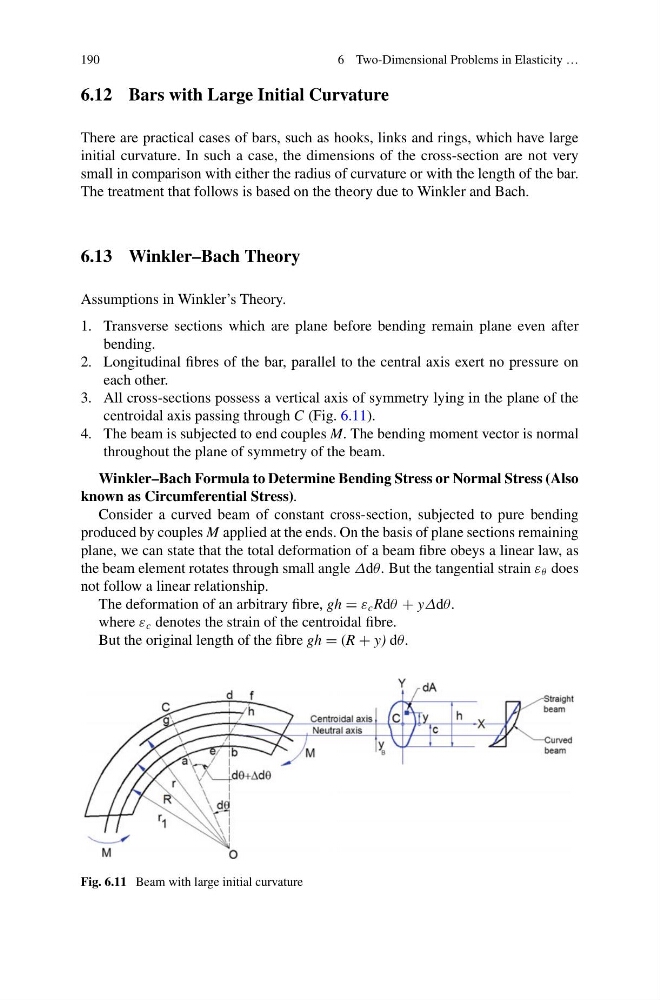
3. All cross-sections possess a vertical axis of symmetry lying in the plane of the
centroidal axis passing through C (Fig. 6.11).
4. The beam is subjected to end couples M. The bending moment vector is normal
throughout the plane of symmetry of the beam.
Winkler–Bach Formula to Determine Bending Stress or Normal Stress (Also
known as Circumferential Stress).
Consider a curved beam of constant cross-section, subjected to pure bending
produced by couples M applied at the ends. On the basis of plane sections remaining
plane, we can state that the total deformation of a beam fibre obeys a linear law, as
the beam element rotates through small angle Δdθ . But the tangential strain ε θ does
not follow a linear relationship.
The deformation of an arbitrary fibre, gh = ε c Rdθ + yΔdθ .
where ε c denotes the strain of the centroidal fibre.
But the original length of the fibre gh = (R + y) dθ .
Fig. 6.11 Beam with large initial curvature
6 Two-Dimensional Problems in Elasticity …
6.12 Bars with Large Initial Curvature
There are practical cases of bars, such as hooks, links and rings, which have large
initial curvature. In such a case, the dimensions of the cross-section are not very
small in comparison with either the radius of curvature or with the length of the bar.
The treatment that follows is based on the theory due to Winkler and Bach.
6.13 Winkler–Bach Theory
Assumptions in Winkler’s Theory.
1. Transverse sections which are plane before bending remain plane even after
bending.
2. Longitudinal fibres of the bar, parallel to the central axis exert no pressure on
each other.
3. All cross-sections possess a vertical axis of symmetry lying in the plane of the
centroidal axis passing through C (Fig. 6.11).
4. The beam is subjected to end couples M. The bending moment vector is normal
throughout the plane of symmetry of the beam.
Winkler–Bach Formula to Determine Bending Stress or Normal Stress (Also
known as Circumferential Stress).
Consider a curved beam of constant cross-section, subjected to pure bending
produced by couples M applied at the ends. On the basis of plane sections remaining
plane, we can state that the total deformation of a beam fibre obeys a linear law, as
the beam element rotates through small angle Δdθ . But the tangential strain ε θ does
not follow a linear relationship.
The deformation of an arbitrary fibre, gh = ε c Rdθ + yΔdθ .
where ε c denotes the strain of the centroidal fibre.
But the original length of the fibre gh = (R + y) dθ .
Fig. 6.11 Beam with large initial curvature