

6.11 The Effect of Circular Holes on Stress Distributions in Plates
189
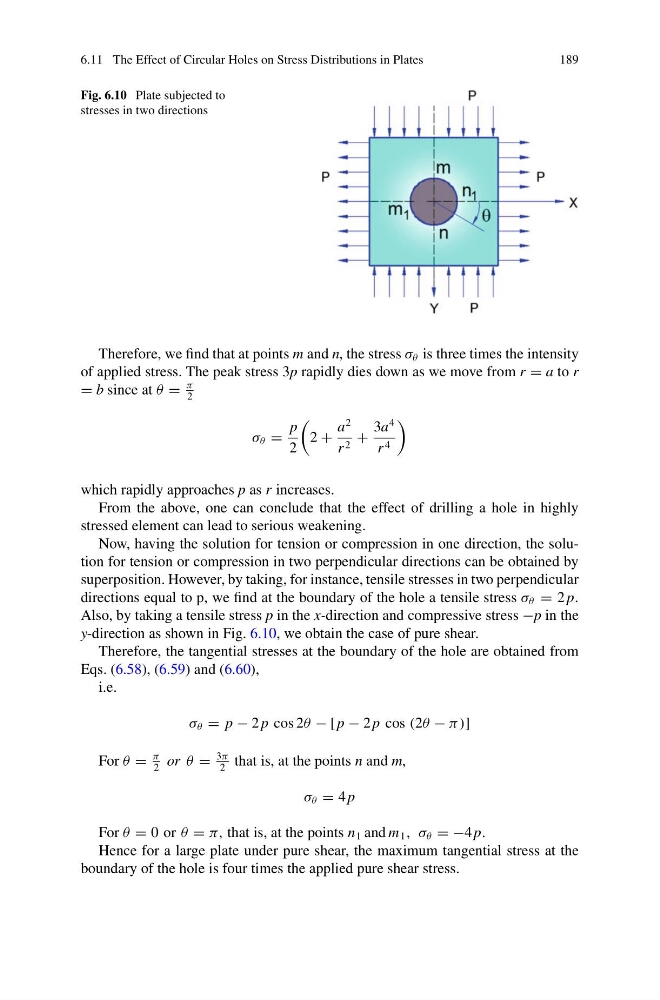
Fig. 6.10 Plate subjected to
stresses in two directions
Therefore, we find that at points m and n, the stress σ θ is three times the intensity
of applied stress. The peak stress 3p rapidly dies down as we move from r = a to r
= b since at θ =
π
2
σ θ =
p
2
2 +
a
2
r 2 +
3a
4
r 4
which rapidly approaches p as r increases.
From the above, one can conclude that the effect of drilling a hole in highly
stressed element can lead to serious weakening.
Now, having the solution for tension or compression in one direction, the solution for tension or compression in two perpendicular directions can be obtained by
superposition. However, by taking, for instance, tensile stresses in two perpendicular
directions equal to p, we find at the boundary of the hole a tensile stress σ θ = 2 p.
Also, by taking a tensile stress p in the x-direction and compressive stress −p in the
y-direction as shown in Fig. 6.10, we obtain the case of pure shear.
Therefore, the tangential stresses at the boundary of the hole are obtained from
Eqs. (6.58), (6.59) and (6.60),
i.e.
σ θ = p − 2 p cos 2θ − [ p − 2 p cos (2θ − π )]
For θ =
π
2
or θ =
3π
2
that is, at the points n and m,
σ θ = 4 p
For θ = 0 or θ = π, that is, at the points n 1 and m 1 , σ θ = −4 p.
Hence for a large plate under pure shear, the maximum tangential stress at the
boundary of the hole is four times the applied pure shear stress.
189
Fig. 6.10 Plate subjected to
stresses in two directions
Therefore, we find that at points m and n, the stress σ θ is three times the intensity
of applied stress. The peak stress 3p rapidly dies down as we move from r = a to r
= b since at θ =
π
2
σ θ =
p
2
2 +
a
2
r 2 +
3a
4
r 4
which rapidly approaches p as r increases.
From the above, one can conclude that the effect of drilling a hole in highly
stressed element can lead to serious weakening.
Now, having the solution for tension or compression in one direction, the solution for tension or compression in two perpendicular directions can be obtained by
superposition. However, by taking, for instance, tensile stresses in two perpendicular
directions equal to p, we find at the boundary of the hole a tensile stress σ θ = 2 p.
Also, by taking a tensile stress p in the x-direction and compressive stress −p in the
y-direction as shown in Fig. 6.10, we obtain the case of pure shear.
Therefore, the tangential stresses at the boundary of the hole are obtained from
Eqs. (6.58), (6.59) and (6.60),
i.e.
σ θ = p − 2 p cos 2θ − [ p − 2 p cos (2θ − π )]
For θ =
π
2
or θ =
3π
2
that is, at the points n and m,
σ θ = 4 p
For θ = 0 or θ = π, that is, at the points n 1 and m 1 , σ θ = −4 p.
Hence for a large plate under pure shear, the maximum tangential stress at the
boundary of the hole is four times the applied pure shear stress.