

6.5 Airy’s Stress Function
169
The above relations can be employed to determine the stress field as a function
of r and θ .
6.6 Biharmonic Equation
As discussed earlier, the Airy’s stress function φ has to satisfy the biharmonic equation ∇
4
φ = 0, provided the body forces are zero or constants. In polar coordinates,
the stress function must satisfy this same equation; however, the definition of ∇
4
operator must be modified to suit the polar co-ordinate system. This modification
may be accomplished by transforming the ∇
4 operator from the Cartesian system to
the polar system.
Now, we have, x = r cos θ, y = r sin θ
r
2
= x
2
+ y
2 and θ = tan
−1
y
x
(6.18)
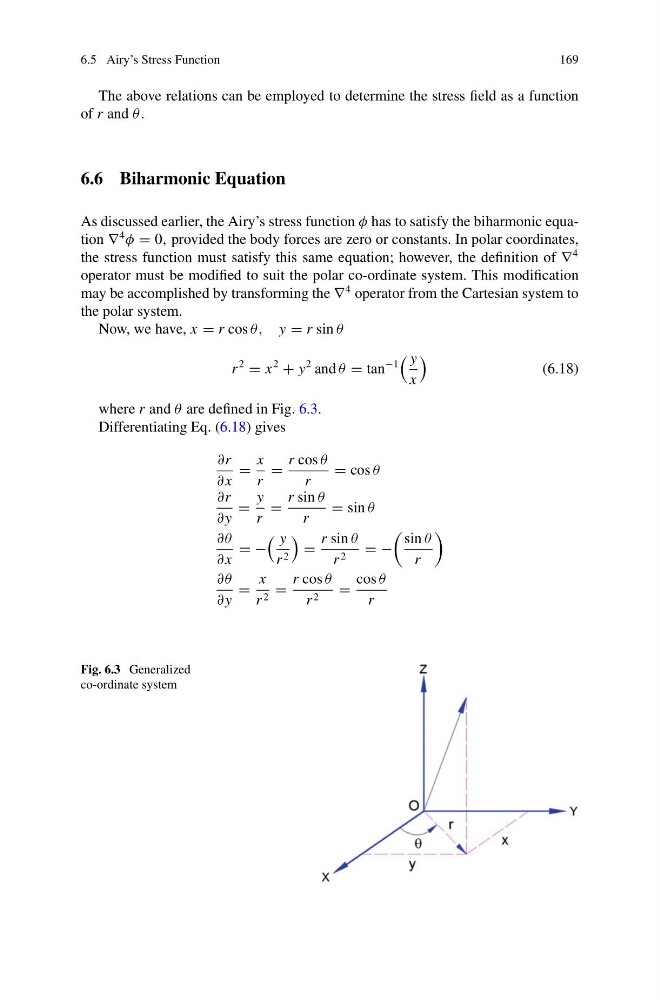
where r and θ are defined in Fig. 6.3.
Differentiating Eq. (6.18) gives
∂r
∂ x
=
x
r
=
r cos θ
r
= cos θ
∂r
∂ y
=
y
r
=
r sin θ
r
= sin θ
∂θ
∂ x
= −
y
r 2
=
r sin θ
r 2 = −
sin θ
r
∂θ
∂ y
=
x
r 2 =
r cos θ
r 2 =
cos θ
r
Fig. 6.3 Generalized
co-ordinate system
169
The above relations can be employed to determine the stress field as a function
of r and θ .
6.6 Biharmonic Equation
As discussed earlier, the Airy’s stress function φ has to satisfy the biharmonic equation ∇
4
φ = 0, provided the body forces are zero or constants. In polar coordinates,
the stress function must satisfy this same equation; however, the definition of ∇
4
operator must be modified to suit the polar co-ordinate system. This modification
may be accomplished by transforming the ∇
4 operator from the Cartesian system to
the polar system.
Now, we have, x = r cos θ, y = r sin θ
r
2
= x
2
+ y
2 and θ = tan
−1
y
x
(6.18)
where r and θ are defined in Fig. 6.3.
Differentiating Eq. (6.18) gives
∂r
∂ x
=
x
r
=
r cos θ
r
= cos θ
∂r
∂ y
=
y
r
=
r sin θ
r
= sin θ
∂θ
∂ x
= −
y
r 2
=
r sin θ
r 2 = −
sin θ
r
∂θ
∂ y
=
x
r 2 =
r cos θ
r 2 =
cos θ
r
Fig. 6.3 Generalized
co-ordinate system