

168
6 Two-Dimensional Problems in Elasticity …
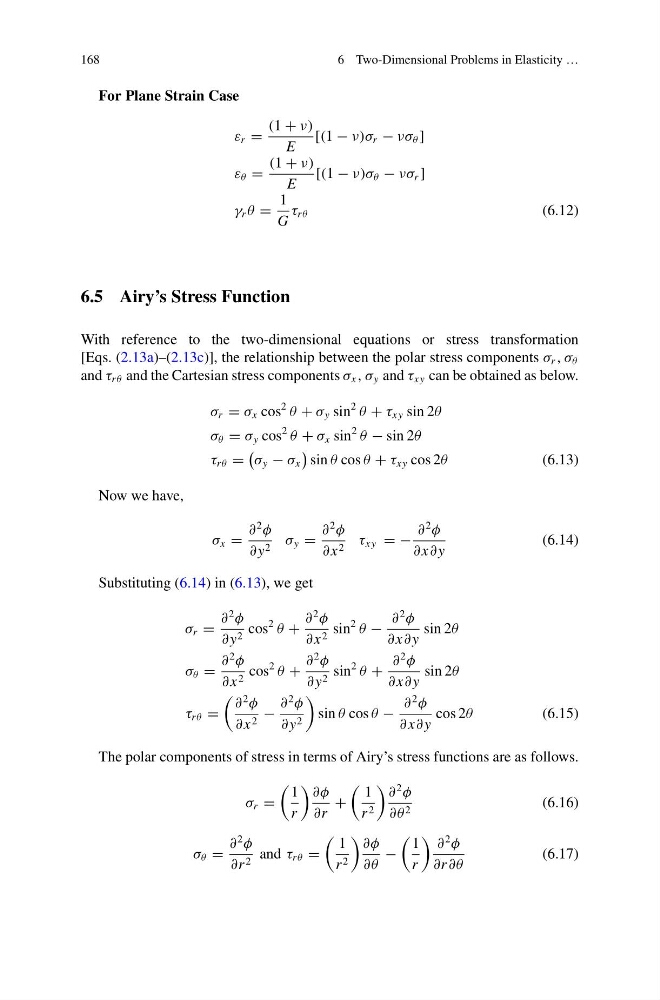
For Plane Strain Case
ε r =
(1 + ν)
E
[(1 − ν)σ r − νσ θ ]
ε θ =
(1 + ν)
E
[(1 − ν)σ θ − νσ r ]
γ r θ =
1
G
τ r θ
(6.12)
6.5 Airy’s Stress Function
With reference to the two-dimensional equations or stress transformation
[Eqs. (2.13a)–(2.13c)], the relationship between the polar stress components σ r , σ θ
and τ r θ and the Cartesian stress components σ x , σ y and τ xy can be obtained as below.
σ r = σ x cos
2
θ + σ y sin
2
θ + τ xy sin 2θ
σ θ = σ y cos
2
θ + σ x sin
2
θ − sin 2θ
τ r θ =
σ y − σ x
sin θ cos θ + τ xy cos 2θ
(6.13)
Now we have,
σ x =
∂
2
φ
∂ y 2 σ y =
∂
2
φ
∂ x 2 τ xy = −
∂
2
φ
∂ x∂ y
(6.14)
Substituting (6.14) in (6.13), we get
σ r =
∂
2
φ
∂ y 2 cos
2
θ +
∂
2
φ
∂ x 2 sin
2
θ −
∂
2
φ
∂ x∂ y
sin 2θ
σ θ =
∂
2
φ
∂ x 2 cos
2
θ +
∂
2
φ
∂ y 2 sin
2
θ +
∂
2
φ
∂ x∂ y
sin 2θ
τ r θ =
∂
2
φ
∂ x 2 −
∂
2
φ
∂ y 2
sin θ cos θ −
∂
2
φ
∂ x∂ y
cos 2θ
(6.15)
The polar components of stress in terms of Airy’s stress functions are as follows.
σ r =
1
r
∂φ
∂r
+
1
r 2
∂
2
φ
∂θ 2
(6.16)
σ θ =
∂
2
φ
∂r 2 and τ r θ =
1
r 2
∂φ
∂θ
−
1
r
∂
2
φ
∂r ∂θ
(6.17)
6 Two-Dimensional Problems in Elasticity …
For Plane Strain Case
ε r =
(1 + ν)
E
[(1 − ν)σ r − νσ θ ]
ε θ =
(1 + ν)
E
[(1 − ν)σ θ − νσ r ]
γ r θ =
1
G
τ r θ
(6.12)
6.5 Airy’s Stress Function
With reference to the two-dimensional equations or stress transformation
[Eqs. (2.13a)–(2.13c)], the relationship between the polar stress components σ r , σ θ
and τ r θ and the Cartesian stress components σ x , σ y and τ xy can be obtained as below.
σ r = σ x cos
2
θ + σ y sin
2
θ + τ xy sin 2θ
σ θ = σ y cos
2
θ + σ x sin
2
θ − sin 2θ
τ r θ =
σ y − σ x
sin θ cos θ + τ xy cos 2θ
(6.13)
Now we have,
σ x =
∂
2
φ
∂ y 2 σ y =
∂
2
φ
∂ x 2 τ xy = −
∂
2
φ
∂ x∂ y
(6.14)
Substituting (6.14) in (6.13), we get
σ r =
∂
2
φ
∂ y 2 cos
2
θ +
∂
2
φ
∂ x 2 sin
2
θ −
∂
2
φ
∂ x∂ y
sin 2θ
σ θ =
∂
2
φ
∂ x 2 cos
2
θ +
∂
2
φ
∂ y 2 sin
2
θ +
∂
2
φ
∂ x∂ y
sin 2θ
τ r θ =
∂
2
φ
∂ x 2 −
∂
2
φ
∂ y 2
sin θ cos θ −
∂
2
φ
∂ x∂ y
cos 2θ
(6.15)
The polar components of stress in terms of Airy’s stress functions are as follows.
σ r =
1
r
∂φ
∂r
+
1
r 2
∂
2
φ
∂θ 2
(6.16)
σ θ =
∂
2
φ
∂r 2 and τ r θ =
1
r 2
∂φ
∂θ
−
1
r
∂
2
φ
∂r ∂θ
(6.17)