

5.8 Bending of a Simply Supported Beam by a Distributed Loading …
151
d 3 = −d 5
L
2
−
2
5
h
2
=
3q
4h 3
L
2
h 2 −
2
5
∴ σ x =
3q
4h 3
L
2
h 2 −
2
5
y −
3q
4h 3
x
2 y −
2
3
y
3
σ y = −
q
2
+
3q
4h
y −
q
4h 3 y
3
τ xy = −
3q
4h
x +
3q
4h 3 x y
2
Now, I =
1×(2h)
3
12
=
8h
3
12
=
2
3
h
3
where I = Moment of inertia of the unit width beam.
∴ σ x =
q
2I
L
2
− x
2
y +
q
I
y
3
3
−
h
2 y
5
(5.47)
σ y = −
q
2I
y
3
3
− h
2 y +
2
3
h
3
(5.48)
τ xy = −
q
2I
h
2
− y
2
x
(5.49)
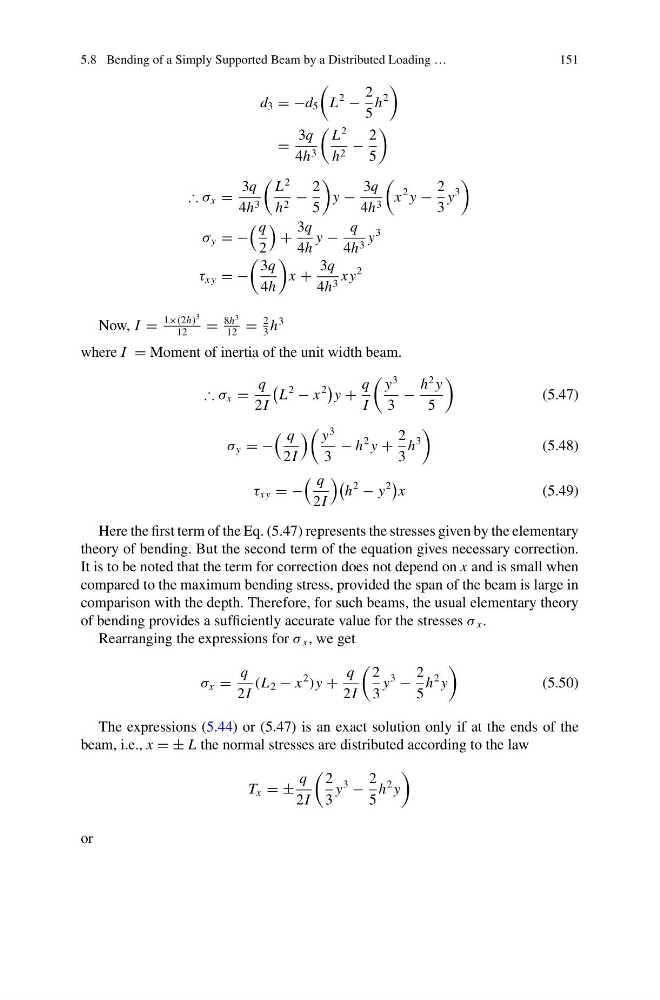
Here the first term of the Eq. (5.47) represents the stresses given by the elementary
theory of bending. But the second term of the equation gives necessary correction.
It is to be noted that the term for correction does not depend on x and is small when
compared to the maximum bending stress, provided the span of the beam is large in
comparison with the depth. Therefore, for such beams, the usual elementary theory
of bending provides a sufficiently accurate value for the stresses σ x .
Rearranging the expressions for σ x , we get
σ x =
q
2I
(L 2 − x
2
)y +
q
2I
2
3
y
3
−
2
5
h
2 y
(5.50)
The expressions (5.44) or (5.47) is an exact solution only if at the ends of the
beam, i.e., x = ± L the normal stresses are distributed according to the law
T x = ±
q
2I
2
3
y
3
−
2
5
h
2 y
or
151
d 3 = −d 5
L
2
−
2
5
h
2
=
3q
4h 3
L
2
h 2 −
2
5
∴ σ x =
3q
4h 3
L
2
h 2 −
2
5
y −
3q
4h 3
x
2 y −
2
3
y
3
σ y = −
q
2
+
3q
4h
y −
q
4h 3 y
3
τ xy = −
3q
4h
x +
3q
4h 3 x y
2
Now, I =
1×(2h)
3
12
=
8h
3
12
=
2
3
h
3
where I = Moment of inertia of the unit width beam.
∴ σ x =
q
2I
L
2
− x
2
y +
q
I
y
3
3
−
h
2 y
5
(5.47)
σ y = −
q
2I
y
3
3
− h
2 y +
2
3
h
3
(5.48)
τ xy = −
q
2I
h
2
− y
2
x
(5.49)
Here the first term of the Eq. (5.47) represents the stresses given by the elementary
theory of bending. But the second term of the equation gives necessary correction.
It is to be noted that the term for correction does not depend on x and is small when
compared to the maximum bending stress, provided the span of the beam is large in
comparison with the depth. Therefore, for such beams, the usual elementary theory
of bending provides a sufficiently accurate value for the stresses σ x .
Rearranging the expressions for σ x , we get
σ x =
q
2I
(L 2 − x
2
)y +
q
2I
2
3
y
3
−
2
5
h
2 y
(5.50)
The expressions (5.44) or (5.47) is an exact solution only if at the ends of the
beam, i.e., x = ± L the normal stresses are distributed according to the law
T x = ±
q
2I
2
3
y
3
−
2
5
h
2 y
or