

130
5 Two-Dimensional Problems in Cartesian Co-ordinate System
∂σ x
∂ x
+
∂τ xy
∂ y
+ F x = 0
(5.11)
∂σ y
∂ y
+
∂τ xy
∂ x
+ F y = 0
(5.12)
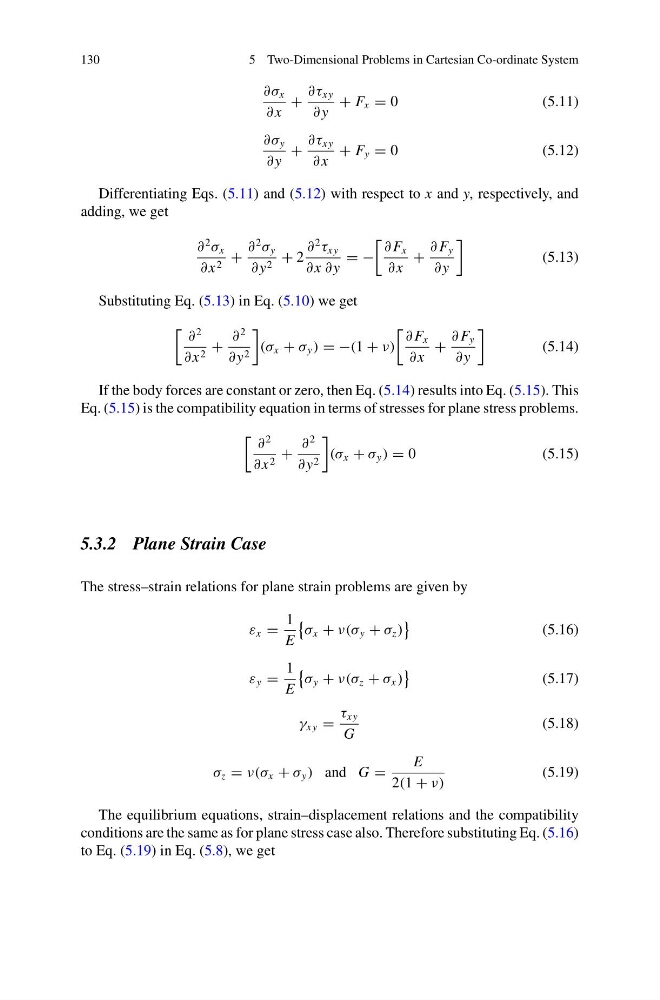
Differentiating Eqs. (5.11) and (5.12) with respect to x and y, respectively, and
adding, we get
∂
2
σ x
∂ x 2 +
∂
2
σ y
∂ y 2 + 2
∂
2
τ xy
∂ x ∂ y
= −
∂ F x
∂ x
+
∂ F y
∂ y
(5.13)
Substituting Eq. (5.13) in Eq. (5.10) we get
∂
2
∂ x 2 +
∂
2
∂ y 2
(σ x + σ y ) = −(1 + ν)
∂ F x
∂ x
+
∂ F y
∂ y
(5.14)
If the body forces are constant or zero, then Eq. (5.14) results into Eq. (5.15). This
Eq. (5.15) is the compatibility equation in terms of stresses for plane stress problems.
∂
2
∂ x 2 +
∂
2
∂ y 2
(σ x + σ y ) = 0
(5.15)
5.3.2 Plane Strain Case
The stress–strain relations for plane strain problems are given by
ε x =
1
E
σ x + ν(σ y + σ z )
(5.16)
ε y =
1
E
σ y + ν(σ z + σ x )
(5.17)
γ xy =
τ xy
G
(5.18)
σ z = ν(σ x + σ y ) and G =
E
2(1 + ν)
(5.19)
The equilibrium equations, strain–displacement relations and the compatibility
conditions are the same as for plane stress case also. Therefore substituting Eq. (5.16)
to Eq. (5.19) in Eq. (5.8), we get
5 Two-Dimensional Problems in Cartesian Co-ordinate System
∂σ x
∂ x
+
∂τ xy
∂ y
+ F x = 0
(5.11)
∂σ y
∂ y
+
∂τ xy
∂ x
+ F y = 0
(5.12)
Differentiating Eqs. (5.11) and (5.12) with respect to x and y, respectively, and
adding, we get
∂
2
σ x
∂ x 2 +
∂
2
σ y
∂ y 2 + 2
∂
2
τ xy
∂ x ∂ y
= −
∂ F x
∂ x
+
∂ F y
∂ y
(5.13)
Substituting Eq. (5.13) in Eq. (5.10) we get
∂
2
∂ x 2 +
∂
2
∂ y 2
(σ x + σ y ) = −(1 + ν)
∂ F x
∂ x
+
∂ F y
∂ y
(5.14)
If the body forces are constant or zero, then Eq. (5.14) results into Eq. (5.15). This
Eq. (5.15) is the compatibility equation in terms of stresses for plane stress problems.
∂
2
∂ x 2 +
∂
2
∂ y 2
(σ x + σ y ) = 0
(5.15)
5.3.2 Plane Strain Case
The stress–strain relations for plane strain problems are given by
ε x =
1
E
σ x + ν(σ y + σ z )
(5.16)
ε y =
1
E
σ y + ν(σ z + σ x )
(5.17)
γ xy =
τ xy
G
(5.18)
σ z = ν(σ x + σ y ) and G =
E
2(1 + ν)
(5.19)
The equilibrium equations, strain–displacement relations and the compatibility
conditions are the same as for plane stress case also. Therefore substituting Eq. (5.16)
to Eq. (5.19) in Eq. (5.8), we get