

114
4 Stress–Strain Relations
(a)
(b)
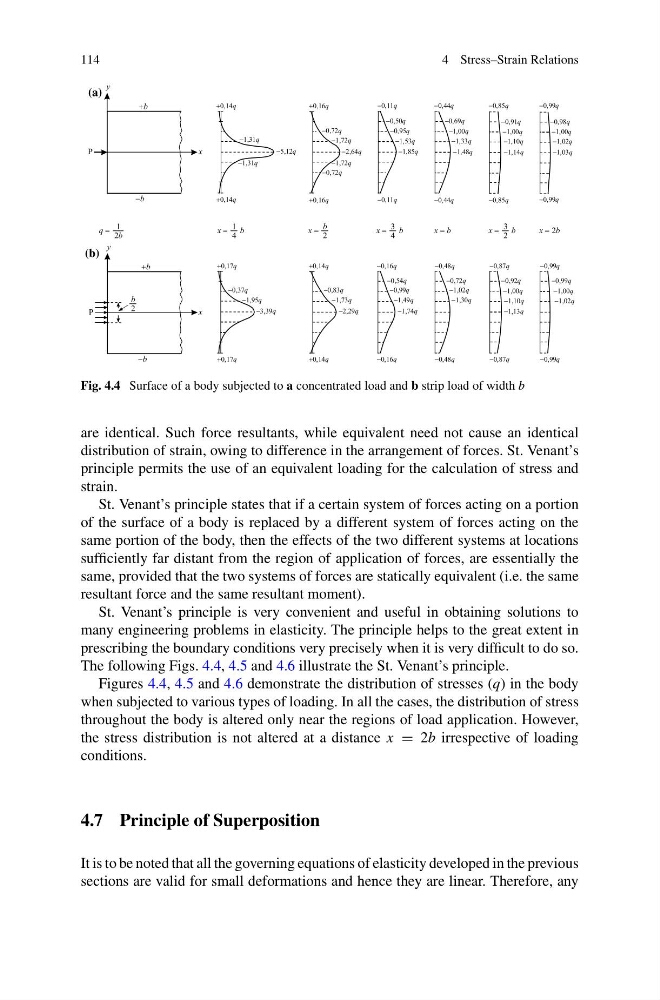
Fig. 4.4 Surface of a body subjected to a concentrated load and b strip load of width b
are identical. Such force resultants, while equivalent need not cause an identical
distribution of strain, owing to difference in the arrangement of forces. St. Venant’s
principle permits the use of an equivalent loading for the calculation of stress and
strain.
St. Venant’s principle states that if a certain system of forces acting on a portion
of the surface of a body is replaced by a different system of forces acting on the
same portion of the body, then the effects of the two different systems at locations
sufficiently far distant from the region of application of forces, are essentially the
same, provided that the two systems of forces are statically equivalent (i.e. the same
resultant force and the same resultant moment).
St. Venant’s principle is very convenient and useful in obtaining solutions to
many engineering problems in elasticity. The principle helps to the great extent in
prescribing the boundary conditions very precisely when it is very difficult to do so.
The following Figs. 4.4, 4.5 and 4.6 illustrate the St. Venant’s principle.
Figures 4.4, 4.5 and 4.6 demonstrate the distribution of stresses (q) in the body
when subjected to various types of loading. In all the cases, the distribution of stress
throughout the body is altered only near the regions of load application. However,
the stress distribution is not altered at a distance x = 2b irrespective of loading
conditions.
4.7 Principle of Superposition
It is to be noted that all the governing equations of elasticity developed in the previous
sections are valid for small deformations and hence they are linear. Therefore, any
4 Stress–Strain Relations
(a)
(b)
Fig. 4.4 Surface of a body subjected to a concentrated load and b strip load of width b
are identical. Such force resultants, while equivalent need not cause an identical
distribution of strain, owing to difference in the arrangement of forces. St. Venant’s
principle permits the use of an equivalent loading for the calculation of stress and
strain.
St. Venant’s principle states that if a certain system of forces acting on a portion
of the surface of a body is replaced by a different system of forces acting on the
same portion of the body, then the effects of the two different systems at locations
sufficiently far distant from the region of application of forces, are essentially the
same, provided that the two systems of forces are statically equivalent (i.e. the same
resultant force and the same resultant moment).
St. Venant’s principle is very convenient and useful in obtaining solutions to
many engineering problems in elasticity. The principle helps to the great extent in
prescribing the boundary conditions very precisely when it is very difficult to do so.
The following Figs. 4.4, 4.5 and 4.6 illustrate the St. Venant’s principle.
Figures 4.4, 4.5 and 4.6 demonstrate the distribution of stresses (q) in the body
when subjected to various types of loading. In all the cases, the distribution of stress
throughout the body is altered only near the regions of load application. However,
the stress distribution is not altered at a distance x = 2b irrespective of loading
conditions.
4.7 Principle of Superposition
It is to be noted that all the governing equations of elasticity developed in the previous
sections are valid for small deformations and hence they are linear. Therefore, any