

4.5 Boundary Conditions
113
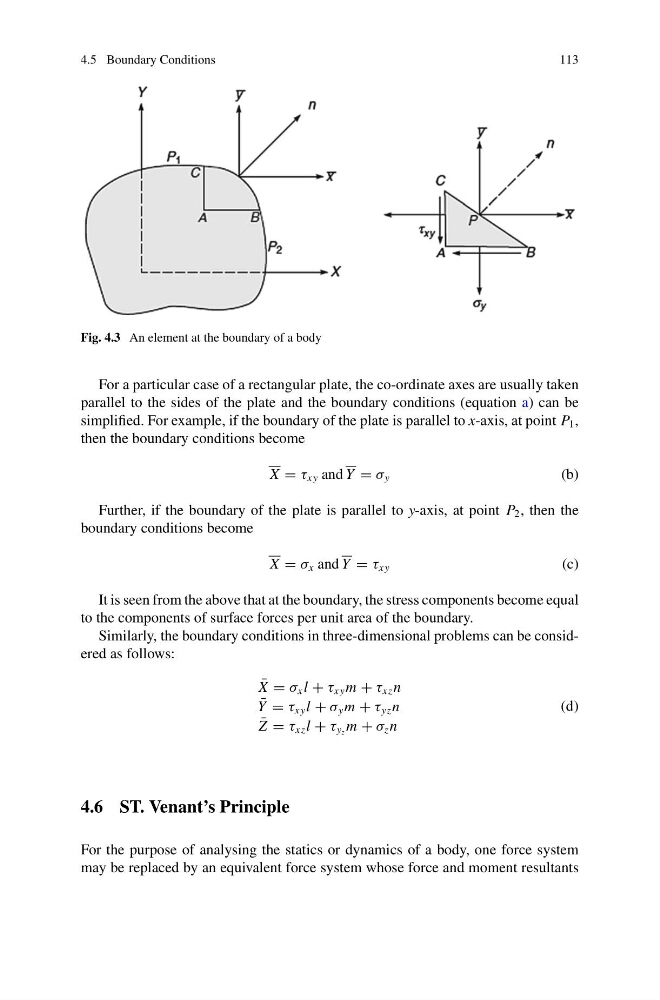
Fig. 4.3 An element at the boundary of a body
For a particular case of a rectangular plate, the co-ordinate axes are usually taken
parallel to the sides of the plate and the boundary conditions (equation a) can be
simplified. For example, if the boundary of the plate is parallel to x-axis, at point P 1 ,
then the boundary conditions become
X = τ xy and Y = σ y
(b)
Further, if the boundary of the plate is parallel to y-axis, at point P 2 , then the
boundary conditions become
X = σ x and Y = τ xy
(c)
It is seen from the above that at the boundary, the stress components become equal
to the components of surface forces per unit area of the boundary.
Similarly, the boundary conditions in three-dimensional problems can be considered as follows:
¯
X = σ x l + τ xy m + τ xz n
¯
Y = τ xy l + σ y m + τ yz n
¯
Z = τ xz l + τ y z m + σ z n
(d)
4.6 ST. Venant’s Principle
For the purpose of analysing the statics or dynamics of a body, one force system
may be replaced by an equivalent force system whose force and moment resultants
113
Fig. 4.3 An element at the boundary of a body
For a particular case of a rectangular plate, the co-ordinate axes are usually taken
parallel to the sides of the plate and the boundary conditions (equation a) can be
simplified. For example, if the boundary of the plate is parallel to x-axis, at point P 1 ,
then the boundary conditions become
X = τ xy and Y = σ y
(b)
Further, if the boundary of the plate is parallel to y-axis, at point P 2 , then the
boundary conditions become
X = σ x and Y = τ xy
(c)
It is seen from the above that at the boundary, the stress components become equal
to the components of surface forces per unit area of the boundary.
Similarly, the boundary conditions in three-dimensional problems can be considered as follows:
¯
X = σ x l + τ xy m + τ xz n
¯
Y = τ xy l + σ y m + τ yz n
¯
Z = τ xz l + τ y z m + σ z n
(d)
4.6 ST. Venant’s Principle
For the purpose of analysing the statics or dynamics of a body, one force system
may be replaced by an equivalent force system whose force and moment resultants