

4.4 Observer Space
63
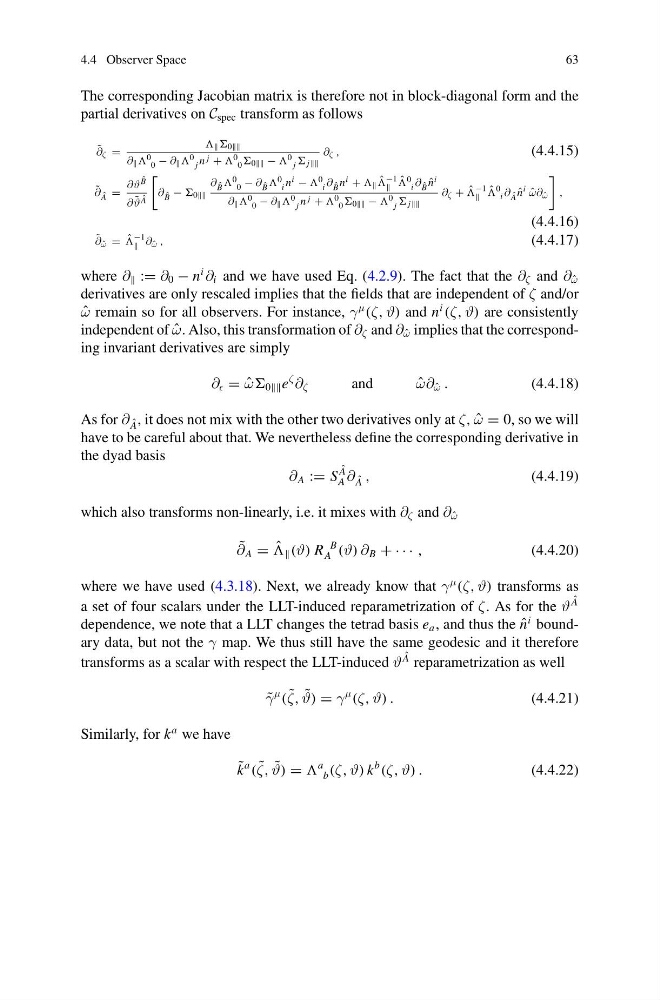
The corresponding Jacobian matrix is therefore not in block-diagonal form and the
partial derivatives on C spec transform as follows
˜
∂ ζ =
0
∂ 0
0 − ∂ 0
j n j + 0
0 0 − 0
j j
∂ ζ ,
(4.4.15)
˜
∂ ˆ
A =
∂ϑ
ˆ
B
∂ ˜
ϑ
ˆ
A
∂ ˆ
B − 0
∂ ˆ
B 0
0 − ∂ ˆ
B 0
i n i − 0
i ∂ ˆ
B n i + ˆ
−1
ˆ
0
i ∂ ˆ
B ˆ
n i
∂ 0
0 − ∂ 0
j n j + 0
0 0 − 0
j j
∂ ζ + ˆ
−1
ˆ
0
i ∂ ˆ
A ˆ
n
i ˆ
ω∂ ˆ
ω
,
(4.4.16)
˜
∂ ˆ
ω = ˆ
−1
∂ ˆ
ω ,
(4.4.17)
where ∂ := ∂ 0 − n
i
∂ i and we have used Eq. (4.2.9). The fact that the ∂ ζ and ∂ ˆ
ω
derivatives are only rescaled implies that the fields that are independent of ζ and/or
ˆ
ω remain so for all observers. For instance, γ
μ
(ζ, ϑ) and n
i
(ζ, ϑ) are consistently
independent of ˆ
ω. Also, this transformation of ∂ ζ and ∂ ˆ
ω implies that the corresponding invariant derivatives are simply
∂ = ˆ
ω 0 e
ζ
∂ ζ
and
ˆ
ω∂ ˆ
ω .
(4.4.18)
As for ∂ ˆ
A , it does not mix with the other two derivatives only at ζ, ˆ
ω = 0, so we will
have to be careful about that. We nevertheless define the corresponding derivative in
the dyad basis
∂ A := S
ˆ
A
A ∂ ˆ
A ,
(4.4.19)
which also transforms non-linearly, i.e. it mixes with ∂ ζ and ∂ ˆ
ω
˜
∂ A = ˆ
(ϑ) R
B
A (ϑ) ∂ B + · · · ,
(4.4.20)
where we have used (4.3.18). Next, we already know that γ
μ
(ζ, ϑ) transforms as
a set of four scalars under the LLT-induced reparametrization of ζ. As for the ϑ
ˆ
A
dependence, we note that a LLT changes the tetrad basis e a , and thus the ˆ
n
i boundary data, but not the γ map. We thus still have the same geodesic and it therefore
transforms as a scalar with respect the LLT-induced ϑ
ˆ
A reparametrization as well
˜
γ
μ
( ˜
ζ, ˜
ϑ) = γ
μ
(ζ, ϑ) .
(4.4.21)
Similarly, for k
a we have
˜
k
a
( ˜
ζ, ˜
ϑ) =
a
b (ζ, ϑ) k
b
(ζ, ϑ) .
(4.4.22)
63
The corresponding Jacobian matrix is therefore not in block-diagonal form and the
partial derivatives on C spec transform as follows
˜
∂ ζ =
0
∂ 0
0 − ∂ 0
j n j + 0
0 0 − 0
j j
∂ ζ ,
(4.4.15)
˜
∂ ˆ
A =
∂ϑ
ˆ
B
∂ ˜
ϑ
ˆ
A
∂ ˆ
B − 0
∂ ˆ
B 0
0 − ∂ ˆ
B 0
i n i − 0
i ∂ ˆ
B n i + ˆ
−1
ˆ
0
i ∂ ˆ
B ˆ
n i
∂ 0
0 − ∂ 0
j n j + 0
0 0 − 0
j j
∂ ζ + ˆ
−1
ˆ
0
i ∂ ˆ
A ˆ
n
i ˆ
ω∂ ˆ
ω
,
(4.4.16)
˜
∂ ˆ
ω = ˆ
−1
∂ ˆ
ω ,
(4.4.17)
where ∂ := ∂ 0 − n
i
∂ i and we have used Eq. (4.2.9). The fact that the ∂ ζ and ∂ ˆ
ω
derivatives are only rescaled implies that the fields that are independent of ζ and/or
ˆ
ω remain so for all observers. For instance, γ
μ
(ζ, ϑ) and n
i
(ζ, ϑ) are consistently
independent of ˆ
ω. Also, this transformation of ∂ ζ and ∂ ˆ
ω implies that the corresponding invariant derivatives are simply
∂ = ˆ
ω 0 e
ζ
∂ ζ
and
ˆ
ω∂ ˆ
ω .
(4.4.18)
As for ∂ ˆ
A , it does not mix with the other two derivatives only at ζ, ˆ
ω = 0, so we will
have to be careful about that. We nevertheless define the corresponding derivative in
the dyad basis
∂ A := S
ˆ
A
A ∂ ˆ
A ,
(4.4.19)
which also transforms non-linearly, i.e. it mixes with ∂ ζ and ∂ ˆ
ω
˜
∂ A = ˆ
(ϑ) R
B
A (ϑ) ∂ B + · · · ,
(4.4.20)
where we have used (4.3.18). Next, we already know that γ
μ
(ζ, ϑ) transforms as
a set of four scalars under the LLT-induced reparametrization of ζ. As for the ϑ
ˆ
A
dependence, we note that a LLT changes the tetrad basis e a , and thus the ˆ
n
i boundary data, but not the γ map. We thus still have the same geodesic and it therefore
transforms as a scalar with respect the LLT-induced ϑ
ˆ
A reparametrization as well
˜
γ
μ
( ˜
ζ, ˜
ϑ) = γ
μ
(ζ, ϑ) .
(4.4.21)
Similarly, for k
a we have
˜
k
a
( ˜
ζ, ˜
ϑ) =
a
b (ζ, ϑ) k
b
(ζ, ϑ) .
(4.4.22)