

62
4 Observer Space-Time Formalism
however, an important disadvantage in this approach. The fact that the angles are
part of a coordinate system on M implies that this formalism cannot handle caustic singularities, i.e. the case where two light-like geodesics based at the observer
position cross each other at some other point down the past light-cone. Indeed, being
parametrized by the coordinate angles, their crossing implies a coordinate singularity
and thus the breakdown of the coordinate system.
In contrast, with the 3-cylinder parametrization one works directly with the
observed angles, by construction, and the presence of caustics does not lead to singularities. Consider for instance two light rays with observed angles ϑ
ˆ
A and ϑ
ˆ
A
crossing each other at respective log-redshifts ζ and ζ
, i.e. the case
γ
μ
(ζ, ϑ) = γ
μ
(ζ
, ϑ
) .
(4.4.13)
In particular, note that this is already the case for ζ = 0, where all angles are sent
to the same space-time point ˆ
P. The possibility of having (4.4.13) simply means
that the γ map is not injective, not that it is singular. The important difference is
that the space-time coordinates, where the singularity occurs, are not the parameters
with respect to which we solve our equations, but rather the parameters of the target
space. One must therefore simply keep in mind that two different points on C may
correspond to the same point on the light-cone γ(C) ⊂ M. As already discussed
in Sect. 4.2, the only limitation for the applicability of our formalism comes from
the choice of the redshift parametrization, which is ill-defined at low ζ, where the
Hubble expansion and observer velocities are comparable. Indeed, in the specific
case 0 = 0, the geodesic equations (4.2.8) and (4.2.9) do become singular, and
thus so does the γ
μ
(ζ, ϑ) function. In these cases, one should choose another λparametrization (see for instance footnote 1).
We therefore stress again that it is crucial not to mistake the space C for a submanifold of M, because this would mean that γ is a coordinate transformation on
that submanifold, which must therefore be bijective. Rather, C is a distinct space,
parametrized by the coordinates ζ and ϑ
ˆ
A , that is mapped to the topologically different γ(C) ⊂ M through a non-injective map γ.
4.4.3 Induced Coordinate Transformations on C from LLTs
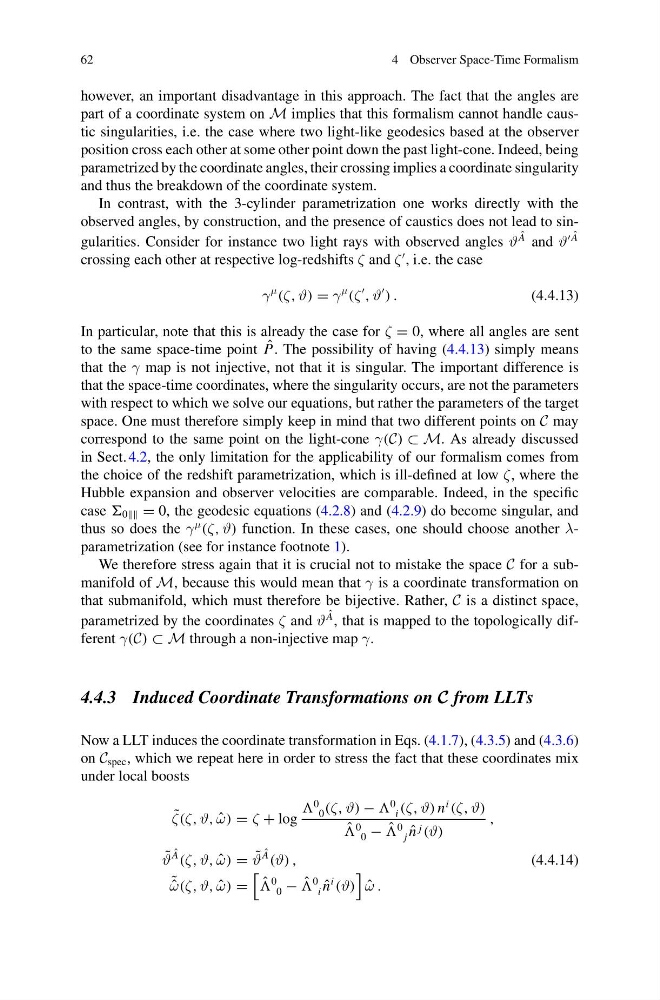
Now a LLT induces the coordinate transformation in Eqs. (4.1.7), (4.3.5) and (4.3.6)
on C spec , which we repeat here in order to stress the fact that these coordinates mix
under local boosts
˜
ζ(ζ, ϑ, ˆ
ω) = ζ + log
0
0 (ζ, ϑ) −
0
i (ζ, ϑ) n
i
(ζ, ϑ)
ˆ
0
0 − ˆ
0
j ˆ
n j (ϑ)
,
˜
ϑ
ˆ
A
(ζ, ϑ, ˆ
ω) = ˜
ϑ
ˆ
A
(ϑ) ,
(4.4.14)
˜ ˆ
ω(ζ, ϑ, ˆ
ω) =
ˆ
0
0 − ˆ
0
i ˆ
n
i
(ϑ)
ˆ
ω .
4 Observer Space-Time Formalism
however, an important disadvantage in this approach. The fact that the angles are
part of a coordinate system on M implies that this formalism cannot handle caustic singularities, i.e. the case where two light-like geodesics based at the observer
position cross each other at some other point down the past light-cone. Indeed, being
parametrized by the coordinate angles, their crossing implies a coordinate singularity
and thus the breakdown of the coordinate system.
In contrast, with the 3-cylinder parametrization one works directly with the
observed angles, by construction, and the presence of caustics does not lead to singularities. Consider for instance two light rays with observed angles ϑ
ˆ
A and ϑ
ˆ
A
crossing each other at respective log-redshifts ζ and ζ
, i.e. the case
γ
μ
(ζ, ϑ) = γ
μ
(ζ
, ϑ
) .
(4.4.13)
In particular, note that this is already the case for ζ = 0, where all angles are sent
to the same space-time point ˆ
P. The possibility of having (4.4.13) simply means
that the γ map is not injective, not that it is singular. The important difference is
that the space-time coordinates, where the singularity occurs, are not the parameters
with respect to which we solve our equations, but rather the parameters of the target
space. One must therefore simply keep in mind that two different points on C may
correspond to the same point on the light-cone γ(C) ⊂ M. As already discussed
in Sect. 4.2, the only limitation for the applicability of our formalism comes from
the choice of the redshift parametrization, which is ill-defined at low ζ, where the
Hubble expansion and observer velocities are comparable. Indeed, in the specific
case 0 = 0, the geodesic equations (4.2.8) and (4.2.9) do become singular, and
thus so does the γ
μ
(ζ, ϑ) function. In these cases, one should choose another λparametrization (see for instance footnote 1).
We therefore stress again that it is crucial not to mistake the space C for a submanifold of M, because this would mean that γ is a coordinate transformation on
that submanifold, which must therefore be bijective. Rather, C is a distinct space,
parametrized by the coordinates ζ and ϑ
ˆ
A , that is mapped to the topologically different γ(C) ⊂ M through a non-injective map γ.
4.4.3 Induced Coordinate Transformations on C from LLTs
Now a LLT induces the coordinate transformation in Eqs. (4.1.7), (4.3.5) and (4.3.6)
on C spec , which we repeat here in order to stress the fact that these coordinates mix
under local boosts
˜
ζ(ζ, ϑ, ˆ
ω) = ζ + log
0
0 (ζ, ϑ) −
0
i (ζ, ϑ) n
i
(ζ, ϑ)
ˆ
0
0 − ˆ
0
j ˆ
n j (ϑ)
,
˜
ϑ
ˆ
A
(ζ, ϑ, ˆ
ω) = ˜
ϑ
ˆ
A
(ϑ) ,
(4.4.14)
˜ ˆ
ω(ζ, ϑ, ˆ
ω) =
ˆ
0
0 − ˆ
0
i ˆ
n
i
(ϑ)
ˆ
ω .