

40
3 Mathematical Framework
S = −
dλ
m
−g μν (γ) ∂ λ γ μ ∂ λ γ ν + q A μ (γ) ∂ λ γ
μ
,
(3.3.15)
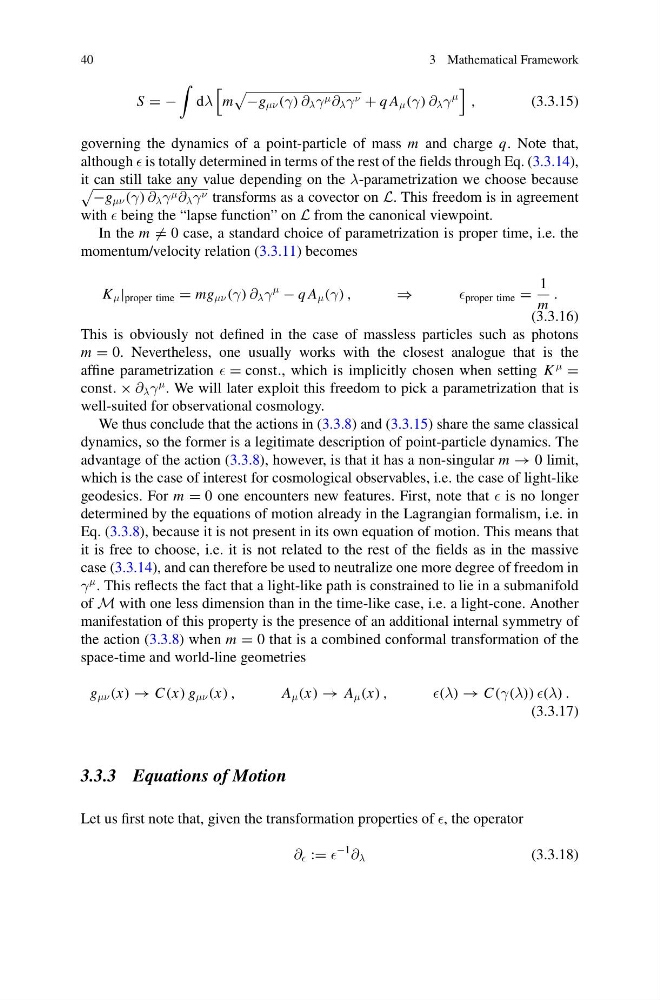
governing the dynamics of a point-particle of mass m and charge q. Note that,
although is totally determined in terms of the rest of the fields through Eq. (3.3.14),
it can still take any value depending on the λ-parametrization we choose because
−g μν (γ) ∂ λ γ μ ∂ λ γ ν transforms as a covector on L. This freedom is in agreement
with being the “lapse function” on L from the canonical viewpoint.
In the m = 0 case, a standard choice of parametrization is proper time, i.e. the
momentum/velocity relation (3.3.11) becomes
K μ | proper time = mg μν (γ) ∂ λ γ
μ
− q A μ (γ) ,
⇒
proper time =
1
m
.
(3.3.16)
This is obviously not defined in the case of massless particles such as photons
m = 0. Nevertheless, one usually works with the closest analogue that is the
affine parametrization = const., which is implicitly chosen when setting K
μ
=
const. × ∂ λ γ
μ . We will later exploit this freedom to pick a parametrization that is
well-suited for observational cosmology.
We thus conclude that the actions in (3.3.8) and (3.3.15) share the same classical
dynamics, so the former is a legitimate description of point-particle dynamics. The
advantage of the action (3.3.8), however, is that it has a non-singular m → 0 limit,
which is the case of interest for cosmological observables, i.e. the case of light-like
geodesics. For m = 0 one encounters new features. First, note that is no longer
determined by the equations of motion already in the Lagrangian formalism, i.e. in
Eq. (3.3.8), because it is not present in its own equation of motion. This means that
it is free to choose, i.e. it is not related to the rest of the fields as in the massive
case (3.3.14), and can therefore be used to neutralize one more degree of freedom in
γ
μ . This reflects the fact that a light-like path is constrained to lie in a submanifold
of M with one less dimension than in the time-like case, i.e. a light-cone. Another
manifestation of this property is the presence of an additional internal symmetry of
the action (3.3.8) when m = 0 that is a combined conformal transformation of the
space-time and world-line geometries
g μν (x) → C(x) g μν (x) ,
A μ (x) → A μ (x) ,
(λ) → C(γ(λ)) (λ) .
(3.3.17)
3.3.3 Equations of Motion
Let us first note that, given the transformation properties of , the operator
∂ :=
−1
∂ λ
(3.3.18)
3 Mathematical Framework
S = −
dλ
m
−g μν (γ) ∂ λ γ μ ∂ λ γ ν + q A μ (γ) ∂ λ γ
μ
,
(3.3.15)
governing the dynamics of a point-particle of mass m and charge q. Note that,
although is totally determined in terms of the rest of the fields through Eq. (3.3.14),
it can still take any value depending on the λ-parametrization we choose because
−g μν (γ) ∂ λ γ μ ∂ λ γ ν transforms as a covector on L. This freedom is in agreement
with being the “lapse function” on L from the canonical viewpoint.
In the m = 0 case, a standard choice of parametrization is proper time, i.e. the
momentum/velocity relation (3.3.11) becomes
K μ | proper time = mg μν (γ) ∂ λ γ
μ
− q A μ (γ) ,
⇒
proper time =
1
m
.
(3.3.16)
This is obviously not defined in the case of massless particles such as photons
m = 0. Nevertheless, one usually works with the closest analogue that is the
affine parametrization = const., which is implicitly chosen when setting K
μ
=
const. × ∂ λ γ
μ . We will later exploit this freedom to pick a parametrization that is
well-suited for observational cosmology.
We thus conclude that the actions in (3.3.8) and (3.3.15) share the same classical
dynamics, so the former is a legitimate description of point-particle dynamics. The
advantage of the action (3.3.8), however, is that it has a non-singular m → 0 limit,
which is the case of interest for cosmological observables, i.e. the case of light-like
geodesics. For m = 0 one encounters new features. First, note that is no longer
determined by the equations of motion already in the Lagrangian formalism, i.e. in
Eq. (3.3.8), because it is not present in its own equation of motion. This means that
it is free to choose, i.e. it is not related to the rest of the fields as in the massive
case (3.3.14), and can therefore be used to neutralize one more degree of freedom in
γ
μ . This reflects the fact that a light-like path is constrained to lie in a submanifold
of M with one less dimension than in the time-like case, i.e. a light-cone. Another
manifestation of this property is the presence of an additional internal symmetry of
the action (3.3.8) when m = 0 that is a combined conformal transformation of the
space-time and world-line geometries
g μν (x) → C(x) g μν (x) ,
A μ (x) → A μ (x) ,
(λ) → C(γ(λ)) (λ) .
(3.3.17)
3.3.3 Equations of Motion
Let us first note that, given the transformation properties of , the operator
∂ :=
−1
∂ λ
(3.3.18)