

3.3 World-Line Fields
39
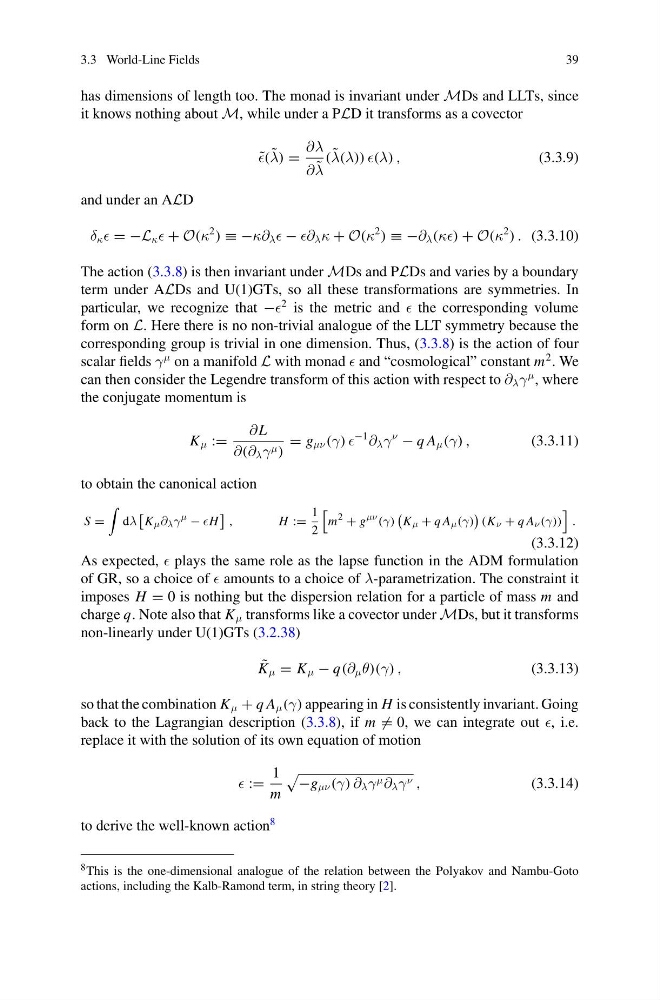
has dimensions of length too. The monad is invariant under MDs and LLTs, since
it knows nothing about M, while under a PLD it transforms as a covector
˜
( ˜
λ) =
∂λ
∂ ˜
λ
( ˜
λ(λ)) (λ) ,
(3.3.9)
and under an ALD
δ κ = −L κ + O(κ
2
) ≡ −κ∂ λ − ∂ λ κ + O(κ
2
) ≡ −∂ λ (κκ) + O(κ
2
) . (3.3.10)
The action (3.3.8) is then invariant under MDs and PLDs and varies by a boundary
term under ALDs and U(1)GTs, so all these transformations are symmetries. In
particular, we recognize that −
2 is the metric and the corresponding volume
form on L. Here there is no non-trivial analogue of the LLT symmetry because the
corresponding group is trivial in one dimension. Thus, (3.3.8) is the action of four
scalar fields γ
μ on a manifold L with monad and “cosmological” constant m
2 . We
can then consider the Legendre transform of this action with respect to ∂ λ γ
μ , where
the conjugate momentum is
K μ :=
∂ L
∂(∂ λ γ μ )
= g μν (γ)
−1
∂ λ γ
ν
− q A μ (γ) ,
(3.3.11)
to obtain the canonical action
S =
dλ
K μ ∂ λ γ
μ − H
,
H :=
1
2
m
2 + g
μν (γ)
K μ + q A μ (γ)
(K ν + q A ν (γ))
.
(3.3.12)
As expected, plays the same role as the lapse function in the ADM formulation
of GR, so a choice of amounts to a choice of λ-parametrization. The constraint it
imposes H = 0 is nothing but the dispersion relation for a particle of mass m and
charge q. Note also that K μ transforms like a covector under MDs, but it transforms
non-linearly under U(1)GTs (3.2.38)
˜
K μ = K μ − q(∂ μ θ)(γ) ,
(3.3.13)
so that the combination K μ + q A μ (γ) appearing in H is consistently invariant. Going
back to the Lagrangian description (3.3.8), if m = 0, we can integrate out , i.e.
replace it with the solution of its own equation of motion
:=
1
m
−g μν (γ) ∂ λ γ μ ∂ λ γ ν ,
(3.3.14)
to derive the well-known action
8
8 This is the one-dimensional analogue of the relation between the Polyakov and Nambu-Goto
actions, including the Kalb-Ramond term, in string theory [2].
39
has dimensions of length too. The monad is invariant under MDs and LLTs, since
it knows nothing about M, while under a PLD it transforms as a covector
˜
( ˜
λ) =
∂λ
∂ ˜
λ
( ˜
λ(λ)) (λ) ,
(3.3.9)
and under an ALD
δ κ = −L κ + O(κ
2
) ≡ −κ∂ λ − ∂ λ κ + O(κ
2
) ≡ −∂ λ (κκ) + O(κ
2
) . (3.3.10)
The action (3.3.8) is then invariant under MDs and PLDs and varies by a boundary
term under ALDs and U(1)GTs, so all these transformations are symmetries. In
particular, we recognize that −
2 is the metric and the corresponding volume
form on L. Here there is no non-trivial analogue of the LLT symmetry because the
corresponding group is trivial in one dimension. Thus, (3.3.8) is the action of four
scalar fields γ
μ on a manifold L with monad and “cosmological” constant m
2 . We
can then consider the Legendre transform of this action with respect to ∂ λ γ
μ , where
the conjugate momentum is
K μ :=
∂ L
∂(∂ λ γ μ )
= g μν (γ)
−1
∂ λ γ
ν
− q A μ (γ) ,
(3.3.11)
to obtain the canonical action
S =
dλ
K μ ∂ λ γ
μ − H
,
H :=
1
2
m
2 + g
μν (γ)
K μ + q A μ (γ)
(K ν + q A ν (γ))
.
(3.3.12)
As expected, plays the same role as the lapse function in the ADM formulation
of GR, so a choice of amounts to a choice of λ-parametrization. The constraint it
imposes H = 0 is nothing but the dispersion relation for a particle of mass m and
charge q. Note also that K μ transforms like a covector under MDs, but it transforms
non-linearly under U(1)GTs (3.2.38)
˜
K μ = K μ − q(∂ μ θ)(γ) ,
(3.3.13)
so that the combination K μ + q A μ (γ) appearing in H is consistently invariant. Going
back to the Lagrangian description (3.3.8), if m = 0, we can integrate out , i.e.
replace it with the solution of its own equation of motion
:=
1
m
−g μν (γ) ∂ λ γ μ ∂ λ γ ν ,
(3.3.14)
to derive the well-known action
8
8 This is the one-dimensional analogue of the relation between the Polyakov and Nambu-Goto
actions, including the Kalb-Ramond term, in string theory [2].