

24
3 Mathematical Framework
where the
C
c
ab := −2e
μ
a e
ν
b ∂ [μ e
c
ν]
(3.2.5)
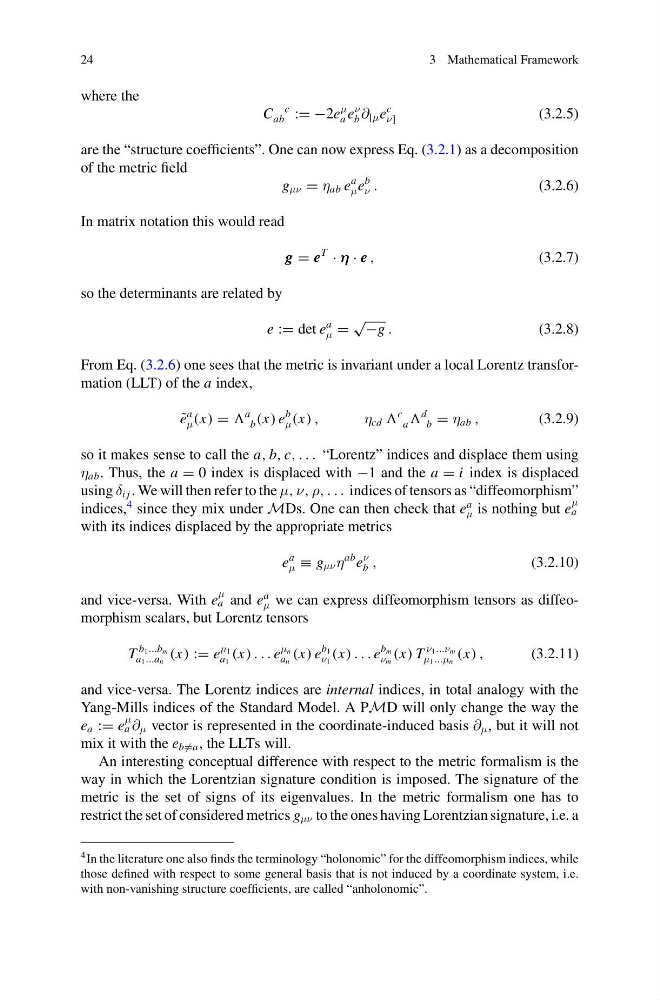
are the “structure coefficients”. One can now express Eq. (3.2.1) as a decomposition
of the metric field
g μν = η ab e
a
μ e
b
ν .
(3.2.6)
In matrix notation this would read
g = e
T
· η · e ,
(3.2.7)
so the determinants are related by
e := det e
a
μ =
√ −g .
(3.2.8)
From Eq. (3.2.6) one sees that the metric is invariant under a local Lorentz transformation (LLT) of the a index,
˜
e
a
μ (x) =
a
b (x) e
b
μ (x) ,
η cd
c
a
d
b = η ab ,
(3.2.9)
so it makes sense to call the a, b, c, . . . “Lorentz” indices and displace them using
η ab . Thus, the a = 0 index is displaced with −1 and the a = i index is displaced
using δ i j . We will then refer to the μ, ν, ρ, . . . indices of tensors as “diffeomorphism”
indices,
4 since they mix under MDs. One can then check that e
a
μ is nothing but e
μ
a
with its indices displaced by the appropriate metrics
e
a
μ ≡ g μν η
ab e
ν
b ,
(3.2.10)
and vice-versa. With e
μ
a and e
a
μ we can express diffeomorphism tensors as diffeomorphism scalars, but Lorentz tensors
T
b 1 ...b m
a 1 ...a n
(x) := e
μ 1
a 1
(x) . . . e
μ n
a n
(x) e
b 1
ν 1
(x) . . . e
b m
ν m
(x) T
ν 1 ...ν m
μ 1 ...μ n
(x) ,
(3.2.11)
and vice-versa. The Lorentz indices are internal indices, in total analogy with the
Yang-Mills indices of the Standard Model. A PMD will only change the way the
e a := e
μ
a ∂ μ vector is represented in the coordinate-induced basis ∂ μ , but it will not
mix it with the e b =a , the LLTs will.
An interesting conceptual difference with respect to the metric formalism is the
way in which the Lorentzian signature condition is imposed. The signature of the
metric is the set of signs of its eigenvalues. In the metric formalism one has to
restrict the set of considered metrics g μν to the ones having Lorentzian signature, i.e. a
4 In the literature one also finds the terminology “holonomic” for the diffeomorphism indices, while
those defined with respect to some general basis that is not induced by a coordinate system, i.e.
with non-vanishing structure coefficients, are called “anholonomic”.
3 Mathematical Framework
where the
C
c
ab := −2e
μ
a e
ν
b ∂ [μ e
c
ν]
(3.2.5)
are the “structure coefficients”. One can now express Eq. (3.2.1) as a decomposition
of the metric field
g μν = η ab e
a
μ e
b
ν .
(3.2.6)
In matrix notation this would read
g = e
T
· η · e ,
(3.2.7)
so the determinants are related by
e := det e
a
μ =
√ −g .
(3.2.8)
From Eq. (3.2.6) one sees that the metric is invariant under a local Lorentz transformation (LLT) of the a index,
˜
e
a
μ (x) =
a
b (x) e
b
μ (x) ,
η cd
c
a
d
b = η ab ,
(3.2.9)
so it makes sense to call the a, b, c, . . . “Lorentz” indices and displace them using
η ab . Thus, the a = 0 index is displaced with −1 and the a = i index is displaced
using δ i j . We will then refer to the μ, ν, ρ, . . . indices of tensors as “diffeomorphism”
indices,
4 since they mix under MDs. One can then check that e
a
μ is nothing but e
μ
a
with its indices displaced by the appropriate metrics
e
a
μ ≡ g μν η
ab e
ν
b ,
(3.2.10)
and vice-versa. With e
μ
a and e
a
μ we can express diffeomorphism tensors as diffeomorphism scalars, but Lorentz tensors
T
b 1 ...b m
a 1 ...a n
(x) := e
μ 1
a 1
(x) . . . e
μ n
a n
(x) e
b 1
ν 1
(x) . . . e
b m
ν m
(x) T
ν 1 ...ν m
μ 1 ...μ n
(x) ,
(3.2.11)
and vice-versa. The Lorentz indices are internal indices, in total analogy with the
Yang-Mills indices of the Standard Model. A PMD will only change the way the
e a := e
μ
a ∂ μ vector is represented in the coordinate-induced basis ∂ μ , but it will not
mix it with the e b =a , the LLTs will.
An interesting conceptual difference with respect to the metric formalism is the
way in which the Lorentzian signature condition is imposed. The signature of the
metric is the set of signs of its eigenvalues. In the metric formalism one has to
restrict the set of considered metrics g μν to the ones having Lorentzian signature, i.e. a
4 In the literature one also finds the terminology “holonomic” for the diffeomorphism indices, while
those defined with respect to some general basis that is not induced by a coordinate system, i.e.
with non-vanishing structure coefficients, are called “anholonomic”.