

3.1 General Preliminaries
23
line diffeomorphisms and PT
∗
MD (resp. AT
∗
MD) for the passive (resp. active)
cotangent bundle diffeomorphisms. When the passive/active distinction is irrelevant,
the first letter will be dropped.
3.2 Space-Time Fields
In this section we introduce the tetrad field and the local Lorentz symmetry that is
associated with it, and express the Einstein-Maxwell equations in this language. We
then discuss the fact that the tetrad formalism is the only way to couple spinors to
gravity and we finally present a privileged choice of observers, i.e. the free-falling
ones, providing the corresponding gauge-fixing condition of the local Lorentz symmetry.
3.2.1 Tetrad Field and Local Lorentz Transformations
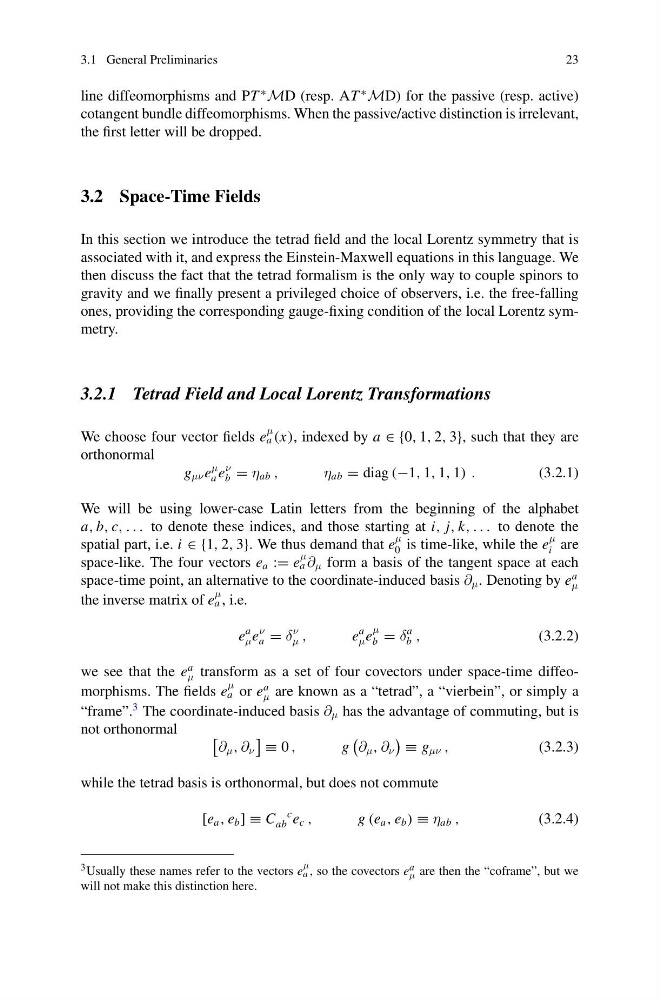
We choose four vector fields e
μ
a (x), indexed by a ∈ {0, 1, 2, 3}, such that they are
orthonormal
g μν e
μ
a e
ν
b = η ab ,
η ab = diag (−1, 1, 1, 1) .
(3.2.1)
We will be using lower-case Latin letters from the beginning of the alphabet
a, b, c, . . . to denote these indices, and those starting at i, j, k, . . . to denote the
spatial part, i.e. i ∈ {1, 2, 3}. We thus demand that e
μ
0 is time-like, while the e
μ
i are
space-like. The four vectors e a := e
μ
a ∂ μ form a basis of the tangent space at each
space-time point, an alternative to the coordinate-induced basis ∂ μ . Denoting by e
a
μ
the inverse matrix of e
μ
a , i.e.
e
a
μ e
ν
a = δ
ν
μ ,
e
a
μ e
μ
b = δ
a
b ,
(3.2.2)
we see that the e
a
μ transform as a set of four covectors under space-time diffeomorphisms. The fields e
μ
a or e
a
μ are known as a “tetrad”, a “vierbein”, or simply a
“frame”.
3 The coordinate-induced basis ∂ μ has the advantage of commuting, but is
not orthonormal
∂ μ , ∂ ν
≡ 0 ,
g
∂ μ , ∂ ν
≡ g μν ,
(3.2.3)
while the tetrad basis is orthonormal, but does not commute
[e a , e b ] ≡ C
c
ab e c ,
g (e a , e b ) ≡ η ab ,
(3.2.4)
3 Usually these names refer to the vectors e
μ
a , so the covectors e a
μ are then the “coframe”, but we
will not make this distinction here.
23
line diffeomorphisms and PT
∗
MD (resp. AT
∗
MD) for the passive (resp. active)
cotangent bundle diffeomorphisms. When the passive/active distinction is irrelevant,
the first letter will be dropped.
3.2 Space-Time Fields
In this section we introduce the tetrad field and the local Lorentz symmetry that is
associated with it, and express the Einstein-Maxwell equations in this language. We
then discuss the fact that the tetrad formalism is the only way to couple spinors to
gravity and we finally present a privileged choice of observers, i.e. the free-falling
ones, providing the corresponding gauge-fixing condition of the local Lorentz symmetry.
3.2.1 Tetrad Field and Local Lorentz Transformations
We choose four vector fields e
μ
a (x), indexed by a ∈ {0, 1, 2, 3}, such that they are
orthonormal
g μν e
μ
a e
ν
b = η ab ,
η ab = diag (−1, 1, 1, 1) .
(3.2.1)
We will be using lower-case Latin letters from the beginning of the alphabet
a, b, c, . . . to denote these indices, and those starting at i, j, k, . . . to denote the
spatial part, i.e. i ∈ {1, 2, 3}. We thus demand that e
μ
0 is time-like, while the e
μ
i are
space-like. The four vectors e a := e
μ
a ∂ μ form a basis of the tangent space at each
space-time point, an alternative to the coordinate-induced basis ∂ μ . Denoting by e
a
μ
the inverse matrix of e
μ
a , i.e.
e
a
μ e
ν
a = δ
ν
μ ,
e
a
μ e
μ
b = δ
a
b ,
(3.2.2)
we see that the e
a
μ transform as a set of four covectors under space-time diffeomorphisms. The fields e
μ
a or e
a
μ are known as a “tetrad”, a “vierbein”, or simply a
“frame”.
3 The coordinate-induced basis ∂ μ has the advantage of commuting, but is
not orthonormal
∂ μ , ∂ ν
≡ 0 ,
g
∂ μ , ∂ ν
≡ g μν ,
(3.2.3)
while the tetrad basis is orthonormal, but does not commute
[e a , e b ] ≡ C
c
ab e c ,
g (e a , e b ) ≡ η ab ,
(3.2.4)
3 Usually these names refer to the vectors e
μ
a , so the covectors e a
μ are then the “coframe”, but we
will not make this distinction here.