

102
5 General-Relativistic Matrix Kinetic Theory
if the s particle is stable. This is because the corresponding kets are time-translation
invariant S|0 = |0 and S| |
p, s = | |
p, s, so sends them to zero. The vacuum case
can also be simply understood from the viewpoint of energy conservation. Knowing
the components of the operator T in the full “in” Fock basis then allows us to express
it in terms of the “in” ladder operators, i.e. its cluster decomposition [18]
=
∞
n,m=0
1
n!m!
⎛
⎝
n
k=1
d 3 p k
(2π) 3
2E p k ,s k
⎞
⎠
⎛
⎝
m
l=1
d 3 q l
(2π) 3
2E q l ,r l
⎞
⎠ (2π) 4 δ (4)
⎛
⎝
n
k=1
p k −
m
l=1
q l
⎞
⎠
×A c ( q 1 , r 1 , . . . ,
q m , r m → →
p 1 , s 1 , . . . ,
p n , s n ) a
†
p n ,s n
. . . a
†
p 1 ,s 1
a
q 1 ,r 1
. . . a
q m ,r m ,
(5.5.9)
where A c are the “fully” connected scattering amplitudes, i.e. those corresponding to
fully connected Feynman diagrams. Indeed, the Feynman diagrams contributing to
A must have every external line connected to some vertex, but they can have several
disconnected components.
6 As an example where the difference is relevant, consider
the 4 → 4 amplitude in λφ
4 theory [18]
p 1 ,
p 2 ,
p 3 ,
p 4 ||| q 1 ,
q 2 ,
q 3 ,
q 4 = (2π) 4 δ (4) ( p 1 + p 2 + p 3 + p 4 − q 1 − q 2 − q 3 − q 4 ) (5.5.10)
×A c ( q 1 ,
q 2 ,
q 3 ,
q 4 → →
p 1 ,
p 2 ,
p 3 ,
p 4 )
+ (2π) 4 δ (4) ( p 1 + p 2 − q 1 − q 2 ) (2π) 4 δ (4) ( p 3 + p 4 − q 3 − q 4 )
×A c ( q 1 ,
q 2 → →
p 1 ,
p 2 ) A c ( q 3 ,
q 4 → →
p 3 ,
p 4 ) + . . .
where the ellipses contain the terms that appropriately symmetrize the
p k ,
q l entries.
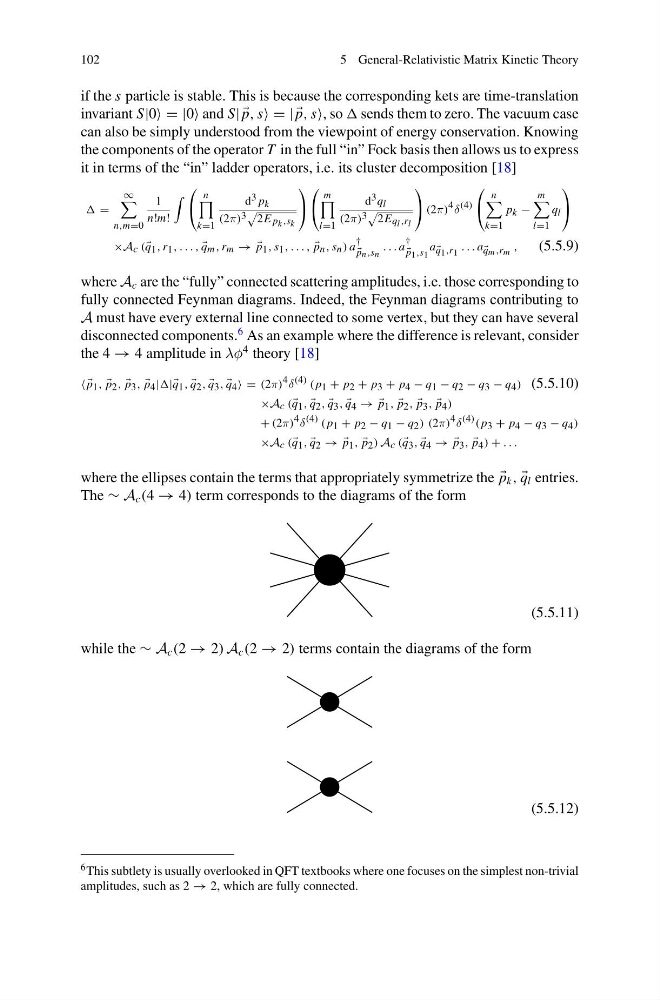
The ∼ A c (4 → 4) term corresponds to the diagrams of the form
(5.5.11)
while the ∼ A c (2 → 2) A c (2 → 2) terms contain the diagrams of the form
(5.5.12)
6 This subtlety is usually overlooked in QFT textbooks where one focuses on the simplest non-trivial
amplitudes, such as 2 → 2, which are fully connected.
5 General-Relativistic Matrix Kinetic Theory
if the s particle is stable. This is because the corresponding kets are time-translation
invariant S|0 = |0 and S| |
p, s = | |
p, s, so sends them to zero. The vacuum case
can also be simply understood from the viewpoint of energy conservation. Knowing
the components of the operator T in the full “in” Fock basis then allows us to express
it in terms of the “in” ladder operators, i.e. its cluster decomposition [18]
=
∞
n,m=0
1
n!m!
⎛
⎝
n
k=1
d 3 p k
(2π) 3
2E p k ,s k
⎞
⎠
⎛
⎝
m
l=1
d 3 q l
(2π) 3
2E q l ,r l
⎞
⎠ (2π) 4 δ (4)
⎛
⎝
n
k=1
p k −
m
l=1
q l
⎞
⎠
×A c ( q 1 , r 1 , . . . ,
q m , r m → →
p 1 , s 1 , . . . ,
p n , s n ) a
†
p n ,s n
. . . a
†
p 1 ,s 1
a
q 1 ,r 1
. . . a
q m ,r m ,
(5.5.9)
where A c are the “fully” connected scattering amplitudes, i.e. those corresponding to
fully connected Feynman diagrams. Indeed, the Feynman diagrams contributing to
A must have every external line connected to some vertex, but they can have several
disconnected components.
6 As an example where the difference is relevant, consider
the 4 → 4 amplitude in λφ
4 theory [18]
p 1 ,
p 2 ,
p 3 ,
p 4 ||| q 1 ,
q 2 ,
q 3 ,
q 4 = (2π) 4 δ (4) ( p 1 + p 2 + p 3 + p 4 − q 1 − q 2 − q 3 − q 4 ) (5.5.10)
×A c ( q 1 ,
q 2 ,
q 3 ,
q 4 → →
p 1 ,
p 2 ,
p 3 ,
p 4 )
+ (2π) 4 δ (4) ( p 1 + p 2 − q 1 − q 2 ) (2π) 4 δ (4) ( p 3 + p 4 − q 3 − q 4 )
×A c ( q 1 ,
q 2 → →
p 1 ,
p 2 ) A c ( q 3 ,
q 4 → →
p 3 ,
p 4 ) + . . .
where the ellipses contain the terms that appropriately symmetrize the
p k ,
q l entries.
The ∼ A c (4 → 4) term corresponds to the diagrams of the form
(5.5.11)
while the ∼ A c (2 → 2) A c (2 → 2) terms contain the diagrams of the form
(5.5.12)
6 This subtlety is usually overlooked in QFT textbooks where one focuses on the simplest non-trivial
amplitudes, such as 2 → 2, which are fully connected.