

100
5 General-Relativistic Matrix Kinetic Theory
where we have recovered the Lorentz-invariant measure d
3 p/E p,s . As in the case
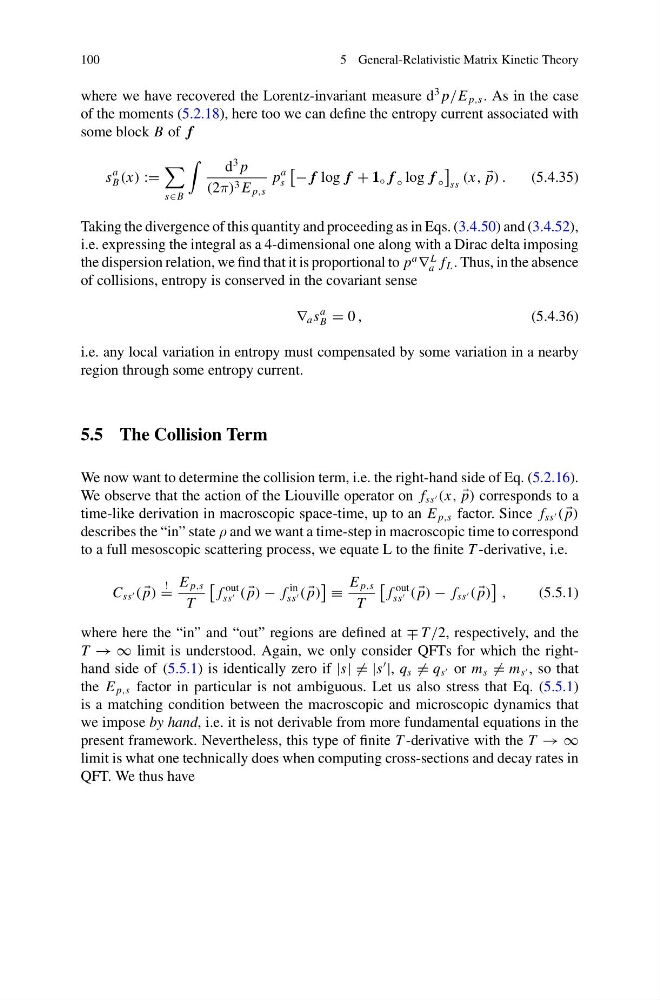
of the moments (5.2.18), here too we can define the entropy current associated with
some block B of f
s
a
B (x) :=
s∈B
d
3 p
(2π) 3 E p,s
p
a
s
− f log f + 1 ◦ f ◦ log f ◦
ss
(x,
p) .
(5.4.35)
Taking the divergence of this quantity and proceeding as in Eqs. (3.4.50) and (3.4.52),
i.e. expressing the integral as a 4-dimensional one along with a Dirac delta imposing
the dispersion relation, we find that it is proportional to p
a
∇
L
a f L . Thus, in the absence
of collisions, entropy is conserved in the covariant sense
∇ a s
a
B = 0 ,
(5.4.36)
i.e. any local variation in entropy must compensated by some variation in a nearby
region through some entropy current.
5.5 The Collision Term
We now want to determine the collision term, i.e. the right-hand side of Eq. (5.2.16).
We observe that the action of the Liouville operator on f ss (x,
p) corresponds to a
time-like derivation in macroscopic space-time, up to an E p,s factor. Since f ss (
p)
describes the “in” state ρ and we want a time-step in macroscopic time to correspond
to a full mesoscopic scattering process, we equate L to the finite T -derivative, i.e.
C ss (
p)
!
=
E p,s
T
f
out
ss (
p) − f
in
ss (
p)
≡
E p,s
T
f
out
ss (
p) − f ss (
p)
,
(5.5.1)
where here the “in” and “out” regions are defined at ∓ T /2, respectively, and the
T → ∞ limit is understood. Again, we only consider QFTs for which the righthand side of (5.5.1) is identically zero if |s| = |s
|, q s = q s or m s = m s , so that
the E p,s factor in particular is not ambiguous. Let us also stress that Eq. (5.5.1)
is a matching condition between the macroscopic and microscopic dynamics that
we impose by hand, i.e. it is not derivable from more fundamental equations in the
present framework. Nevertheless, this type of finite T -derivative with the T → ∞
limit is what one technically does when computing cross-sections and decay rates in
QFT. We thus have
5 General-Relativistic Matrix Kinetic Theory
where we have recovered the Lorentz-invariant measure d
3 p/E p,s . As in the case
of the moments (5.2.18), here too we can define the entropy current associated with
some block B of f
s
a
B (x) :=
s∈B
d
3 p
(2π) 3 E p,s
p
a
s
− f log f + 1 ◦ f ◦ log f ◦
ss
(x,
p) .
(5.4.35)
Taking the divergence of this quantity and proceeding as in Eqs. (3.4.50) and (3.4.52),
i.e. expressing the integral as a 4-dimensional one along with a Dirac delta imposing
the dispersion relation, we find that it is proportional to p
a
∇
L
a f L . Thus, in the absence
of collisions, entropy is conserved in the covariant sense
∇ a s
a
B = 0 ,
(5.4.36)
i.e. any local variation in entropy must compensated by some variation in a nearby
region through some entropy current.
5.5 The Collision Term
We now want to determine the collision term, i.e. the right-hand side of Eq. (5.2.16).
We observe that the action of the Liouville operator on f ss (x,
p) corresponds to a
time-like derivation in macroscopic space-time, up to an E p,s factor. Since f ss (
p)
describes the “in” state ρ and we want a time-step in macroscopic time to correspond
to a full mesoscopic scattering process, we equate L to the finite T -derivative, i.e.
C ss (
p)
!
=
E p,s
T
f
out
ss (
p) − f
in
ss (
p)
≡
E p,s
T
f
out
ss (
p) − f ss (
p)
,
(5.5.1)
where here the “in” and “out” regions are defined at ∓ T /2, respectively, and the
T → ∞ limit is understood. Again, we only consider QFTs for which the righthand side of (5.5.1) is identically zero if |s| = |s
|, q s = q s or m s = m s , so that
the E p,s factor in particular is not ambiguous. Let us also stress that Eq. (5.5.1)
is a matching condition between the macroscopic and microscopic dynamics that
we impose by hand, i.e. it is not derivable from more fundamental equations in the
present framework. Nevertheless, this type of finite T -derivative with the T → ∞
limit is what one technically does when computing cross-sections and decay rates in
QFT. We thus have