

96
5 General-Relativistic Matrix Kinetic Theory
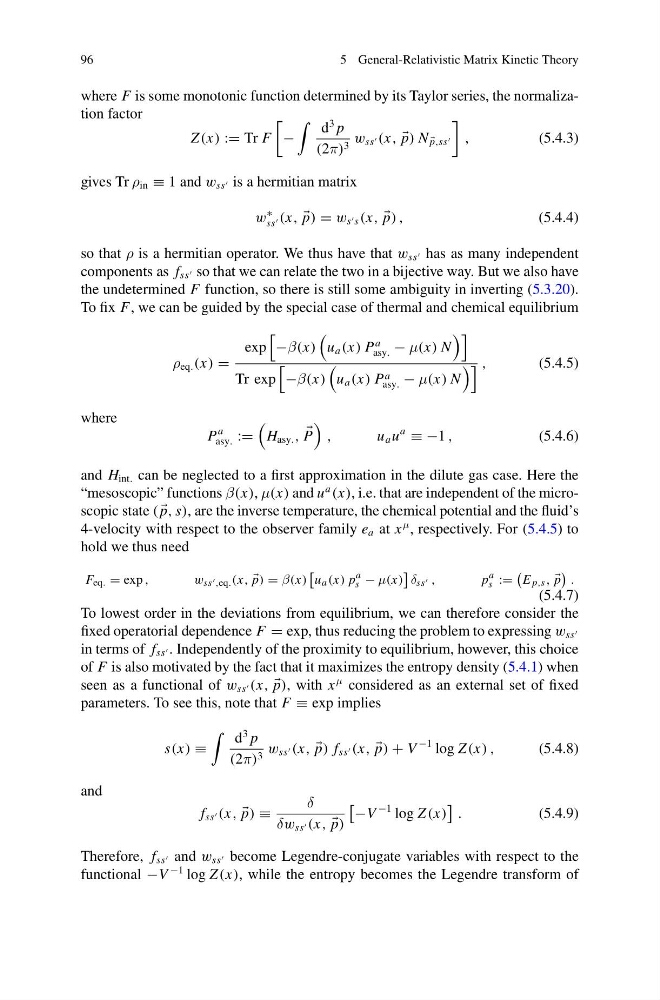
where F is some monotonic function determined by its Taylor series, the normalization factor
Z (x) := Tr F
−
d
3 p
(2π) 3 w ss (x,
p) N
p,ss
,
(5.4.3)
gives Tr ρ in ≡ 1 and w ss is a hermitian matrix
w
∗
ss (x,
p) = w s s (x,
p) ,
(5.4.4)
so that ρ is a hermitian operator. We thus have that w ss has as many independent
components as f ss so that we can relate the two in a bijective way. But we also have
the undetermined F function, so there is still some ambiguity in inverting (5.3.20).
To fix F, we can be guided by the special case of thermal and chemical equilibrium
ρ eq. (x) =
exp
−β(x)
u a (x) P
a
asy. − μ(x) N
Tr exp
−β(x)
u a (x) P a
asy. − μ(x) N
,
(5.4.5)
where
P
a
asy. :=
H asy. ,
P
,
u a u
a
≡ −1 ,
(5.4.6)
and H int. can be neglected to a first approximation in the dilute gas case. Here the
“mesoscopic” functions β(x), μ(x) and u
a
(x), i.e. that are independent of the microscopic state (
p, s), are the inverse temperature, the chemical potential and the fluid’s
4-velocity with respect to the observer family e a at x
μ , respectively. For (5.4.5) to
hold we thus need
F eq. = exp ,
w ss ,eq. (x,
p) = β(x)
u a (x) p
a
s − μ(x)
δ ss ,
p
a
s :=
E p,s ,
p
.
(5.4.7)
To lowest order in the deviations from equilibrium, we can therefore consider the
fixed operatorial dependence F = exp, thus reducing the problem to expressing w ss
in terms of f ss . Independently of the proximity to equilibrium, however, this choice
of F is also motivated by the fact that it maximizes the entropy density (5.4.1) when
seen as a functional of w ss (x,
p), with x
μ considered as an external set of fixed
parameters. To see this, note that F ≡ exp implies
s(x) ≡
d
3 p
(2π) 3 w ss (x,
p) f ss (x,
p) + V
−1 log Z (x) ,
(5.4.8)
and
f ss (x,
p) ≡
δ
δw ss (x,
p)
−V
−1 log Z (x)
.
(5.4.9)
Therefore, f ss and w ss become Legendre-conjugate variables with respect to the
functional −V
−1 log Z (x), while the entropy becomes the Legendre transform of
5 General-Relativistic Matrix Kinetic Theory
where F is some monotonic function determined by its Taylor series, the normalization factor
Z (x) := Tr F
−
d
3 p
(2π) 3 w ss (x,
p) N
p,ss
,
(5.4.3)
gives Tr ρ in ≡ 1 and w ss is a hermitian matrix
w
∗
ss (x,
p) = w s s (x,
p) ,
(5.4.4)
so that ρ is a hermitian operator. We thus have that w ss has as many independent
components as f ss so that we can relate the two in a bijective way. But we also have
the undetermined F function, so there is still some ambiguity in inverting (5.3.20).
To fix F, we can be guided by the special case of thermal and chemical equilibrium
ρ eq. (x) =
exp
−β(x)
u a (x) P
a
asy. − μ(x) N
Tr exp
−β(x)
u a (x) P a
asy. − μ(x) N
,
(5.4.5)
where
P
a
asy. :=
H asy. ,
P
,
u a u
a
≡ −1 ,
(5.4.6)
and H int. can be neglected to a first approximation in the dilute gas case. Here the
“mesoscopic” functions β(x), μ(x) and u
a
(x), i.e. that are independent of the microscopic state (
p, s), are the inverse temperature, the chemical potential and the fluid’s
4-velocity with respect to the observer family e a at x
μ , respectively. For (5.4.5) to
hold we thus need
F eq. = exp ,
w ss ,eq. (x,
p) = β(x)
u a (x) p
a
s − μ(x)
δ ss ,
p
a
s :=
E p,s ,
p
.
(5.4.7)
To lowest order in the deviations from equilibrium, we can therefore consider the
fixed operatorial dependence F = exp, thus reducing the problem to expressing w ss
in terms of f ss . Independently of the proximity to equilibrium, however, this choice
of F is also motivated by the fact that it maximizes the entropy density (5.4.1) when
seen as a functional of w ss (x,
p), with x
μ considered as an external set of fixed
parameters. To see this, note that F ≡ exp implies
s(x) ≡
d
3 p
(2π) 3 w ss (x,
p) f ss (x,
p) + V
−1 log Z (x) ,
(5.4.8)
and
f ss (x,
p) ≡
δ
δw ss (x,
p)
−V
−1 log Z (x)
.
(5.4.9)
Therefore, f ss and w ss become Legendre-conjugate variables with respect to the
functional −V
−1 log Z (x), while the entropy becomes the Legendre transform of