

4.2 Methane Metabolism in Methane-Oxidizing Bacteria
81
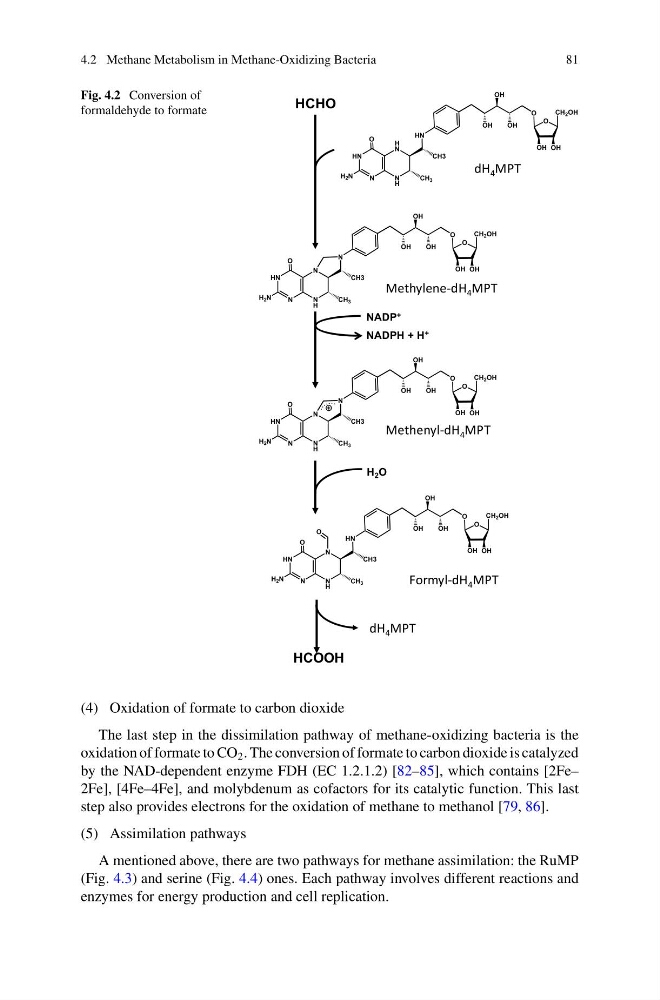
Fig. 4.2 Conversion of
formaldehyde to formate
HN
N
N
H
H
N
N
CH3
O
H2
CH3
HN
OH
OH
OH
O
O
OH OH
CH2OH
HN
N
N
H
N
N
CH3
O
H2
CH3
N
OH
OH
OH
O
O
OH OH
CH2OH
dH 4 MPT
HN
N
N
H
N
N
CH3
O
H2
CH3
N
OH
OH
OH
O
O
OH OH
CH2OH
Methylene-dH 4 MPT
Methenyl-dH 4 MPT
HN
N
N
H
N
N
CH3
O
H2
CH3
HN
OH
OH
OH
O
O
OH OH
CH2OH
O
Formyl-dH 4 MPT
HCHO
NADPH + H +
NADP +
H 2 O
dH 4 MPT
HCOOH
(4) Oxidation of formate to carbon dioxide
The last step in the dissimilation pathway of methane-oxidizing bacteria is the
oxidation of formate to CO 2 . The conversion of formate to carbon dioxide is catalyzed
by the NAD-dependent enzyme FDH (EC 1.2.1.2) [82–85], which contains [2Fe–
2Fe], [4Fe–4Fe], and molybdenum as cofactors for its catalytic function. This last
step also provides electrons for the oxidation of methane to methanol [79, 86].
(5) Assimilation pathways
A mentioned above, there are two pathways for methane assimilation: the RuMP
(Fig. 4.3) and serine (Fig. 4.4) ones. Each pathway involves different reactions and
enzymes for energy production and cell replication.
81
Fig. 4.2 Conversion of
formaldehyde to formate
HN
N
N
H
H
N
N
CH3
O
H2
CH3
HN
OH
OH
OH
O
O
OH OH
CH2OH
HN
N
N
H
N
N
CH3
O
H2
CH3
N
OH
OH
OH
O
O
OH OH
CH2OH
dH 4 MPT
HN
N
N
H
N
N
CH3
O
H2
CH3
N
OH
OH
OH
O
O
OH OH
CH2OH
Methylene-dH 4 MPT
Methenyl-dH 4 MPT
HN
N
N
H
N
N
CH3
O
H2
CH3
HN
OH
OH
OH
O
O
OH OH
CH2OH
O
Formyl-dH 4 MPT
HCHO
NADPH + H +
NADP +
H 2 O
dH 4 MPT
HCOOH
(4) Oxidation of formate to carbon dioxide
The last step in the dissimilation pathway of methane-oxidizing bacteria is the
oxidation of formate to CO 2 . The conversion of formate to carbon dioxide is catalyzed
by the NAD-dependent enzyme FDH (EC 1.2.1.2) [82–85], which contains [2Fe–
2Fe], [4Fe–4Fe], and molybdenum as cofactors for its catalytic function. This last
step also provides electrons for the oxidation of methane to methanol [79, 86].
(5) Assimilation pathways
A mentioned above, there are two pathways for methane assimilation: the RuMP
(Fig. 4.3) and serine (Fig. 4.4) ones. Each pathway involves different reactions and
enzymes for energy production and cell replication.