

3.3 Homogeneous Reactions for the Production of Methanol from Methane
61
3.3 Homogeneous Reactions for the Production
of Methanol from Methane
Methane
oxidation
to
methanol
with
a
di-nuclear,
bridged
Ru(III)
catalyst
[(HSalen) 2 Ru 2 (µ-O)(µ-CH 3 CO 2 ) 2 ]
(salen
=
2,2
-
ethylenebis(nitrilomethylidene)diphenol, N,N
-ethylenebis(salicylimine)) was
reported by Jasra et al. The homogeneous catalyst achieved 100% methanol selectivity in the oxidation of methane (12.5 atm) using molecular oxygen (2.5 atm)
at 303 K in a 1:1 mixture of acetone and H 2 O [64]. The reaction conditions of
the catalyst are very close to the ideal conditions for a practical process (neutral
media, ambient temperature, atmospheric pressure, etc.). In a typical experiment
(CH 4 : 10 atm, O 2 : 5 atm), this catalyst achieved a methanol yield of ~9% based on
methane with a TON of 54 and a selectivity of 96.6%. The authors suggested that
the homogeneous catalyst first activated both molecular oxygen and methane in the
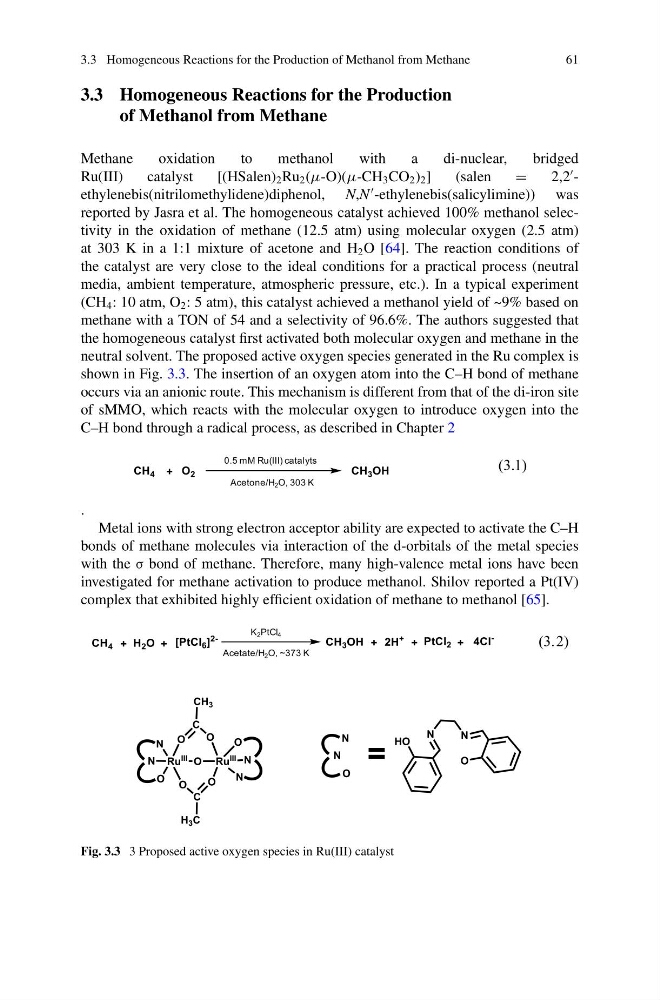
neutral solvent. The proposed active oxygen species generated in the Ru complex is
shown in Fig. 3.3. The insertion of an oxygen atom into the C–H bond of methane
occurs via an anionic route. This mechanism is different from that of the di-iron site
of sMMO, which reacts with the molecular oxygen to introduce oxygen into the
C–H bond through a radical process, as described in Chapter 2
(3.1)
Acetone/H 2 O, 303 K
0.5 mM Ru(III) catalyts
.
Metal ions with strong electron acceptor ability are expected to activate the C–H
bonds of methane molecules via interaction of the d-orbitals of the metal species
with the σ bond of methane. Therefore, many high-valence metal ions have been
investigated for methane activation to produce methanol. Shilov reported a Pt(IV)
complex that exhibited highly efficient oxidation of methane to methanol [65].
(3.2)
K 2 PtCl 4
Acetate/H 2 O, ~373 K
N
O
N
HO
O
N
N
Ru
III O Ru
III
CH 3
C
O
O
H 3 C
C
O
O
O
N
N
O
N
N
=
Fig. 3.3 3 Proposed active oxygen species in Ru(III) catalyst
61
3.3 Homogeneous Reactions for the Production
of Methanol from Methane
Methane
oxidation
to
methanol
with
a
di-nuclear,
bridged
Ru(III)
catalyst
[(HSalen) 2 Ru 2 (µ-O)(µ-CH 3 CO 2 ) 2 ]
(salen
=
2,2
-
ethylenebis(nitrilomethylidene)diphenol, N,N
-ethylenebis(salicylimine)) was
reported by Jasra et al. The homogeneous catalyst achieved 100% methanol selectivity in the oxidation of methane (12.5 atm) using molecular oxygen (2.5 atm)
at 303 K in a 1:1 mixture of acetone and H 2 O [64]. The reaction conditions of
the catalyst are very close to the ideal conditions for a practical process (neutral
media, ambient temperature, atmospheric pressure, etc.). In a typical experiment
(CH 4 : 10 atm, O 2 : 5 atm), this catalyst achieved a methanol yield of ~9% based on
methane with a TON of 54 and a selectivity of 96.6%. The authors suggested that
the homogeneous catalyst first activated both molecular oxygen and methane in the
neutral solvent. The proposed active oxygen species generated in the Ru complex is
shown in Fig. 3.3. The insertion of an oxygen atom into the C–H bond of methane
occurs via an anionic route. This mechanism is different from that of the di-iron site
of sMMO, which reacts with the molecular oxygen to introduce oxygen into the
C–H bond through a radical process, as described in Chapter 2
(3.1)
Acetone/H 2 O, 303 K
0.5 mM Ru(III) catalyts
.
Metal ions with strong electron acceptor ability are expected to activate the C–H
bonds of methane molecules via interaction of the d-orbitals of the metal species
with the σ bond of methane. Therefore, many high-valence metal ions have been
investigated for methane activation to produce methanol. Shilov reported a Pt(IV)
complex that exhibited highly efficient oxidation of methane to methanol [65].
(3.2)
K 2 PtCl 4
Acetate/H 2 O, ~373 K
N
O
N
HO
O
N
N
Ru
III O Ru
III
CH 3
C
O
O
H 3 C
C
O
O
O
N
N
O
N
N
=
Fig. 3.3 3 Proposed active oxygen species in Ru(III) catalyst