

3.2 Heterogeneous Reactions for the Production of Methanol …
59
species or the corresponding “reduced sites” VO(OH) x (OSi) 2-x (valence of the vanadium ion is 4+), which were believed to be the true active sites. A V 2 O 5 /SiO 2 xerogel
was also able to convert methane to methanol, and the vanadium species on its surface were investigated using solid-state
51 V nuclear magnetic resonance (NMR) and
Raman spectroscopy. According to these analyses, the monomeric tetrahedral V
5+
species on the surface were the active sites for the conversion of methane to methanol
and formaldehyde, and these species, along with polymeric surface tetrahedral V
5+
species and crystalline V 2 O 5 , were the active sites for the further oxidation of the
primary products to carbon dioxide and carbon monoxide [49].
3.2.4 Copper
Very few studies have investigated the use of synthetic Cu-based catalysts for the
selective oxidation of methane to methanol and formaldehyde, as CuO x species, like
Fe 2 O 3 aggregates, favor the total oxidation of methane [26, 32, 34, 49]. Although no
heterogeneous Cu materials that can catalyze the oxidation of methane to methanol
have been reported, stoichiometric heterogeneous transformations involving Cu are
interesting, as copper (and iron) sites are the active centers in the biologically catalyzed oxidation of methane to methanol using O 2 at ambient temperature (see
Chapter 2 for a detailed discussion of the biocatalytic reaction). So far, the use of
copper-exchanged zeolites such as Cu-ZSM-5 for methane oxidation has been investigated [50]. Also, the selective oxidation of methane to formaldehyde over a very
low loading of CuO x on mesoporous silica, SBA-15, has also been documented [51].
In most reactions using zeolites, the methanol must be extracted from the zeolite
using water because the methoxy species are typically produced on the zeolitebased material. In addition, these materials require reactivation via calcination before
the subsequent reaction cycle [50, 52]. For example, the oxidation of methane to
methanol over Cu-ZSM-5 at 398 K was reported [50]. However, the zeolite was
only active after pretreatment with O 2 at ≥573 K, and the formed methanol had to
be extracted from the zeolite. As these reactions do not occur in a catalytic cycle in
which all elementary reactions occur under the same conditions, they are not catalytic
and require the use of multi-step processes to obtain methanol from methane.
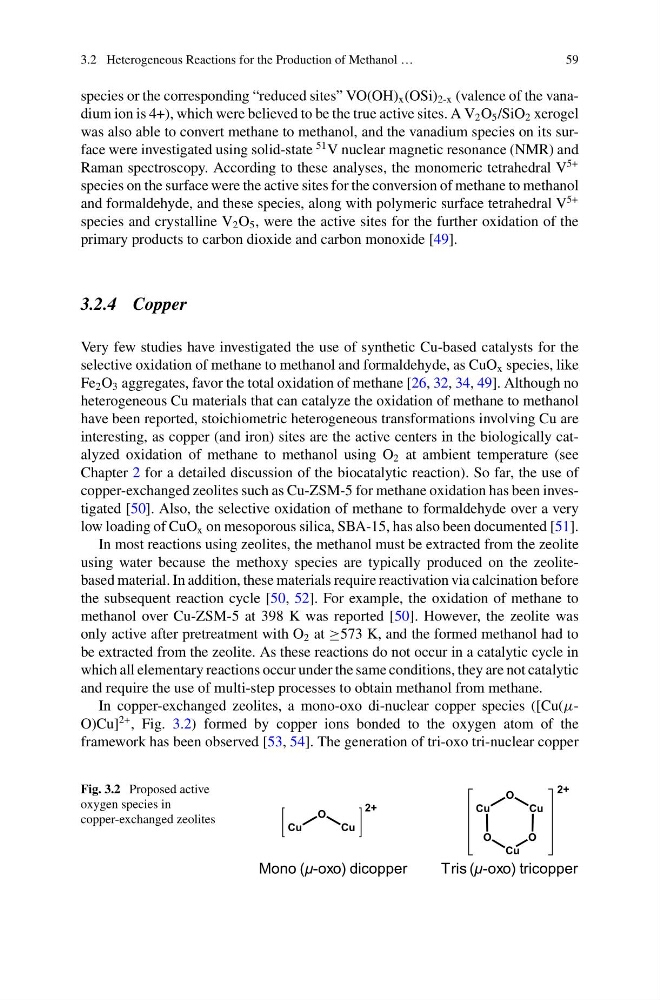
In copper-exchanged zeolites, a mono-oxo di-nuclear copper species ([Cu(µO)Cu]
2+ , Fig. 3.2) formed by copper ions bonded to the oxygen atom of the
framework has been observed [53, 54]. The generation of tri-oxo tri-nuclear copper
Fig. 3.2 Proposed active
oxygen species in
copper-exchanged zeolites
Cu
O
Cu
2+
2+
Cu
O
Cu
O
Cu
O
Mono (µ-oxo) dicopper
Tris (µ-oxo) tricopper
59
species or the corresponding “reduced sites” VO(OH) x (OSi) 2-x (valence of the vanadium ion is 4+), which were believed to be the true active sites. A V 2 O 5 /SiO 2 xerogel
was also able to convert methane to methanol, and the vanadium species on its surface were investigated using solid-state
51 V nuclear magnetic resonance (NMR) and
Raman spectroscopy. According to these analyses, the monomeric tetrahedral V
5+
species on the surface were the active sites for the conversion of methane to methanol
and formaldehyde, and these species, along with polymeric surface tetrahedral V
5+
species and crystalline V 2 O 5 , were the active sites for the further oxidation of the
primary products to carbon dioxide and carbon monoxide [49].
3.2.4 Copper
Very few studies have investigated the use of synthetic Cu-based catalysts for the
selective oxidation of methane to methanol and formaldehyde, as CuO x species, like
Fe 2 O 3 aggregates, favor the total oxidation of methane [26, 32, 34, 49]. Although no
heterogeneous Cu materials that can catalyze the oxidation of methane to methanol
have been reported, stoichiometric heterogeneous transformations involving Cu are
interesting, as copper (and iron) sites are the active centers in the biologically catalyzed oxidation of methane to methanol using O 2 at ambient temperature (see
Chapter 2 for a detailed discussion of the biocatalytic reaction). So far, the use of
copper-exchanged zeolites such as Cu-ZSM-5 for methane oxidation has been investigated [50]. Also, the selective oxidation of methane to formaldehyde over a very
low loading of CuO x on mesoporous silica, SBA-15, has also been documented [51].
In most reactions using zeolites, the methanol must be extracted from the zeolite
using water because the methoxy species are typically produced on the zeolitebased material. In addition, these materials require reactivation via calcination before
the subsequent reaction cycle [50, 52]. For example, the oxidation of methane to
methanol over Cu-ZSM-5 at 398 K was reported [50]. However, the zeolite was
only active after pretreatment with O 2 at ≥573 K, and the formed methanol had to
be extracted from the zeolite. As these reactions do not occur in a catalytic cycle in
which all elementary reactions occur under the same conditions, they are not catalytic
and require the use of multi-step processes to obtain methanol from methane.
In copper-exchanged zeolites, a mono-oxo di-nuclear copper species ([Cu(µO)Cu]
2+ , Fig. 3.2) formed by copper ions bonded to the oxygen atom of the
framework has been observed [53, 54]. The generation of tri-oxo tri-nuclear copper
Fig. 3.2 Proposed active
oxygen species in
copper-exchanged zeolites
Cu
O
Cu
2+
2+
Cu
O
Cu
O
Cu
O
Mono (µ-oxo) dicopper
Tris (µ-oxo) tricopper