

58
3 Heterogeneous and Homogeneous Catalytic Partial Oxidations …
M n+
O
M n+
O
O
H R
M
O
M
O
O
H
R
M (n-1)+
O
M n+
O
O
H
R
M
O
M
O
O
H
R
M (n-1)+
O
M (n-1)+
O
O
H
R
Radical pair
intermediate
TS 2
(O rebound)
TS 1
(H abstraction)
ΔG ‡ = 265 kJ/mol
ΔG ‡ = 30 kJ/mol
M: Mo
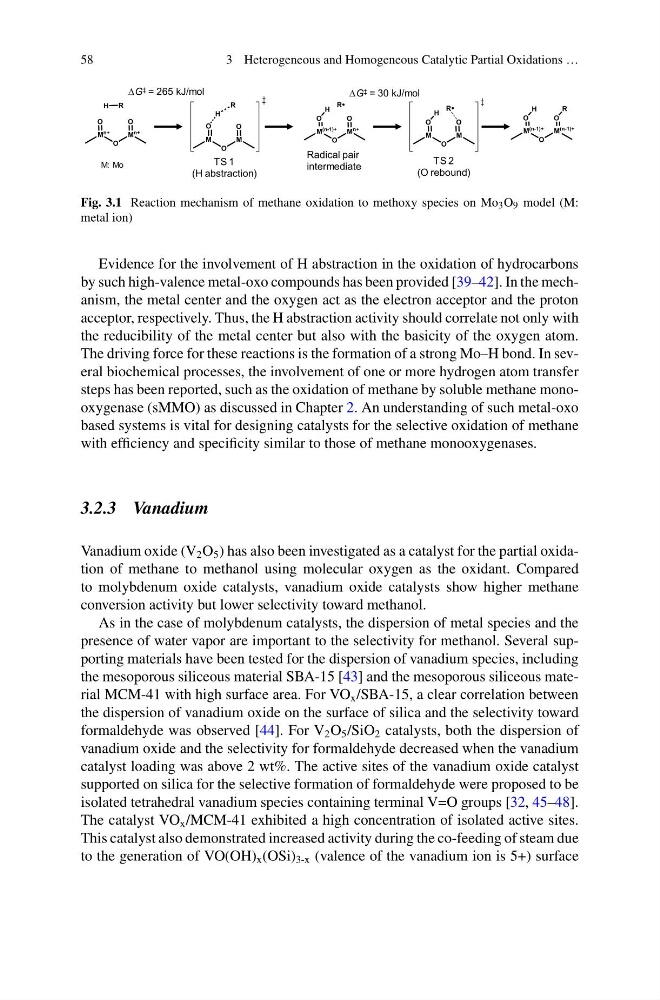
Fig. 3.1 Reaction mechanism of methane oxidation to methoxy species on Mo 3 O 9 model (M:
metal ion)
Evidence for the involvement of H abstraction in the oxidation of hydrocarbons
by such high-valence metal-oxo compounds has been provided [39–42]. In the mechanism, the metal center and the oxygen act as the electron acceptor and the proton
acceptor, respectively. Thus, the H abstraction activity should correlate not only with
the reducibility of the metal center but also with the basicity of the oxygen atom.
The driving force for these reactions is the formation of a strong Mo–H bond. In several biochemical processes, the involvement of one or more hydrogen atom transfer
steps has been reported, such as the oxidation of methane by soluble methane monooxygenase (sMMO) as discussed in Chapter 2. An understanding of such metal-oxo
based systems is vital for designing catalysts for the selective oxidation of methane
with efficiency and specificity similar to those of methane monooxygenases.
3.2.3 Vanadium
Vanadium oxide (V 2 O 5 ) has also been investigated as a catalyst for the partial oxidation of methane to methanol using molecular oxygen as the oxidant. Compared
to molybdenum oxide catalysts, vanadium oxide catalysts show higher methane
conversion activity but lower selectivity toward methanol.
As in the case of molybdenum catalysts, the dispersion of metal species and the
presence of water vapor are important to the selectivity for methanol. Several supporting materials have been tested for the dispersion of vanadium species, including
the mesoporous siliceous material SBA-15 [43] and the mesoporous siliceous material MCM-41 with high surface area. For VO x /SBA-15, a clear correlation between
the dispersion of vanadium oxide on the surface of silica and the selectivity toward
formaldehyde was observed [44]. For V 2 O 5 /SiO 2 catalysts, both the dispersion of
vanadium oxide and the selectivity for formaldehyde decreased when the vanadium
catalyst loading was above 2 wt%. The active sites of the vanadium oxide catalyst
supported on silica for the selective formation of formaldehyde were proposed to be
isolated tetrahedral vanadium species containing terminal V=O groups [32, 45–48].
The catalyst VO x /MCM-41 exhibited a high concentration of isolated active sites.
This catalyst also demonstrated increased activity during the co-feeding of steam due
to the generation of VO(OH) x (OSi) 3-x (valence of the vanadium ion is 5+) surface
3 Heterogeneous and Homogeneous Catalytic Partial Oxidations …
M n+
O
M n+
O
O
H R
M
O
M
O
O
H
R
M (n-1)+
O
M n+
O
O
H
R
M
O
M
O
O
H
R
M (n-1)+
O
M (n-1)+
O
O
H
R
Radical pair
intermediate
TS 2
(O rebound)
TS 1
(H abstraction)
ΔG ‡ = 265 kJ/mol
ΔG ‡ = 30 kJ/mol
M: Mo
Fig. 3.1 Reaction mechanism of methane oxidation to methoxy species on Mo 3 O 9 model (M:
metal ion)
Evidence for the involvement of H abstraction in the oxidation of hydrocarbons
by such high-valence metal-oxo compounds has been provided [39–42]. In the mechanism, the metal center and the oxygen act as the electron acceptor and the proton
acceptor, respectively. Thus, the H abstraction activity should correlate not only with
the reducibility of the metal center but also with the basicity of the oxygen atom.
The driving force for these reactions is the formation of a strong Mo–H bond. In several biochemical processes, the involvement of one or more hydrogen atom transfer
steps has been reported, such as the oxidation of methane by soluble methane monooxygenase (sMMO) as discussed in Chapter 2. An understanding of such metal-oxo
based systems is vital for designing catalysts for the selective oxidation of methane
with efficiency and specificity similar to those of methane monooxygenases.
3.2.3 Vanadium
Vanadium oxide (V 2 O 5 ) has also been investigated as a catalyst for the partial oxidation of methane to methanol using molecular oxygen as the oxidant. Compared
to molybdenum oxide catalysts, vanadium oxide catalysts show higher methane
conversion activity but lower selectivity toward methanol.
As in the case of molybdenum catalysts, the dispersion of metal species and the
presence of water vapor are important to the selectivity for methanol. Several supporting materials have been tested for the dispersion of vanadium species, including
the mesoporous siliceous material SBA-15 [43] and the mesoporous siliceous material MCM-41 with high surface area. For VO x /SBA-15, a clear correlation between
the dispersion of vanadium oxide on the surface of silica and the selectivity toward
formaldehyde was observed [44]. For V 2 O 5 /SiO 2 catalysts, both the dispersion of
vanadium oxide and the selectivity for formaldehyde decreased when the vanadium
catalyst loading was above 2 wt%. The active sites of the vanadium oxide catalyst
supported on silica for the selective formation of formaldehyde were proposed to be
isolated tetrahedral vanadium species containing terminal V=O groups [32, 45–48].
The catalyst VO x /MCM-41 exhibited a high concentration of isolated active sites.
This catalyst also demonstrated increased activity during the co-feeding of steam due
to the generation of VO(OH) x (OSi) 3-x (valence of the vanadium ion is 5+) surface