

2.3 pMMO
43
should be different from those of the binding sites of the two pMMOs; additionally,
these amino acid residues likely affect the ability of pMMO to control the orientation
of n-butane and n-pentane. Thus, comparison of amino acids in the cavities of the
two pMMOs and AMO implies that the cavity adjacent to the di-copper center is
most likely the substrate-binding site in these three enzymes.
2.3.5 Electron Transfer from the Electron Donor
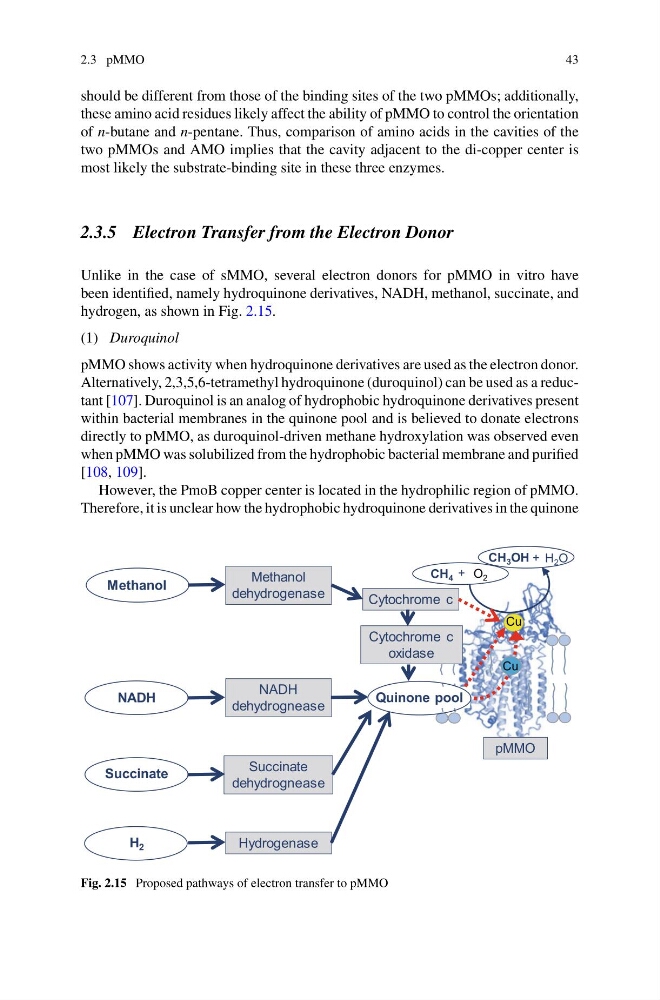
Unlike in the case of sMMO, several electron donors for pMMO in vitro have
been identified, namely hydroquinone derivatives, NADH, methanol, succinate, and
hydrogen, as shown in Fig. 2.15.
(1) Duroquinol
pMMO shows activity when hydroquinone derivatives are used as the electron donor.
Alternatively, 2,3,5,6-tetramethyl hydroquinone (duroquinol) can be used as a reductant [107]. Duroquinol is an analog of hydrophobic hydroquinone derivatives present
within bacterial membranes in the quinone pool and is believed to donate electrons
directly to pMMO, as duroquinol-driven methane hydroxylation was observed even
when pMMO was solubilized from the hydrophobic bacterial membrane and purified
[108, 109].
However, the PmoB copper center is located in the hydrophilic region of pMMO.
Therefore, it is unclear how the hydrophobic hydroquinone derivatives in the quinone
Fig. 2.15 Proposed pathways of electron transfer to pMMO
43
should be different from those of the binding sites of the two pMMOs; additionally,
these amino acid residues likely affect the ability of pMMO to control the orientation
of n-butane and n-pentane. Thus, comparison of amino acids in the cavities of the
two pMMOs and AMO implies that the cavity adjacent to the di-copper center is
most likely the substrate-binding site in these three enzymes.
2.3.5 Electron Transfer from the Electron Donor
Unlike in the case of sMMO, several electron donors for pMMO in vitro have
been identified, namely hydroquinone derivatives, NADH, methanol, succinate, and
hydrogen, as shown in Fig. 2.15.
(1) Duroquinol
pMMO shows activity when hydroquinone derivatives are used as the electron donor.
Alternatively, 2,3,5,6-tetramethyl hydroquinone (duroquinol) can be used as a reductant [107]. Duroquinol is an analog of hydrophobic hydroquinone derivatives present
within bacterial membranes in the quinone pool and is believed to donate electrons
directly to pMMO, as duroquinol-driven methane hydroxylation was observed even
when pMMO was solubilized from the hydrophobic bacterial membrane and purified
[108, 109].
However, the PmoB copper center is located in the hydrophilic region of pMMO.
Therefore, it is unclear how the hydrophobic hydroquinone derivatives in the quinone
Fig. 2.15 Proposed pathways of electron transfer to pMMO