

42
2 Selective Production of Methanol …
but is expected to be located in the cavity or pocket adjacent to the catalytic site in
pMMO. The properties of the substrate-binding cavity of pMMO have been analyzed
using structural information for pMMO obtained from Methylosinus trichosporium
OB3b and Methylococcus capsulatus (Bath), the substrate specificity of pMMO,
and the general mechanism of host–guest molecular recognition [103–105]. In terms
of specificity, pMMO can oxidize not only methane, but also C2–C5 n-alkanes.
However, n-hexane cannot be oxidized by pMMO. This substrate specificity implies
that the greatest volume that the substrate-binding site of pMMO can accommodate
is that of n-pentane (96.4 Å
3 ), while larger substrates such as n-hexane (120.4 Å
3 )
cannot be accommodated. In host–guest chemistry, it is generally accepted that the
maximum guest molecule to host cavity volume ratio (packing coefficient) is 0.7
[104]. By assuming that the packing coefficient of n-pentane in the substrate-binding
site of pMMO is ~0.7 (v/v), the volume of the pMMO substrate-binding site can be
estimated as ~138 Å
3 . The predicted cavity volume is very large compared to the
molecular volume of methane (28.4 Å
3 ). However, the volume of cavity 1 adjacent
to the di-nuclear iron center of MMOH (Fig. 2.8) is even larger at 225 Å
3 .
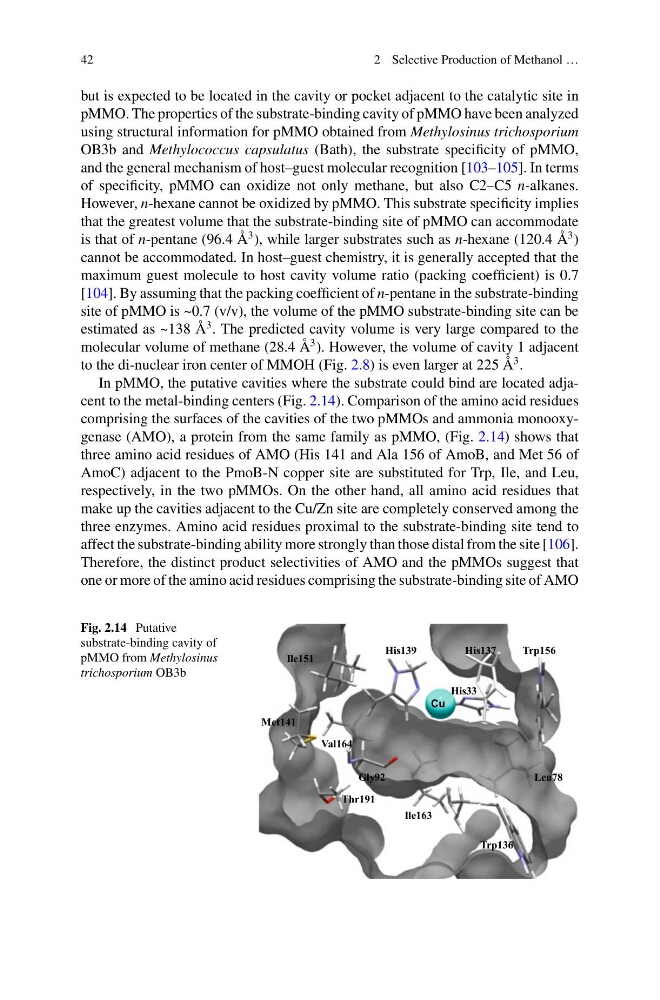
In pMMO, the putative cavities where the substrate could bind are located adjacent to the metal-binding centers (Fig. 2.14). Comparison of the amino acid residues
comprising the surfaces of the cavities of the two pMMOs and ammonia monooxygenase (AMO), a protein from the same family as pMMO, (Fig. 2.14) shows that
three amino acid residues of AMO (His 141 and Ala 156 of AmoB, and Met 56 of
AmoC) adjacent to the PmoB-N copper site are substituted for Trp, Ile, and Leu,
respectively, in the two pMMOs. On the other hand, all amino acid residues that
make up the cavities adjacent to the Cu/Zn site are completely conserved among the
three enzymes. Amino acid residues proximal to the substrate-binding site tend to
affect the substrate-binding ability more strongly than those distal from the site [106].
Therefore, the distinct product selectivities of AMO and the pMMOs suggest that
one or more of the amino acid residues comprising the substrate-binding site of AMO
Fig. 2.14 Putative
substrate-binding cavity of
pMMO from Methylosinus
trichosporium OB3b
His139
His137
His33
Cu
Ile151
Met141
Val164
Gly92
Thr191
Ile163
Trp136
Trp156
Leu78
2 Selective Production of Methanol …
but is expected to be located in the cavity or pocket adjacent to the catalytic site in
pMMO. The properties of the substrate-binding cavity of pMMO have been analyzed
using structural information for pMMO obtained from Methylosinus trichosporium
OB3b and Methylococcus capsulatus (Bath), the substrate specificity of pMMO,
and the general mechanism of host–guest molecular recognition [103–105]. In terms
of specificity, pMMO can oxidize not only methane, but also C2–C5 n-alkanes.
However, n-hexane cannot be oxidized by pMMO. This substrate specificity implies
that the greatest volume that the substrate-binding site of pMMO can accommodate
is that of n-pentane (96.4 Å
3 ), while larger substrates such as n-hexane (120.4 Å
3 )
cannot be accommodated. In host–guest chemistry, it is generally accepted that the
maximum guest molecule to host cavity volume ratio (packing coefficient) is 0.7
[104]. By assuming that the packing coefficient of n-pentane in the substrate-binding
site of pMMO is ~0.7 (v/v), the volume of the pMMO substrate-binding site can be
estimated as ~138 Å
3 . The predicted cavity volume is very large compared to the
molecular volume of methane (28.4 Å
3 ). However, the volume of cavity 1 adjacent
to the di-nuclear iron center of MMOH (Fig. 2.8) is even larger at 225 Å
3 .
In pMMO, the putative cavities where the substrate could bind are located adjacent to the metal-binding centers (Fig. 2.14). Comparison of the amino acid residues
comprising the surfaces of the cavities of the two pMMOs and ammonia monooxygenase (AMO), a protein from the same family as pMMO, (Fig. 2.14) shows that
three amino acid residues of AMO (His 141 and Ala 156 of AmoB, and Met 56 of
AmoC) adjacent to the PmoB-N copper site are substituted for Trp, Ile, and Leu,
respectively, in the two pMMOs. On the other hand, all amino acid residues that
make up the cavities adjacent to the Cu/Zn site are completely conserved among the
three enzymes. Amino acid residues proximal to the substrate-binding site tend to
affect the substrate-binding ability more strongly than those distal from the site [106].
Therefore, the distinct product selectivities of AMO and the pMMOs suggest that
one or more of the amino acid residues comprising the substrate-binding site of AMO
Fig. 2.14 Putative
substrate-binding cavity of
pMMO from Methylosinus
trichosporium OB3b
His139
His137
His33
Cu
Ile151
Met141
Val164
Gly92
Thr191
Ile163
Trp136
Trp156
Leu78