

206
7 C–C Bond Formation via Carbocations in the Methane …
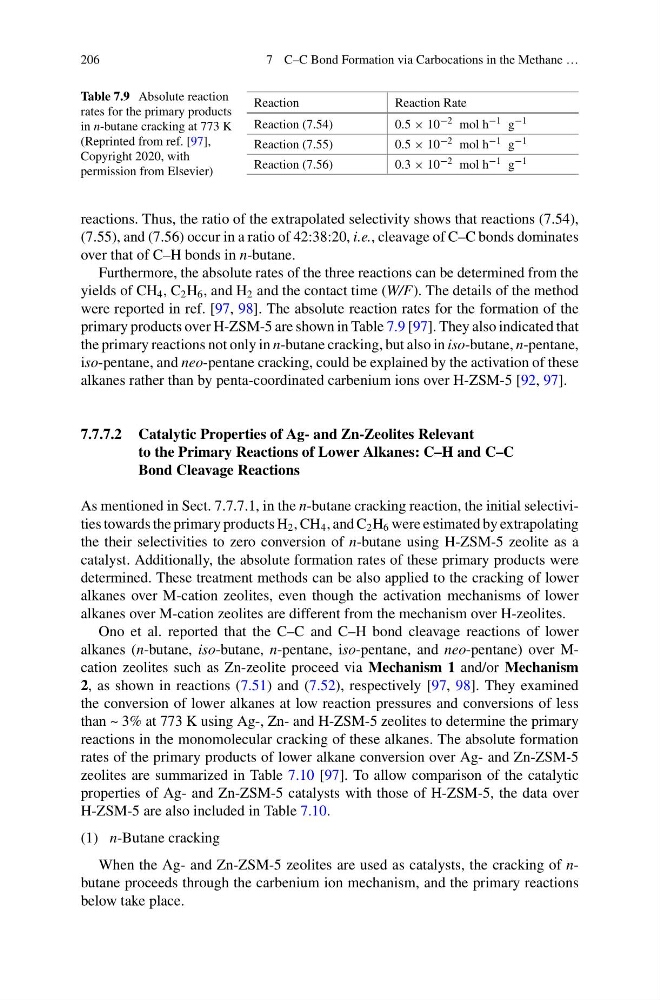
Table 7.9 Absolute reaction
rates for the primary products
in n-butane cracking at 773 K
(Reprinted from ref. [97],
Copyright 2020, with
permission from Elsevier)
Reaction
Reaction Rate
Reaction (7.54)
0.5 × 10 −2 mol h −1 g −1
Reaction (7.55)
0.5 × 10 −2 mol h −1 g −1
Reaction (7.56)
0.3 × 10 −2 mol h −1 g −1
reactions. Thus, the ratio of the extrapolated selectivity shows that reactions (7.54),
(7.55), and (7.56) occur in a ratio of 42:38:20, i.e., cleavage of C–C bonds dominates
over that of C–H bonds in n-butane.
Furthermore, the absolute rates of the three reactions can be determined from the
yields of CH 4 , C 2 H 6 , and H 2 and the contact time (W/F). The details of the method
were reported in ref. [97, 98]. The absolute reaction rates for the formation of the
primary products over H-ZSM-5 are shown in Table 7.9 [97]. They also indicated that
the primary reactions not only in n-butane cracking, but also in iso-butane, n-pentane,
iso-pentane, and neo-pentane cracking, could be explained by the activation of these
alkanes rather than by penta-coordinated carbenium ions over H-ZSM-5 [92, 97].
7.7.7.2 Catalytic Properties of Ag- and Zn-Zeolites Relevant
to the Primary Reactions of Lower Alkanes: C–H and C–C
Bond Cleavage Reactions
As mentioned in Sect. 7.7.7.1, in the n-butane cracking reaction, the initial selectivities towards the primary products H 2 , CH 4 , and C 2 H 6 were estimated by extrapolating
the their selectivities to zero conversion of n-butane using H-ZSM-5 zeolite as a
catalyst. Additionally, the absolute formation rates of these primary products were
determined. These treatment methods can be also applied to the cracking of lower
alkanes over M-cation zeolites, even though the activation mechanisms of lower
alkanes over M-cation zeolites are different from the mechanism over H-zeolites.
Ono et al. reported that the C–C and C–H bond cleavage reactions of lower
alkanes (n-butane, iso-butane, n-pentane, iso-pentane, and neo-pentane) over Mcation zeolites such as Zn-zeolite proceed via Mechanism 1 and/or Mechanism
2, as shown in reactions (7.51) and (7.52), respectively [97, 98]. They examined
the conversion of lower alkanes at low reaction pressures and conversions of less
than ~ 3% at 773 K using Ag-, Zn- and H-ZSM-5 zeolites to determine the primary
reactions in the monomolecular cracking of these alkanes. The absolute formation
rates of the primary products of lower alkane conversion over Ag- and Zn-ZSM-5
zeolites are summarized in Table 7.10 [97]. To allow comparison of the catalytic
properties of Ag- and Zn-ZSM-5 catalysts with those of H-ZSM-5, the data over
H-ZSM-5 are also included in Table 7.10.
(1) n-Butane cracking
When the Ag- and Zn-ZSM-5 zeolites are used as catalysts, the cracking of nbutane proceeds through the carbenium ion mechanism, and the primary reactions
below take place.
7 C–C Bond Formation via Carbocations in the Methane …
Table 7.9 Absolute reaction
rates for the primary products
in n-butane cracking at 773 K
(Reprinted from ref. [97],
Copyright 2020, with
permission from Elsevier)
Reaction
Reaction Rate
Reaction (7.54)
0.5 × 10 −2 mol h −1 g −1
Reaction (7.55)
0.5 × 10 −2 mol h −1 g −1
Reaction (7.56)
0.3 × 10 −2 mol h −1 g −1
reactions. Thus, the ratio of the extrapolated selectivity shows that reactions (7.54),
(7.55), and (7.56) occur in a ratio of 42:38:20, i.e., cleavage of C–C bonds dominates
over that of C–H bonds in n-butane.
Furthermore, the absolute rates of the three reactions can be determined from the
yields of CH 4 , C 2 H 6 , and H 2 and the contact time (W/F). The details of the method
were reported in ref. [97, 98]. The absolute reaction rates for the formation of the
primary products over H-ZSM-5 are shown in Table 7.9 [97]. They also indicated that
the primary reactions not only in n-butane cracking, but also in iso-butane, n-pentane,
iso-pentane, and neo-pentane cracking, could be explained by the activation of these
alkanes rather than by penta-coordinated carbenium ions over H-ZSM-5 [92, 97].
7.7.7.2 Catalytic Properties of Ag- and Zn-Zeolites Relevant
to the Primary Reactions of Lower Alkanes: C–H and C–C
Bond Cleavage Reactions
As mentioned in Sect. 7.7.7.1, in the n-butane cracking reaction, the initial selectivities towards the primary products H 2 , CH 4 , and C 2 H 6 were estimated by extrapolating
the their selectivities to zero conversion of n-butane using H-ZSM-5 zeolite as a
catalyst. Additionally, the absolute formation rates of these primary products were
determined. These treatment methods can be also applied to the cracking of lower
alkanes over M-cation zeolites, even though the activation mechanisms of lower
alkanes over M-cation zeolites are different from the mechanism over H-zeolites.
Ono et al. reported that the C–C and C–H bond cleavage reactions of lower
alkanes (n-butane, iso-butane, n-pentane, iso-pentane, and neo-pentane) over Mcation zeolites such as Zn-zeolite proceed via Mechanism 1 and/or Mechanism
2, as shown in reactions (7.51) and (7.52), respectively [97, 98]. They examined
the conversion of lower alkanes at low reaction pressures and conversions of less
than ~ 3% at 773 K using Ag-, Zn- and H-ZSM-5 zeolites to determine the primary
reactions in the monomolecular cracking of these alkanes. The absolute formation
rates of the primary products of lower alkane conversion over Ag- and Zn-ZSM-5
zeolites are summarized in Table 7.10 [97]. To allow comparison of the catalytic
properties of Ag- and Zn-ZSM-5 catalysts with those of H-ZSM-5, the data over
H-ZSM-5 are also included in Table 7.10.
(1) n-Butane cracking
When the Ag- and Zn-ZSM-5 zeolites are used as catalysts, the cracking of nbutane proceeds through the carbenium ion mechanism, and the primary reactions
below take place.