

198
7 C–C Bond Formation via Carbocations in the Methane …
was not generated [74]. These results indicate that the activation of methane over
Ag-zeolites proceeds selectively via Mechanism 2.
In the case of Zn-zeolites, the C–H bond cleavage reaction proceeds via both
Mechanism 1 and Mechanism 2. For example, Zn
2+ -exchanged β-zeolite (Zn-β zeolite) [81–84], and Zn-ZSM-5 zeolite [85–87] activate CH 4 to generate both Zn–CH 3
species and –OCH 3 groups, which were observed via
13 C MAS NMR spectroscopy.
Zn
2+ and In
3+ (InO
+ ) cation-exchanged zeolites have also been reported to form
zinc–methyl (Zn–CH 3 ) species and indium–methyl species (In–CH 3 ), which were
further transformed to zinc–methoxy (Zn–OCH 3 ) [88] and In–methoxy (In–OCH 3 )
species [89], respectively. These metal–methoxy (M–OCH 3 ) species reacted with
ethylene and benzene to produce propylene and toluene, respectively.
7.7.6.2 Reaction of
13 CH 4 with C 2 H 4 Using Metal-Cation-Exchanged
Zeolites: Roles of Metal Cations and/or Metal Cationic Species
Because the –OCH 3 species react with ethylene to produce C 3 H 6 over M-cation zeolites as shown in reaction (7.34), the reaction of CH 4 with ethylene should proceed
via
+ CH 3 carbenium ion intermediates (Mechanism 2). Baba et al. reported that the
reaction of
13 CH 4 with C 2 H 4 using various M-cation ZSM-5 zeolites proceeded to
produce singly
13 C-labeled hydrocarbons such as
13 CC 2 H 6 at 673 K [75, 76, 90].
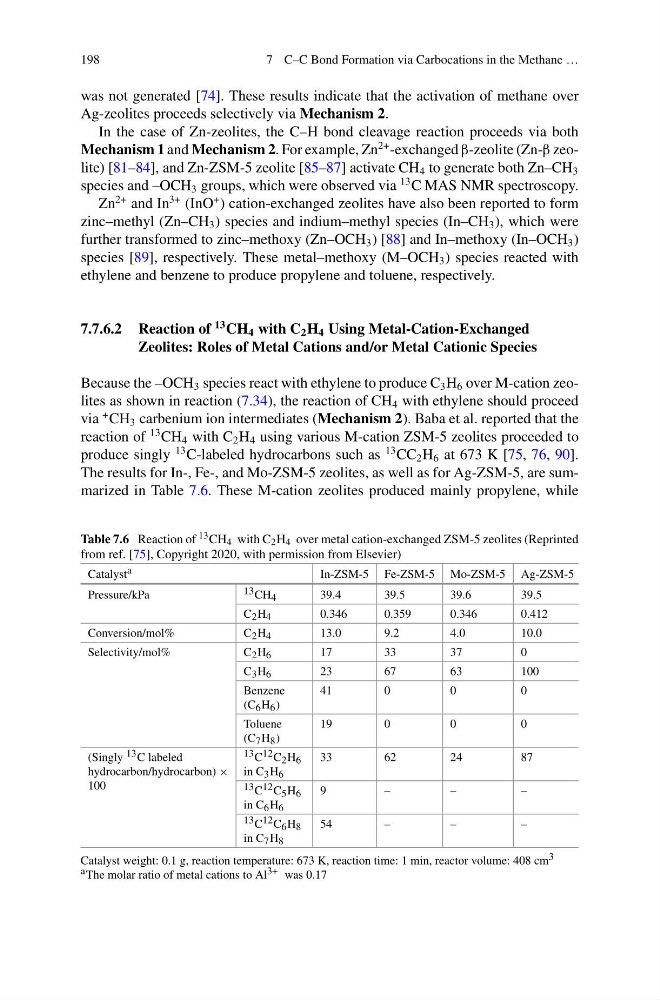
The results for In-, Fe-, and Mo-ZSM-5 zeolites, as well as for Ag-ZSM-5, are summarized in Table 7.6. These M-cation zeolites produced mainly propylene, while
Table 7.6 Reaction of 13 CH 4 with C 2 H 4 over metal cation-exchanged ZSM-5 zeolites (Reprinted
from ref. [75], Copyright 2020, with permission from Elsevier)
Catalyst a
In-ZSM-5 Fe-ZSM-5 Mo-ZSM-5 Ag-ZSM-5
Pressure/kPa
13 CH 4
39.4
39.5
39.6
39.5
C 2 H 4
0.346
0.359
0.346
0.412
Conversion/mol%
C 2 H 4
13.0
9.2
4.0
10.0
Selectivity/mol%
C 2 H 6
17
33
37
0
C 3 H 6
23
67
63
100
Benzene
(C 6 H 6 )
41
0
0
0
Toluene
(C 7 H 8 )
19
0
0
0
(Singly 13 C labeled
hydrocarbon/hydrocarbon) ×
100
13 C 12 C 2 H 6
in C 3 H 6
33
62
24
87
13 C 12 C 5 H 6
in C 6 H 6
9
–
–
–
13 C 12 C 6 H 8
in C 7 H 8
54
–
–
–
Catalyst weight: 0.1 g, reaction temperature: 673 K, reaction time: 1 min, reactor volume: 408 cm 3
a The molar ratio of metal cations to Al 3+ was 0.17
7 C–C Bond Formation via Carbocations in the Methane …
was not generated [74]. These results indicate that the activation of methane over
Ag-zeolites proceeds selectively via Mechanism 2.
In the case of Zn-zeolites, the C–H bond cleavage reaction proceeds via both
Mechanism 1 and Mechanism 2. For example, Zn
2+ -exchanged β-zeolite (Zn-β zeolite) [81–84], and Zn-ZSM-5 zeolite [85–87] activate CH 4 to generate both Zn–CH 3
species and –OCH 3 groups, which were observed via
13 C MAS NMR spectroscopy.
Zn
2+ and In
3+ (InO
+ ) cation-exchanged zeolites have also been reported to form
zinc–methyl (Zn–CH 3 ) species and indium–methyl species (In–CH 3 ), which were
further transformed to zinc–methoxy (Zn–OCH 3 ) [88] and In–methoxy (In–OCH 3 )
species [89], respectively. These metal–methoxy (M–OCH 3 ) species reacted with
ethylene and benzene to produce propylene and toluene, respectively.
7.7.6.2 Reaction of
13 CH 4 with C 2 H 4 Using Metal-Cation-Exchanged
Zeolites: Roles of Metal Cations and/or Metal Cationic Species
Because the –OCH 3 species react with ethylene to produce C 3 H 6 over M-cation zeolites as shown in reaction (7.34), the reaction of CH 4 with ethylene should proceed
via
+ CH 3 carbenium ion intermediates (Mechanism 2). Baba et al. reported that the
reaction of
13 CH 4 with C 2 H 4 using various M-cation ZSM-5 zeolites proceeded to
produce singly
13 C-labeled hydrocarbons such as
13 CC 2 H 6 at 673 K [75, 76, 90].
The results for In-, Fe-, and Mo-ZSM-5 zeolites, as well as for Ag-ZSM-5, are summarized in Table 7.6. These M-cation zeolites produced mainly propylene, while
Table 7.6 Reaction of 13 CH 4 with C 2 H 4 over metal cation-exchanged ZSM-5 zeolites (Reprinted
from ref. [75], Copyright 2020, with permission from Elsevier)
Catalyst a
In-ZSM-5 Fe-ZSM-5 Mo-ZSM-5 Ag-ZSM-5
Pressure/kPa
13 CH 4
39.4
39.5
39.6
39.5
C 2 H 4
0.346
0.359
0.346
0.412
Conversion/mol%
C 2 H 4
13.0
9.2
4.0
10.0
Selectivity/mol%
C 2 H 6
17
33
37
0
C 3 H 6
23
67
63
100
Benzene
(C 6 H 6 )
41
0
0
0
Toluene
(C 7 H 8 )
19
0
0
0
(Singly 13 C labeled
hydrocarbon/hydrocarbon) ×
100
13 C 12 C 2 H 6
in C 3 H 6
33
62
24
87
13 C 12 C 5 H 6
in C 6 H 6
9
–
–
–
13 C 12 C 6 H 8
in C 7 H 8
54
–
–
–
Catalyst weight: 0.1 g, reaction temperature: 673 K, reaction time: 1 min, reactor volume: 408 cm 3
a The molar ratio of metal cations to Al 3+ was 0.17