

7.7 Unique Properties of Silver Cations …
197
7.7.6 Reaction of Methane with Ethylene Over
Metal-Cations-Exchanged Zeolites
7.7.6.1 Mechanism of the C–H Bond Cleavage of CH 4 Over
Metal-Cation-Exchanged Zeolites
As mentioned above, the C–H bond cleavage of CH 4 proceeds over Ag-zeolites
to form silver hydrides (Ag n –H) and –OCH 3 species, as shown in reaction (7.48).
However, neither Ag-methyl (Ag–CH 3 ) species nor acidic protons are generated.
On the other hand, for metal-cation-exchanged zeolites (M-cation zeolites), such as
Zn
2+ -exchanged zeolites (Zn-zeolites), two types of methane activation mechanisms
(Mechanism 1 and Mechanism 2) have been proposed, as described below.
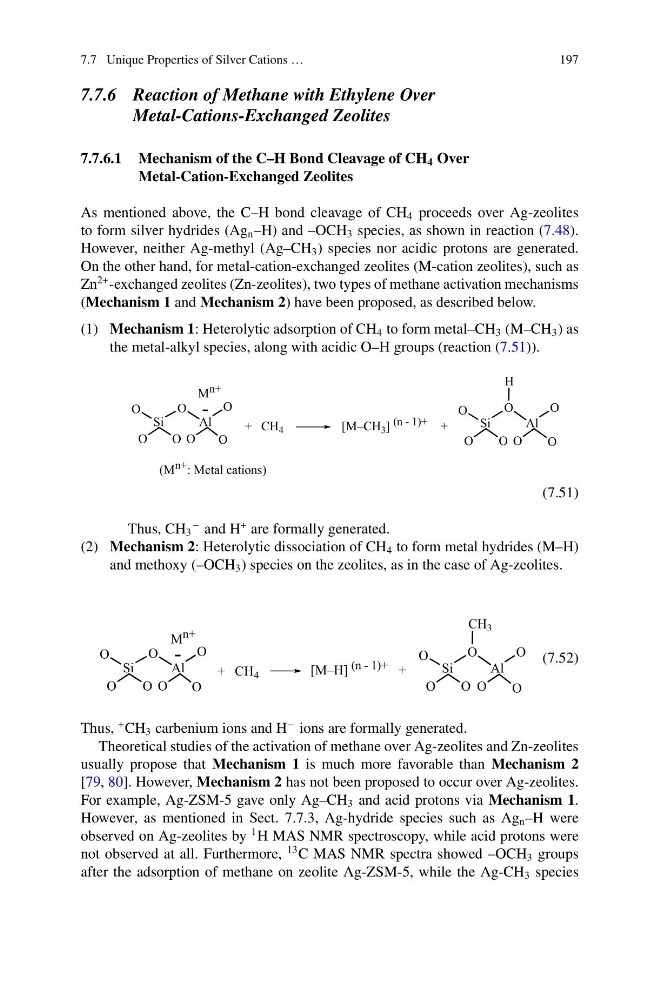
(1) Mechanism 1: Heterolytic adsorption of CH 4 to form metal–CH 3 (M–CH 3 ) as
the metal-alkyl species, along with acidic O–H groups (reaction (7.51)).
M n+
+ CH 4
[M–CH 3 ] (n - 1)+ +
(M n+ : Metal cations)
O
O
O
Si
O
Al
O
O
O
-
O
O
O
Si
O
Al
O
O
O
H
(7.51)
Thus, CH 3
− and H
+ are formally generated.
(2) Mechanism 2: Heterolytic dissociation of CH 4 to form metal hydrides (M–H)
and methoxy (–OCH 3 ) species on the zeolites, as in the case of Ag-zeolites.
+ CH 4
M n+
[M–H] (n - 1)+ +
O
O
O
Si
O
Al
O
O
O
-
O
O
O
Si
O
Al
O
O
O
CH 3
(7.52)
Thus,
+ CH 3 carbenium ions and H
− ions are formally generated.
Theoretical studies of the activation of methane over Ag-zeolites and Zn-zeolites
usually propose that Mechanism 1 is much more favorable than Mechanism 2
[79, 80]. However, Mechanism 2 has not been proposed to occur over Ag-zeolites.
For example, Ag-ZSM-5 gave only Ag–CH 3 and acid protons via Mechanism 1.
However, as mentioned in Sect. 7.7.3, Ag-hydride species such as Ag n –H were
observed on Ag-zeolites by
1 H MAS NMR spectroscopy, while acid protons were
not observed at all. Furthermore,
13 C MAS NMR spectra showed –OCH 3 groups
after the adsorption of methane on zeolite Ag-ZSM-5, while the Ag-CH 3 species
197
7.7.6 Reaction of Methane with Ethylene Over
Metal-Cations-Exchanged Zeolites
7.7.6.1 Mechanism of the C–H Bond Cleavage of CH 4 Over
Metal-Cation-Exchanged Zeolites
As mentioned above, the C–H bond cleavage of CH 4 proceeds over Ag-zeolites
to form silver hydrides (Ag n –H) and –OCH 3 species, as shown in reaction (7.48).
However, neither Ag-methyl (Ag–CH 3 ) species nor acidic protons are generated.
On the other hand, for metal-cation-exchanged zeolites (M-cation zeolites), such as
Zn
2+ -exchanged zeolites (Zn-zeolites), two types of methane activation mechanisms
(Mechanism 1 and Mechanism 2) have been proposed, as described below.
(1) Mechanism 1: Heterolytic adsorption of CH 4 to form metal–CH 3 (M–CH 3 ) as
the metal-alkyl species, along with acidic O–H groups (reaction (7.51)).
M n+
+ CH 4
[M–CH 3 ] (n - 1)+ +
(M n+ : Metal cations)
O
O
O
Si
O
Al
O
O
O
-
O
O
O
Si
O
Al
O
O
O
H
(7.51)
Thus, CH 3
− and H
+ are formally generated.
(2) Mechanism 2: Heterolytic dissociation of CH 4 to form metal hydrides (M–H)
and methoxy (–OCH 3 ) species on the zeolites, as in the case of Ag-zeolites.
+ CH 4
M n+
[M–H] (n - 1)+ +
O
O
O
Si
O
Al
O
O
O
-
O
O
O
Si
O
Al
O
O
O
CH 3
(7.52)
Thus,
+ CH 3 carbenium ions and H
− ions are formally generated.
Theoretical studies of the activation of methane over Ag-zeolites and Zn-zeolites
usually propose that Mechanism 1 is much more favorable than Mechanism 2
[79, 80]. However, Mechanism 2 has not been proposed to occur over Ag-zeolites.
For example, Ag-ZSM-5 gave only Ag–CH 3 and acid protons via Mechanism 1.
However, as mentioned in Sect. 7.7.3, Ag-hydride species such as Ag n –H were
observed on Ag-zeolites by
1 H MAS NMR spectroscopy, while acid protons were
not observed at all. Furthermore,
13 C MAS NMR spectra showed –OCH 3 groups
after the adsorption of methane on zeolite Ag-ZSM-5, while the Ag-CH 3 species