

190
7 C–C Bond Formation via Carbocations in the Methane …
+ CH 4
Ag n –H +
Ag n
+
O
O
O
Si
O
Al
O
O
O
-
O
O
O
Si
O
Al
O
O
O
CH 3
(7.48)
However, the signal of the protons of the methoxy (–OCH 3 ) groups was possibly
overlapped by the signal of physically adsorbed and/or gas-phase methane.
As mentioned above, the signal corresponding to the acidic protons of O–H
groups, which are usually observed at around 4 ppm, was not observed. This result
indicated that neither Ag–CH 3 nor acidic protons (O–H groups) were produced by
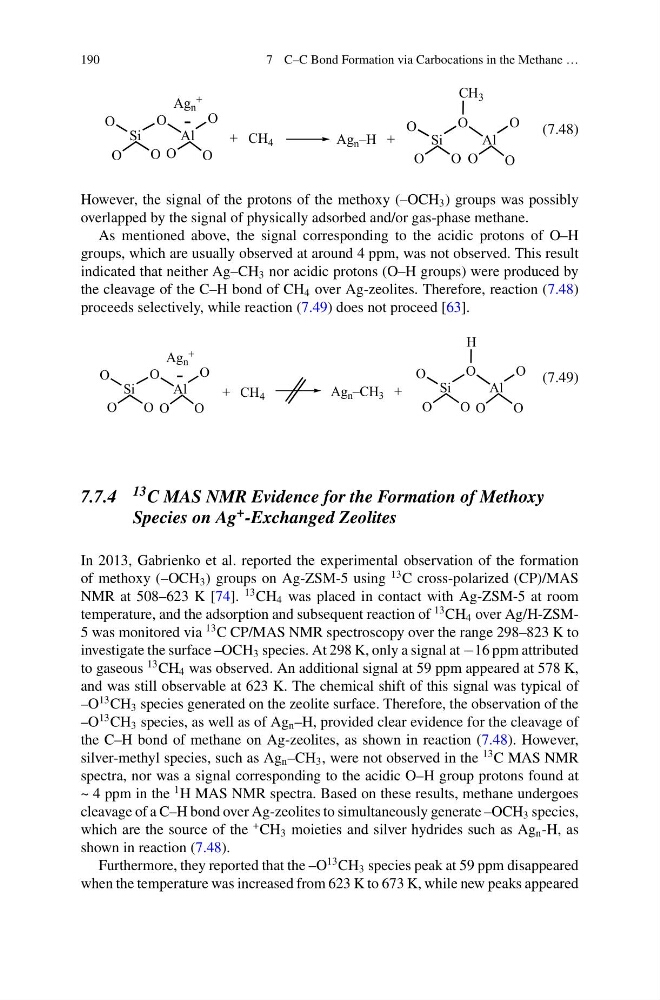
the cleavage of the C–H bond of CH 4 over Ag-zeolites. Therefore, reaction (7.48)
proceeds selectively, while reaction (7.49) does not proceed [63].
+ CH 4
Ag n –CH 3 +
O
O
O
Si
O
Al
O
O
O
H
Ag n
+
O
O
O
Si
O
Al
O
O
O
-
(7.49)
7.7.4 13 C MAS NMR Evidence for the Formation of Methoxy
Species on Ag + -Exchanged Zeolites
In 2013, Gabrienko et al. reported the experimental observation of the formation
of methoxy (–OCH 3 ) groups on Ag-ZSM-5 using
13 C cross-polarized (CP)/MAS
NMR at 508–623 K [74].
13 CH 4 was placed in contact with Ag-ZSM-5 at room
temperature, and the adsorption and subsequent reaction of
13 CH 4 over Ag/H-ZSM5 was monitored via
13 C CP/MAS NMR spectroscopy over the range 298–823 K to
investigate the surface –OCH 3 species. At 298 K, only a signal at −16 ppm attributed
to gaseous
13 CH 4 was observed. An additional signal at 59 ppm appeared at 578 K,
and was still observable at 623 K. The chemical shift of this signal was typical of
–O
13 CH 3 species generated on the zeolite surface. Therefore, the observation of the
–O
13 CH 3 species, as well as of Ag n –H, provided clear evidence for the cleavage of
the C–H bond of methane on Ag-zeolites, as shown in reaction (7.48). However,
silver-methyl species, such as Ag n –CH 3 , were not observed in the
13 C MAS NMR
spectra, nor was a signal corresponding to the acidic O–H group protons found at
~ 4 ppm in the
1 H MAS NMR spectra. Based on these results, methane undergoes
cleavage of a C–H bond over Ag-zeolites to simultaneously generate –OCH 3 species,
which are the source of the
+ CH 3 moieties and silver hydrides such as Ag n -H, as
shown in reaction (7.48).
Furthermore, they reported that the –O
13 CH 3 species peak at 59 ppm disappeared
when the temperature was increased from 623 K to 673 K, while new peaks appeared
7 C–C Bond Formation via Carbocations in the Methane …
+ CH 4
Ag n –H +
Ag n
+
O
O
O
Si
O
Al
O
O
O
-
O
O
O
Si
O
Al
O
O
O
CH 3
(7.48)
However, the signal of the protons of the methoxy (–OCH 3 ) groups was possibly
overlapped by the signal of physically adsorbed and/or gas-phase methane.
As mentioned above, the signal corresponding to the acidic protons of O–H
groups, which are usually observed at around 4 ppm, was not observed. This result
indicated that neither Ag–CH 3 nor acidic protons (O–H groups) were produced by
the cleavage of the C–H bond of CH 4 over Ag-zeolites. Therefore, reaction (7.48)
proceeds selectively, while reaction (7.49) does not proceed [63].
+ CH 4
Ag n –CH 3 +
O
O
O
Si
O
Al
O
O
O
H
Ag n
+
O
O
O
Si
O
Al
O
O
O
-
(7.49)
7.7.4 13 C MAS NMR Evidence for the Formation of Methoxy
Species on Ag + -Exchanged Zeolites
In 2013, Gabrienko et al. reported the experimental observation of the formation
of methoxy (–OCH 3 ) groups on Ag-ZSM-5 using
13 C cross-polarized (CP)/MAS
NMR at 508–623 K [74].
13 CH 4 was placed in contact with Ag-ZSM-5 at room
temperature, and the adsorption and subsequent reaction of
13 CH 4 over Ag/H-ZSM5 was monitored via
13 C CP/MAS NMR spectroscopy over the range 298–823 K to
investigate the surface –OCH 3 species. At 298 K, only a signal at −16 ppm attributed
to gaseous
13 CH 4 was observed. An additional signal at 59 ppm appeared at 578 K,
and was still observable at 623 K. The chemical shift of this signal was typical of
–O
13 CH 3 species generated on the zeolite surface. Therefore, the observation of the
–O
13 CH 3 species, as well as of Ag n –H, provided clear evidence for the cleavage of
the C–H bond of methane on Ag-zeolites, as shown in reaction (7.48). However,
silver-methyl species, such as Ag n –CH 3 , were not observed in the
13 C MAS NMR
spectra, nor was a signal corresponding to the acidic O–H group protons found at
~ 4 ppm in the
1 H MAS NMR spectra. Based on these results, methane undergoes
cleavage of a C–H bond over Ag-zeolites to simultaneously generate –OCH 3 species,
which are the source of the
+ CH 3 moieties and silver hydrides such as Ag n -H, as
shown in reaction (7.48).
Furthermore, they reported that the –O
13 CH 3 species peak at 59 ppm disappeared
when the temperature was increased from 623 K to 673 K, while new peaks appeared