

7.7 Unique Properties of Silver Cations …
189
reversible reaction:
+ H 2
Ag n –H +
Ag n
+
O
O
O
Si
O
Al
O
O
O
-
O
O
O
Si
O
Al
O
O
O
H
(7.47)
Reversible reaction (7.47) is crucial to regenerate Ag
+
n in Ag-zeolites, which
allows the reaction of methane with ethylene or benzene to proceed catalytically, as
described in Sect. 7.5. Thus, the reversible inter-conversion between Ag
+
n and Ag n –H
is essential to generate the catalytic activity of the Ag-zeolite for the conversion of
methane following the activation of methane.
7.7.3 Cleavage of the C–H Bond of CH 4 Over
Ag + -Exchanged Zeolites
As described above, hydrogen molecules undergo reversible heterolytic dissociation
over zeolites Ag-A and Ag-Y, as shown in Figs. 7.2 and 7.3, respectively. The H–H
bond energy of the H 2 molecule is nearly equal to that of the C–H bond of the CH 4
molecule at ~ 420 kJ mol
−1 [73]. On the basis of these bond energies, the C–H bond
of CH 4 should also be cleaved over Ag-zeolites. Baba et al. found that silver hydride
species are generated when CH 4 is placed in contact with the zeolite Ag-Y [63].
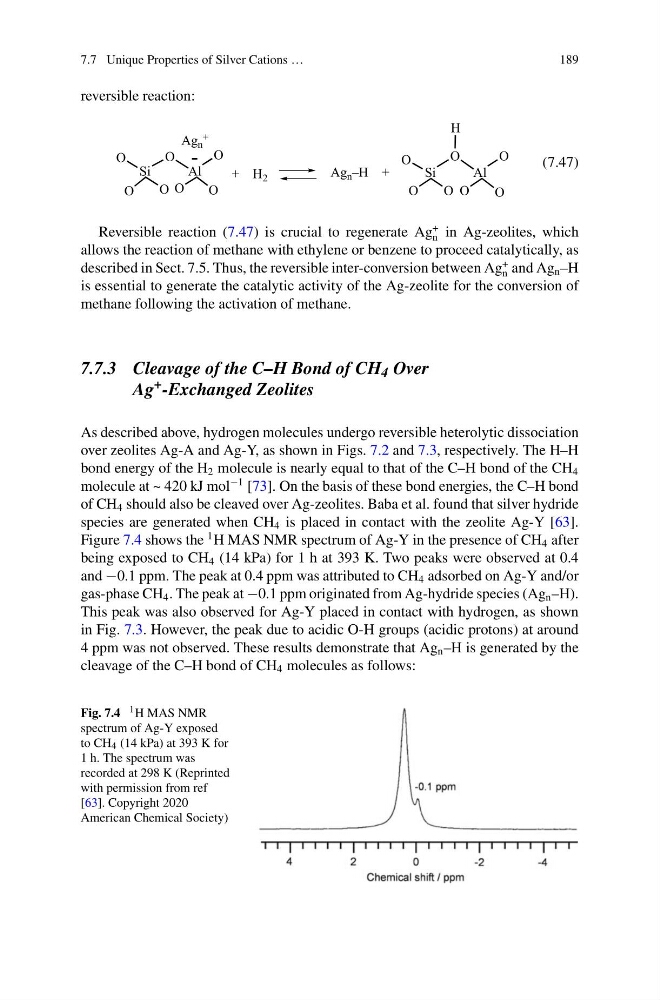
Figure 7.4 shows the
1 H MAS NMR spectrum of Ag-Y in the presence of CH 4 after
being exposed to CH 4 (14 kPa) for 1 h at 393 K. Two peaks were observed at 0.4
and −0.1 ppm. The peak at 0.4 ppm was attributed to CH 4 adsorbed on Ag-Y and/or
gas-phase CH 4 . The peak at −0.1 ppm originated from Ag-hydride species (Ag n –H).
This peak was also observed for Ag-Y placed in contact with hydrogen, as shown
in Fig. 7.3. However, the peak due to acidic O-H groups (acidic protons) at around
4 ppm was not observed. These results demonstrate that Ag n –H is generated by the
cleavage of the C–H bond of CH 4 molecules as follows:
Fig. 7.4 1 H MAS NMR
spectrum of Ag-Y exposed
to CH 4 (14 kPa) at 393 K for
1 h. The spectrum was
recorded at 298 K (Reprinted
with permission from ref
[63]. Copyright 2020
American Chemical Society)
189
reversible reaction:
+ H 2
Ag n –H +
Ag n
+
O
O
O
Si
O
Al
O
O
O
-
O
O
O
Si
O
Al
O
O
O
H
(7.47)
Reversible reaction (7.47) is crucial to regenerate Ag
+
n in Ag-zeolites, which
allows the reaction of methane with ethylene or benzene to proceed catalytically, as
described in Sect. 7.5. Thus, the reversible inter-conversion between Ag
+
n and Ag n –H
is essential to generate the catalytic activity of the Ag-zeolite for the conversion of
methane following the activation of methane.
7.7.3 Cleavage of the C–H Bond of CH 4 Over
Ag + -Exchanged Zeolites
As described above, hydrogen molecules undergo reversible heterolytic dissociation
over zeolites Ag-A and Ag-Y, as shown in Figs. 7.2 and 7.3, respectively. The H–H
bond energy of the H 2 molecule is nearly equal to that of the C–H bond of the CH 4
molecule at ~ 420 kJ mol
−1 [73]. On the basis of these bond energies, the C–H bond
of CH 4 should also be cleaved over Ag-zeolites. Baba et al. found that silver hydride
species are generated when CH 4 is placed in contact with the zeolite Ag-Y [63].
Figure 7.4 shows the
1 H MAS NMR spectrum of Ag-Y in the presence of CH 4 after
being exposed to CH 4 (14 kPa) for 1 h at 393 K. Two peaks were observed at 0.4
and −0.1 ppm. The peak at 0.4 ppm was attributed to CH 4 adsorbed on Ag-Y and/or
gas-phase CH 4 . The peak at −0.1 ppm originated from Ag-hydride species (Ag n –H).
This peak was also observed for Ag-Y placed in contact with hydrogen, as shown
in Fig. 7.3. However, the peak due to acidic O-H groups (acidic protons) at around
4 ppm was not observed. These results demonstrate that Ag n –H is generated by the
cleavage of the C–H bond of CH 4 molecules as follows:
Fig. 7.4 1 H MAS NMR
spectrum of Ag-Y exposed
to CH 4 (14 kPa) at 393 K for
1 h. The spectrum was
recorded at 298 K (Reprinted
with permission from ref
[63]. Copyright 2020
American Chemical Society)