

174
7 C–C Bond Formation via Carbocations in the Methane …
+ CH 5 carbonium ions have not been observed in superacid solutions, although their
existence under other conditions has been confirmed using various spectroscopic
methods [20–29]. Recently, Dinér et al. reported that carbenium ions, rather than
carbonium ions were the key intermediate in reactions promoted by the superacid HF–
SbF 5 , such as the C–H bond cleavage and hydrogen–deuterium exchange reactions.
In other words, the carbenium ions are directly produced without the formation of
penta-coordinated carbonium ions [30]. These results indicate that the conversion of
methane may proceed via
+ CH 3 carbenium ions to produce the C–C bonds without
using the superacid as a catalyst.
7.5 Role of Penta-Coordinated Carbonium Ion
Intermediates in C–C Bond Formation in the Reaction
of Alkenes with Alkanes
As shown in reactions (7.17) and (7.18), the C–C bond cleavage of tert-butyl carbonium ion (6) in superacid catalyst systems can result in not only intermolecular
hydride transfer to produce
+ CR 3 (7) and HCR’ 3 (8), but also in proton elimination and direct alkylation to produce H
+ and alkane (9), which can be expressed
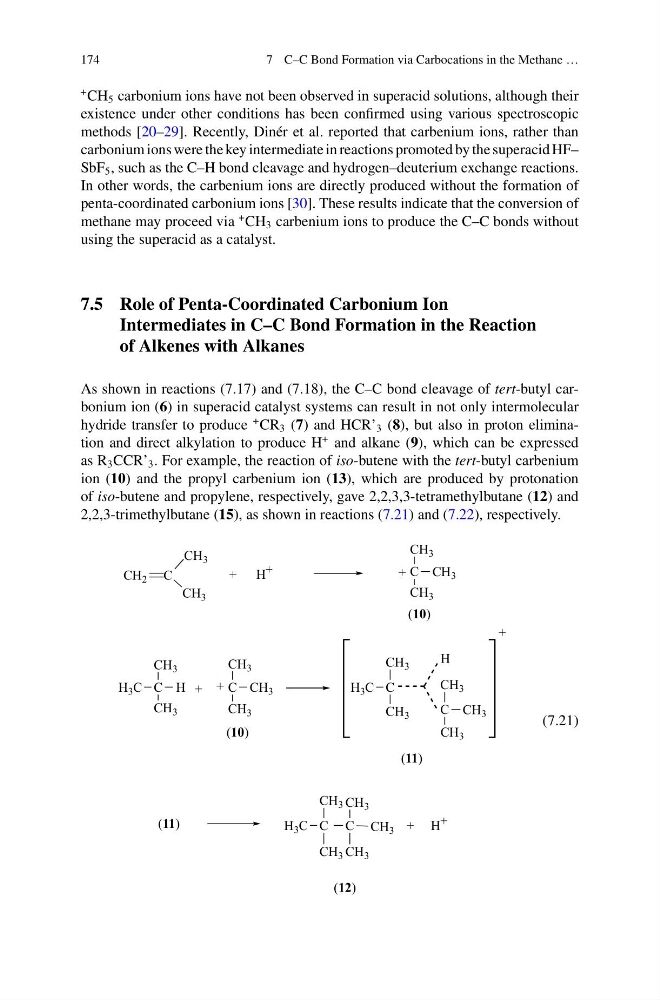
as R 3 CCR’ 3 . For example, the reaction of iso-butene with the tert-butyl carbenium
ion (10) and the propyl carbenium ion (13), which are produced by protonation
of iso-butene and propylene, respectively, gave 2,2,3,3-tetramethylbutane (12) and
2,2,3-trimethylbutane (15), as shown in reactions (7.21) and (7.22), respectively.
CH 3
CH 2 C
CH 3
C
CH 3
CH 3
CH 3
+
(10)
C
CH 3
CH 3
H
H 3 C
+
C
CH 3
CH 3
CH 3
+
(10)
+
C
CH 3
CH 3
H 3 C
H
(11)
C
CH 3
CH 3
CH 3
C
CH 3
CH 3
H 3 C
C
CH 3
CH 3
CH 3 + H +
(12)
+ H +
(11)
(7.21)
7 C–C Bond Formation via Carbocations in the Methane …
+ CH 5 carbonium ions have not been observed in superacid solutions, although their
existence under other conditions has been confirmed using various spectroscopic
methods [20–29]. Recently, Dinér et al. reported that carbenium ions, rather than
carbonium ions were the key intermediate in reactions promoted by the superacid HF–
SbF 5 , such as the C–H bond cleavage and hydrogen–deuterium exchange reactions.
In other words, the carbenium ions are directly produced without the formation of
penta-coordinated carbonium ions [30]. These results indicate that the conversion of
methane may proceed via
+ CH 3 carbenium ions to produce the C–C bonds without
using the superacid as a catalyst.
7.5 Role of Penta-Coordinated Carbonium Ion
Intermediates in C–C Bond Formation in the Reaction
of Alkenes with Alkanes
As shown in reactions (7.17) and (7.18), the C–C bond cleavage of tert-butyl carbonium ion (6) in superacid catalyst systems can result in not only intermolecular
hydride transfer to produce
+ CR 3 (7) and HCR’ 3 (8), but also in proton elimination and direct alkylation to produce H
+ and alkane (9), which can be expressed
as R 3 CCR’ 3 . For example, the reaction of iso-butene with the tert-butyl carbenium
ion (10) and the propyl carbenium ion (13), which are produced by protonation
of iso-butene and propylene, respectively, gave 2,2,3,3-tetramethylbutane (12) and
2,2,3-trimethylbutane (15), as shown in reactions (7.21) and (7.22), respectively.
CH 3
CH 2 C
CH 3
C
CH 3
CH 3
CH 3
+
(10)
C
CH 3
CH 3
H
H 3 C
+
C
CH 3
CH 3
CH 3
+
(10)
+
C
CH 3
CH 3
H 3 C
H
(11)
C
CH 3
CH 3
CH 3
C
CH 3
CH 3
H 3 C
C
CH 3
CH 3
CH 3 + H +
(12)
+ H +
(11)
(7.21)