

7.4 Reaction of Alkanes with Carbenium Ions …
173
7.4.1 Conversion of Methane into Higher Hydrocarbons
in FSO 3 H–SbF 5 Solution
Olah et al. reported that superacids catalyze the conversion of methane to produce
hydrocarbons such as C 2 H 6 together with hydrogen at around 400 K [1, 16, 18].
Thus, when methane was treated at either 423 K in an autoclave in the presence of
a ten-fold excess of 1:1 FSO 3 H-SbF 6 solution or at 413 K under atmospheric pressure, higher-molecular-weight hydrocarbons such as C 2 H 6 and C 3 H 8 were produced.
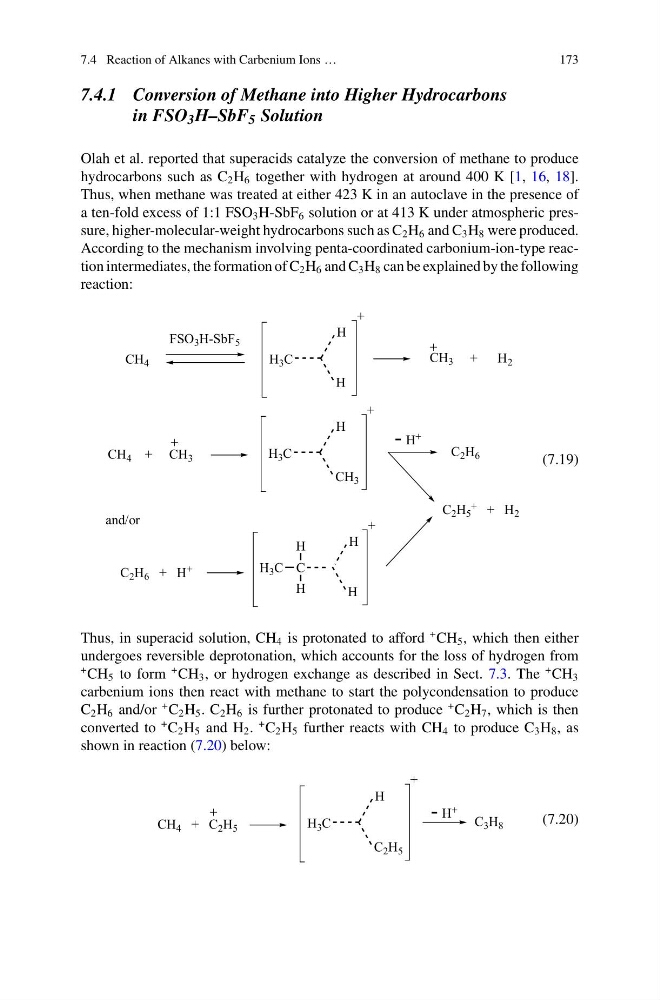
According to the mechanism involving penta-coordinated carbonium-ion-type reaction intermediates, the formation of C 2 H 6 and C 3 H 8 can be explained by the following
reaction:
+ H 2
+
CH 4
FSO 3 H-SbF 5
H
H
H 3 C
+
CH 3
+
CH 3
H
H 3 C
+
C 2 H 6
CH 4 + CH 3
- H +
C 2 H 5
+ + H 2
and/or
C 2 H 6 + H +
H
H
+
H 3 C C
H
H
(7.19)
Thus, in superacid solution, CH 4 is protonated to afford
+ CH 5 , which then either
undergoes reversible deprotonation, which accounts for the loss of hydrogen from
+ CH 5 to form
+ CH 3 , or hydrogen exchange as described in Sect. 7.3. The
+ CH 3
carbenium ions then react with methane to start the polycondensation to produce
C 2 H 6 and/or
+ C 2 H 5 . C 2 H 6 is further protonated to produce
+ C 2 H 7 , which is then
converted to
+ C 2 H 5 and H 2 .
+ C 2 H 5 further reacts with CH 4 to produce C 3 H 8 , as
shown in reaction (7.20) below:
+
C 2 H 5
H
H 3 C
+
C 3 H 8
- H +
CH 4 + C 2 H 5
(7.20)
173
7.4.1 Conversion of Methane into Higher Hydrocarbons
in FSO 3 H–SbF 5 Solution
Olah et al. reported that superacids catalyze the conversion of methane to produce
hydrocarbons such as C 2 H 6 together with hydrogen at around 400 K [1, 16, 18].
Thus, when methane was treated at either 423 K in an autoclave in the presence of
a ten-fold excess of 1:1 FSO 3 H-SbF 6 solution or at 413 K under atmospheric pressure, higher-molecular-weight hydrocarbons such as C 2 H 6 and C 3 H 8 were produced.
According to the mechanism involving penta-coordinated carbonium-ion-type reaction intermediates, the formation of C 2 H 6 and C 3 H 8 can be explained by the following
reaction:
+ H 2
+
CH 4
FSO 3 H-SbF 5
H
H
H 3 C
+
CH 3
+
CH 3
H
H 3 C
+
C 2 H 6
CH 4 + CH 3
- H +
C 2 H 5
+ + H 2
and/or
C 2 H 6 + H +
H
H
+
H 3 C C
H
H
(7.19)
Thus, in superacid solution, CH 4 is protonated to afford
+ CH 5 , which then either
undergoes reversible deprotonation, which accounts for the loss of hydrogen from
+ CH 5 to form
+ CH 3 , or hydrogen exchange as described in Sect. 7.3. The
+ CH 3
carbenium ions then react with methane to start the polycondensation to produce
C 2 H 6 and/or
+ C 2 H 5 . C 2 H 6 is further protonated to produce
+ C 2 H 7 , which is then
converted to
+ C 2 H 5 and H 2 .
+ C 2 H 5 further reacts with CH 4 to produce C 3 H 8 , as
shown in reaction (7.20) below:
+
C 2 H 5
H
H 3 C
+
C 3 H 8
- H +
CH 4 + C 2 H 5
(7.20)