

4
1 Overview of Direct Methane Conversion to Chemicals …
is often converted to ammonia via the Haber–Bosch process. Iron-based catalysts
have long been used in this process; however, a ruthenium catalyst that enables the
process pressure to be reduced from 150–300 bar to 70–105 bar and the temperature
from 370–510 °C to 350–470 °C has also been developed.
1.3 Direct Conversion of Methane in Industrial Processes
Approximately 4% of methane is used for the industrial production of hydrocyanic
acid (HCN), chlorinated methane derivatives (e.g., CH 3 Cl and CCl 4 ), and CS 2 [7],
as shown on the left side of Fig. 1.2.
1.3.1 Hydrocyanic Acid
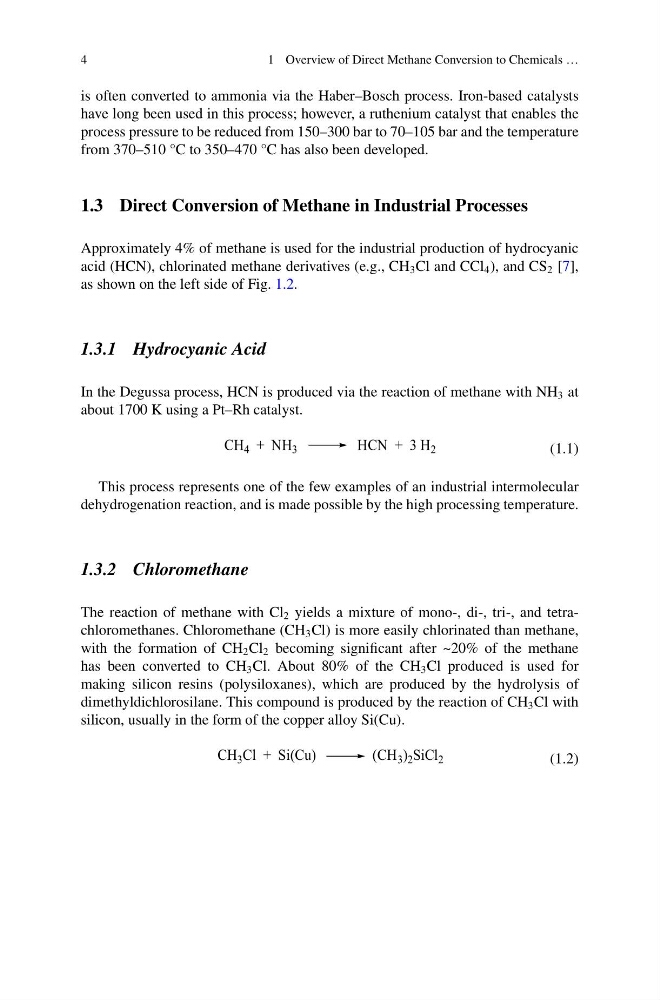
In the Degussa process, HCN is produced via the reaction of methane with NH 3 at
about 1700 K using a Pt–Rh catalyst.
CH 4 + NH 3
HCN + 3 H 2
(1.1)
This process represents one of the few examples of an industrial intermolecular
dehydrogenation reaction, and is made possible by the high processing temperature.
1.3.2 Chloromethane
The reaction of methane with Cl 2 yields a mixture of mono-, di-, tri-, and tetrachloromethanes. Chloromethane (CH 3 Cl) is more easily chlorinated than methane,
with the formation of CH 2 Cl 2 becoming significant after ~20% of the methane
has been converted to CH 3 Cl. About 80% of the CH 3 Cl produced is used for
making silicon resins (polysiloxanes), which are produced by the hydrolysis of
dimethyldichlorosilane. This compound is produced by the reaction of CH 3 Cl with
silicon, usually in the form of the copper alloy Si(Cu).
CH 3 Cl + Si(Cu)
(CH 3 ) 2 SiCl 2
(1.2)
1 Overview of Direct Methane Conversion to Chemicals …
is often converted to ammonia via the Haber–Bosch process. Iron-based catalysts
have long been used in this process; however, a ruthenium catalyst that enables the
process pressure to be reduced from 150–300 bar to 70–105 bar and the temperature
from 370–510 °C to 350–470 °C has also been developed.
1.3 Direct Conversion of Methane in Industrial Processes
Approximately 4% of methane is used for the industrial production of hydrocyanic
acid (HCN), chlorinated methane derivatives (e.g., CH 3 Cl and CCl 4 ), and CS 2 [7],
as shown on the left side of Fig. 1.2.
1.3.1 Hydrocyanic Acid
In the Degussa process, HCN is produced via the reaction of methane with NH 3 at
about 1700 K using a Pt–Rh catalyst.
CH 4 + NH 3
HCN + 3 H 2
(1.1)
This process represents one of the few examples of an industrial intermolecular
dehydrogenation reaction, and is made possible by the high processing temperature.
1.3.2 Chloromethane
The reaction of methane with Cl 2 yields a mixture of mono-, di-, tri-, and tetrachloromethanes. Chloromethane (CH 3 Cl) is more easily chlorinated than methane,
with the formation of CH 2 Cl 2 becoming significant after ~20% of the methane
has been converted to CH 3 Cl. About 80% of the CH 3 Cl produced is used for
making silicon resins (polysiloxanes), which are produced by the hydrolysis of
dimethyldichlorosilane. This compound is produced by the reaction of CH 3 Cl with
silicon, usually in the form of the copper alloy Si(Cu).
CH 3 Cl + Si(Cu)
(CH 3 ) 2 SiCl 2
(1.2)